


WHAT THIS BRIEF COVERS
›The 72-hour mobility window — and how the corridor closes before most families realize a decision is required.
›Three historical banking freezes that locked wealthy depositors out of their own accounts, regardless of balance size — in EU member countries.
›Why the staff at your family compound may be your largest unaddressed security liability when a crisis activates.
›The psychological mechanism that makes wealthy people slower to leave, not faster — and how to engineer the decision out of the equation.
› A five-point access framework: what separates families who reach their retreat from those who are still waiting when the window closes.
When I hear families who have invested in rural estates or family compounds, I hear the same confidence: “If things get bad, we’ll go there.” Sounds simple. But I always pause and ask one follow-up: how, exactly, do you plan to get there when the world is unraveling?
That’s usually when the silence comes.
The most overlooked flaw in preparedness isn’t the retreat, the compound, the food supply, or even the staff. It’s the corridor between where you are when a crisis erupts and where you need to be. That corridor is fragile, and it involves more than roads and runways. It involves your bank account, your compound’s people, and — most inconveniently — your own willingness to act.
The 72-Hour Window
Under most conditions, you have fewer than 72 hours to move when a crisis erupts. In some scenarios, far less. The families who understand that start planning the corridor long before they need it.
We live in a moment when the rules of movement can change overnight. Think back a few years. Entire countries grounded flights for months. Cities imposed curfews that turned roads into empty grids patrolled by police and soldiers. Borders closed with almost no warning, leaving even the wealthy stranded with passports in hand. That wasn’t a drill. It was a preview.
Today the conditions are sharper. Economic turbulence is mounting. Wars abroad are intensifying. The military is already visible in several U.S. cities under various “temporary deployments.” As directed by the Office of the President, a National Guard quick reaction force of 20,000 to 23,500 troops trained in riot-control techniques is now fully operational and ready for deployment across all 50 states. The January 1, 2026 deadline has passed. The force exists. The notion that movement could be restricted in the name of order is no longer speculation.
A convoy of SUVs can’t outrun a curfew. A private jet can’t take off if the airport is locked down or fuel is rationed. This is how quickly access evaporates.
Picture the chain reaction. A market collapse triggers panic withdrawals. Banks shutter. Protests erupt in major metropolitan centers. Local authorities request federal support. Within hours, military units roll into downtown corridors, checkpoints appear on highway arteries, and a curfew order lands on your phone.
Now ask yourself: how do you reach that well-stocked mountain retreat or family compound two states away? A convoy of SUVs can’t outrun a curfew. A private jet can’t take off if the airport is locked down or fuel is rationed. Even a helicopter loses value when local airspace is restricted or patrolled.
What the Air Corridor Data Shows
The evidence isn’t hypothetical. When Houthi forces struck Abu Dhabi on January 17, 2022, targeting the city’s oil infrastructure and its airport extension under construction, private aviation markets responded immediately. Three civilians were killed, six wounded, and the world saw how fast a tier-one Gulf hub moves from operational to contested (Bloomberg News, 2022).
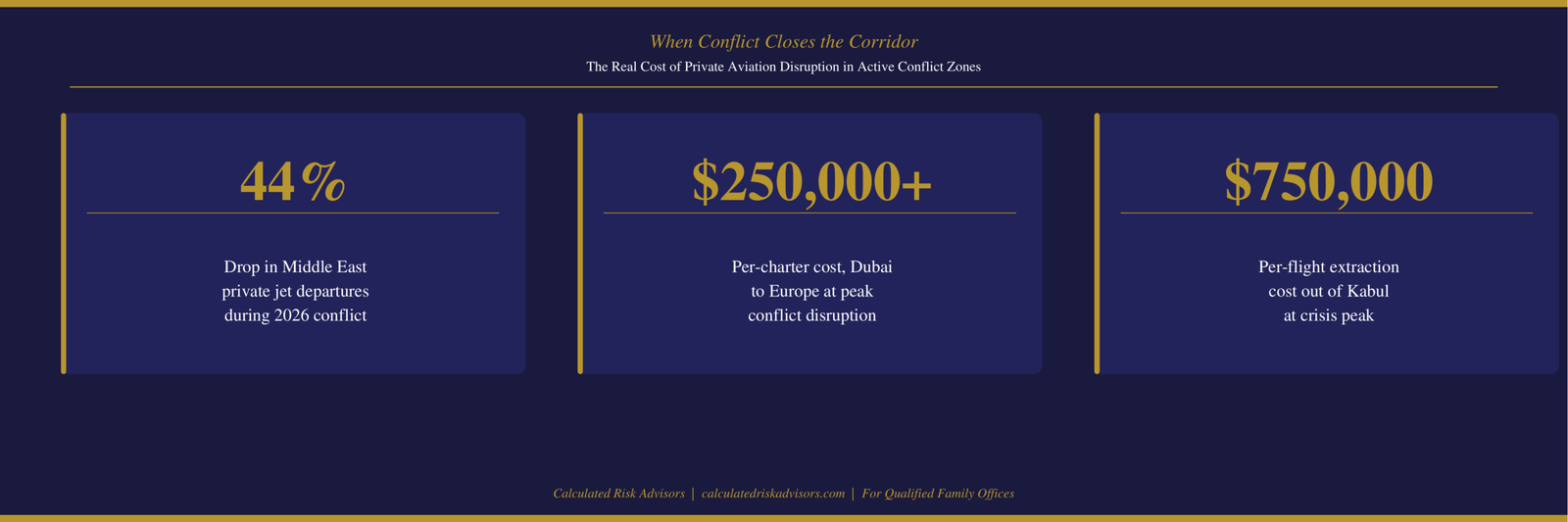
In early 2026, when U.S. and Israeli strikes on Iran triggered airspace closures across Iran, Israel, and parts of the Gulf, the private aviation market seized. Business-jet departures across the Middle East fell 44 percent year-on-year. Emergency charter demand surged 200 to 300 percent in key corridors. One-way private flights from Dubai to Europe exceeded €250,000. Fuel costs at Gulf hubs climbed 120 percent in weeks. War-risk insurance premiums tripled (Fly WorldJet Aviation Intelligence, 2026).
On June 14-15, 2026, the United States and Iran announced a 14-point Memorandum of Understanding to halt fighting on all fronts, lift the U.S. naval blockade, and reopen the Strait of Hormuz. This is not a peace deal. It is an agreement under active contestation. Israel declared it would not be bound by the MOU and launched its strongest strikes on Lebanon the same day the ceasefire was announced, asserting that the agreement “does not include Lebanon” (Times of Israel, 2026; NBC News, 2026). Iran’s own hardliners erupted in protest against the negotiators who signed it. Renewed fighting between Israel and Hezbollah has already threatened to collapse the agreement entirely (NBC News, 2026). The Strait of Hormuz remains a pressure point, not a resolved one. A memorandum of understanding is not stability. It is a pause that other actors are working to end.
When Afghanistan fell in August 2021, the corridor collapsed overnight. Charter aircraft out of Kabul reached $750,000 per flight. Per-seat costs through private operators hit $6,500. Monarch Air Group coordinated evacuation flights under U.S. government approval with limited availability. Those without pre-arranged logistics waited. Many did not get out (Newsweek, 2021; Monarch Air Group, 2021).
Who Extracts People When the System Fails
A small number of specialized firms exist specifically to move high-value clients out of hostile or collapsing environments. Their caseloads have grown sharply in recent years.
Global Rescue, founded in 2004, provides 24/7 field extraction and security evacuation worldwide. Membership begins at $329 annually; a single extraction can exceed $100,000 (Global Rescue, n.d.). International SOS operates across 140 countries with 13,000 medical and security professionals covering evacuation, repatriation, and crisis response (International SOS, n.d.). Sicuro Group arranges charter flights within hours during urgent extractions from conflict zones. Solace Global maintains a 24/7 global security operations center with proven extraction capacity across politically volatile regions. Air Charter Service runs dedicated evacuation flights on short notice for families and executives.
Having a pre-existing relationship with at least one of these firms — with verified account access and a current membership — is not optional for any serious preparedness plan. By the time you search for them, the window may already be narrowing.
The Financial Corridor: Your Wealth Cannot Move If Your Bank Is Closed
Here is the assumption almost every wealthy family makes: money equals mobility. The larger the account balance, the wider the door. But that assumption has been disproven, repeatedly, in countries that did not see themselves as fragile — including members of the European Union.
In June 2015, Greece imposed capital controls that shut banks for nearly three weeks and capped ATM withdrawals at €60 per day — for every account holder, regardless of balance. Daily cash outflows before the freeze had reached €1 to €2 billion. The controls remained in force until September 2019 — more than four years (CNBC, 2015; Bloomberg, 2015).
Cyprus in 2013 went further. Deposits above €100,000 lost 37.5 percent, converted to nearly worthless bank shares. An additional 22.5 percent was frozen pending bailout conditions. Total deposits in the system: $120 billion. The accounts that got hit hardest were the large ones (Chicago Fed, 2013).
Lebanon’s collapse is the most instructive case for HNWI. From late 2019, commercial banks unilaterally froze access to dollar-denominated deposits. Approximately $82 billion in deposits were effectively frozen. The top 0.1 percent of depositors held 20 percent of all deposits before the crisis. Those were the accounts that suffered most. The national currency subsequently lost more than 95 percent of its pre-crisis value (World Bank, 2022; EX NIHILO Magazine, 2024).
Argentina in 2001 froze $70 to $85 billion in deposits, limiting cash withdrawals to the equivalent of $250 per week. By 2025, Argentines held an estimated $200 billion in cash savings outside the banking system — roughly five times the central bank’s reserves — as a direct consequence of that event (Federal Reserve Bank of San Francisco, 2002).
In Greece, Cyprus, Lebanon, and Argentina, wealth on paper meant nothing when the electronic system froze. The families who moved before the gates closed preserved their options. Those who waited, waited too long.
A multi-million dollar account balance does not guarantee access to funds when a crisis triggers banking restrictions. Physical hard assets — pre-positioned cash in multiple currencies, allocated gold stored outside the banking system, and cryptocurrency held in cold storage wallets under personal custody — are the only financial assets that remain liquid when electronic systems close. Pre-positioning six to twelve months of operating cash at the family compound before it is needed is not pessimism. It is standard practice for anyone who has studied history.
The Staff Problem: Your Most Trusted People Have Their Own Families
Most preparedness planning treats the family compound or estate as a static asset: stocked, secured, and waiting. What it rarely accounts for is the human infrastructure that keeps the property functional — and what happens to those people when the same crisis your family is fleeing arrives at their door first.
The private security industry runs at annual staff turnover rates between 75 and 200 percent — meaning most firms cycle through an entirely new workforce every twelve months (TrackTik, 2024; Security InfoWatch, 2026). The caretakers, groundskeepers, household managers, and security personnel at a remote compound are typically drawn from the surrounding community. That community will be under the same pressure your family is under, with fewer resources to respond.
When a crisis activates, these individuals face competing priorities. Their children attend local schools. Their parents live nearby. Their neighbors are panicking. The compound’s supplies, its access codes, its communications systems, and its security protocols are known to them in detail. According to the American Society for Industrial Security, trust is the center of gravity of insider threats — and the vulnerability exists not just in digital environments but in every physical setting where trust has been converted into unchecked access (ASIS, 2026).
This is not a reason to distrust your staff. It is a reason to design systems that do not rely on any single person’s presence or loyalty under extreme stress. Remote monitoring systems, layered access protocols that limit what any individual knows, pre-negotiated retention agreements that include provisions for staff families, and a designated compound manager with a succession plan are structural safeguards that keep the retreat functional when you actually need it.
The Overlooked Pain Point: The Decision You Won’t Make in Time
Every preparedness conversation focuses on assets: the land, the fuel, the food, the staff, the jet. Almost none of them focus on the decision itself — the moment when a family actually has to say “we are leaving now” and act on it. That decision is harder than it sounds. For high-net-worth families, it may be the hardest part of the entire equation.
Behavioral research is unambiguous on what happens to most people during a developing crisis. Approximately 70 to 80 percent of people become stunned and unable to respond effectively. Only about 10 percent take proper action immediately. Most people, when confronted with warning signals, check with multiple sources before acting — sociologist Thomas Drabek found that the average person consults four or more sources of information before deciding to evacuate (Drabek, 2001). Every verification pass costs time the corridor may not have.
Wealthy families face a specific amplification of this problem. Behavioral economics identifies loss aversion as one of the most consistent forces in human decision-making: losses feel approximately twice as painful as equivalent gains feel satisfying (Kahneman and Tversky, 1979). For a family with a $50 million estate, a business in the city, a social network built over decades, and staff who depend on them, the psychological cost of triggering departure is enormous — far greater than it is for someone with less to leave behind. The very wealth that makes the retreat possible makes the decision to use it harder.
Venezuela makes this concrete. The first wave of wealthy Venezuelans who left — between roughly 2013 and 2015, when conditions were deteriorating but still manageable — preserved their capital and reestablished in Miami, Bogota, and Madrid. Those who waited, anchored by their assets and the belief that conditions would stabilize, watched the bolivar lose virtually all of its value. The difference between the two groups was not intelligence or resources. It was the timing of a single decision.
The decision to leave cannot be a real-time judgment made under stress. It must be pre-engineered. Set the trigger conditions now, in writing, while the system is stable — so that when those conditions are met, the action is automatic, not deliberated.
Establish written trigger criteria in advance — specific, observable conditions that, when met, automatically initiate the departure protocol. Not “when things get bad enough” but concrete, measurable thresholds tied to market conditions, geopolitical events, or domestic security signals. Pre-set triggers convert an emotionally loaded judgment into a mechanical response to conditions that were anticipated. This is how serious operators plan. It should be how serious families plan.
The Three Logistics Vulnerabilities Nobody Addresses
Beyond the financial and psychological barriers, three operational gaps consistently appear in preparedness plans for families who own private estates and family compounds.
- Fuel and logistics. Without on-site fuel reserves, private airstrips, or pre-mapped secondary ground routes, a private jet and a convoy become inert assets. The equipment exists; the logistics chain to activate it does not.
- Intelligence triggers. Without early signals that identify unrest, financial collapse, or military escalation before they are confirmed by mainstream news, any departure will be reactive rather than proactive. By the time the news confirms the threat, the grid is already tightening.
- Legal and jurisdictional mobility. Pre-cleared landing rights, alternate travel documents, and jurisdictional agreements that permit movement when standard channels are closed are not paperwork. They are infrastructure. Without them, wealth and aircraft mean nothing at a closed border.
The Framework: From Having to Reaching
The entire structure of preparedness for wealthy families must shift from asset accumulation to access assurance. The retreat is acquired. The question is whether it can be reached when required.
That means diversified retreat options — multiple locations within range rather than one perfect compound that a single road closure or airspace restriction could make inaccessible. It means diversified transport modes. It means pre-positioned financial liquidity in hard assets and alternative systems, not just bank balances. It means staff structures designed for continuity under stress. It means pre-set departure triggers that require no in-the-moment decision. And it means legal frameworks designed to protect freedom of movement, not just freedom of capital.
When I raise this with clients, I use the same frame I’d use for a portfolio. Nobody serious puts all their capital into a single position. No disciplined investor bets everything on one outcome or one liquidity source. Yet when it comes to the safety of their family, many of them have a single retreat, a single route, and a single plan. If you wouldn’t put all your wealth into a single stock, why would you put your family’s security into a single access corridor? Diversification is not just a financial principle. It is a survival strategy.
The Decisive Variable
The public will not be thinking about corridors when the moment comes. Their concerns will be food, water, and power at home. For families who have already built the compound, already bought the land, already invested in the estate, the question is different. The question is whether you can reach what you’ve prepared. That is what determines everything else.
Preparedness is about preserving freedom of action. Freedom of action starts with mobility. Lose that, and your retreat, your supplies, your protection become irrelevant. Preserve it, and you keep the one advantage that matters most when the system falters: the ability to decide where you will be, not to be told where you must stay.
As Winston Churchill observed, “He who fails to plan is planning to fail.” For high-net-worth families, planning the access corridor isn’t optional. It is the plan.
About the Author
Limited Availability
Calculated Risk Advisors accepts a limited number of new families each quarter. Each engagement is tailored, confidential, and managed directly by our principals. There is no public intake. All relationships begin by private introduction.
A Note on This Publication
The observations, analysis, and commentary published on this site are produced for general informational and educational purposes only. They represent the research and independent perspective of the author and do not constitute financial, investment, legal, tax, real estate, or any other form of professional advice.
Nothing published here represents a solicitation, recommendation, or offer to acquire or dispose of any security, asset, property, or service. Access to this content does not establish an advisory, fiduciary, or client relationship of any kind between the reader and Calculated Risk Advisors LLC or any of its affiliated entities.
The decisions explored on this site — jurisdictional positioning, estate design, infrastructure strategy, and multi-generational wealth planning — are among the most consequential a family can make. They require qualified legal counsel, licensed tax professionals, credentialed financial advisors, and specialist practitioners who have direct knowledge of your specific circumstances, objectives, and risk profile. No publication, regardless of its depth or specificity, is a substitute for that counsel.
Calculated Risk Advisors LLC and its affiliates expressly disclaim responsibility for any decision made, action taken, or action not taken in reliance on content published here.
If you are seriously evaluating any of the strategies, jurisdictions, or approaches discussed in this publication, engage qualified independent advisors before proceeding. If you would like to explore whether a private advisory relationship with Calculated Risk Advisors is appropriate for your situation, you are welcome to request an introduction.
“The intelligence that protects generational wealth doesn’t make headlines; it circulates quietly among those who know where to look. Subscribe to the Calculated Risk Advisors Daily Brief. No noise. No mass-market advice. Just the signal.”
References
American Society for Industrial Security (ASIS). (2026, June). Trust: The center of gravity of insider threats. Security Management. https://www.asisonline.org/security-management-magazine/articles/2026/06/insider-threat/
Bloomberg. (2015, June 29). Fines, pensions and ATM caps: A guide to Greek capital controls. Bloomberg. https://www.bloomberg.com/news/articles/2015-06-29/fines-pensions-and-atm-caps-a-guide-to-greek-capital-controls
Drabek, T. E. (2001). The social factors that condition responses to environmental threats and hazards. University of Denver.
EX NIHILO Magazine. (2024). How Lebanon’s capital controls locked four million depositors. EX NIHILO. https://exnihilomagazine.com/lebanon-banking-crisis-capital-controls/
Fly WorldJet Aviation Intelligence. (2026, April 4). Middle East conflict 2026: How geopolitical tensions are reshaping private jet travel. https://www.flyworldjetaviation.aero/blog/middle-east-conflict-2026-how-geopolitical-tensions-are-reshaping-private-jet-travel
Global Rescue. (n.d.). Travel security services. https://www.globalrescue.com/lp/travel-security-services/
International SOS. (n.d.). Compare plans. https://buymembership.internationalsos.com/compare/
Kahneman, D., & Tversky, A. (1979). Prospect theory: An analysis of decision under risk. Econometrica, 47(2), 263-291.
Monarch Air Group. (2021). Kabul, Afghanistan (OAKB/KBL) private charter evacuation flights. https://monarchairgroup.com/kabul-afghanistan-private-charter-evacuation-flights/
Newsweek. (2021, August 26). Private company charging $6k for flights out of Afghanistan, other planes leave empty. https://www.newsweek.com/private-company-charging-6k-flights-out-afghanistan-other-planes-leave-empty-1623144
Security InfoWatch. (2026). As police forces struggle, can private security industry seize the moment? https://www.securityinfowatch.com/security-executives/article/53068258/
CNBC. (2015, June 29). Capital controls: How Greeks and tourists will be hit. https://www.cnbc.com/2015/06/29/capital-controls-how-greeks-and-tourists-will-be-hit.html
Federal Reserve Bank of San Francisco. (2002, October). Learning from Argentina’s crisis. https://www.frbsf.org/research-and-insights/publications/economic-letter/2002/10/learning-from-argentina-crisis/
Chicago Fed. (2013, October). The Cyprus crisis through the lens of bank investors. https://www.chicagofed.org/publications/chicago-fed-letter/2013/october-315
NBC News. (2026). Renewed fighting between Israel and Hezbollah could scupper the U.S.-Iran deal. https://www.nbcnews.com/world/israel/us-iran-ceasefire-deal-memorandum-israel-netanyahu-hezbollah-lebanon-rcna350085
NPR. (2026, June 15). U.S. and Iran announce an initial deal to end the war and reopen the Strait of Hormuz. https://www.npr.org/2026/06/15/nx-s1-5858590/us-iran-deal-updates
Times of Israel. (2026). Ministers say Israel won’t be bound by Iran deal. https://www.timesofisrael.com/israel-vows-to-stay-in-south-lebanon-if-iran-strikes-well-hit-it-with-full-force/
Bloomberg News. (2022, January 17). Abu Dhabi attack: Drone strike at airport kills three. https://www.bloomberg.com/news/articles/2022-01-17/uae-says-explosion-in-abu-dhabi-possibly-caused-by-drone-strike
Axios. (2026, June 14). US, Iran reach deal to extend ceasefire, open strait. https://www.axios.com/2026/06/14/us-iran-ceasefire-extended-hormuz-reopen-trump
Al Jazeera. (2026, June 17). Read the US account of unreleased 14-point Iran ceasefire memorandum. https://www.aljazeera.com/news/2026/6/17/read-the-us-account-of-unreleased-14-point-iran-ceasefire-memorandum
World Bank. (2022). Lebanon economic monitor, fall 2022. https://www.worldbank.org/en/country/lebanon/publication/lebanon-economic-monitor
© 2026 Calculated Risk Advisors. All rights reserved. This content is provided for informational purposes only and does not constitute legal, financial, or investment advice.


0 Comments