


Across private wealth networks, a quiet migration is underway. Not toward tax efficiency or lifestyle. Toward sovereignty. In 2025, an estimated 142,000 millionaires relocated internationally, the largest coordinated movement of private wealth on record, according to Henley and Partners. By 2026, projections reach 165,000. The Knight Frank Wealth Report has tracked this acceleration across five consecutive years. The UBS Billionaire Ambitions Report confirms that 36% of billionaire clients surveyed relocated at least once in 2025, with 44% of those under 54 having done so. Earlier waves chased opportunity. These moves are defensive.
Most of these families have moved. Few of them have truly prepared. A critical distinction: relocating to Dubai, Singapore, or the Cayman Islands is a tax and lifestyle decision. It is not a sovereignty decision. A family in a premium apartment in a global financial center is as dependent on public infrastructure, supply chains, and institutional stability as a family in Manhattan. Geographic diversification is the entry point. What follows, sovereign infrastructure, operational skill, and community architecture, is what makes it real.
“Affluent families are increasingly approaching nationality and residency as strategic variables, treating jurisdictional exposure the same way they treat asset allocation.” (Knight Frank Wealth Report)
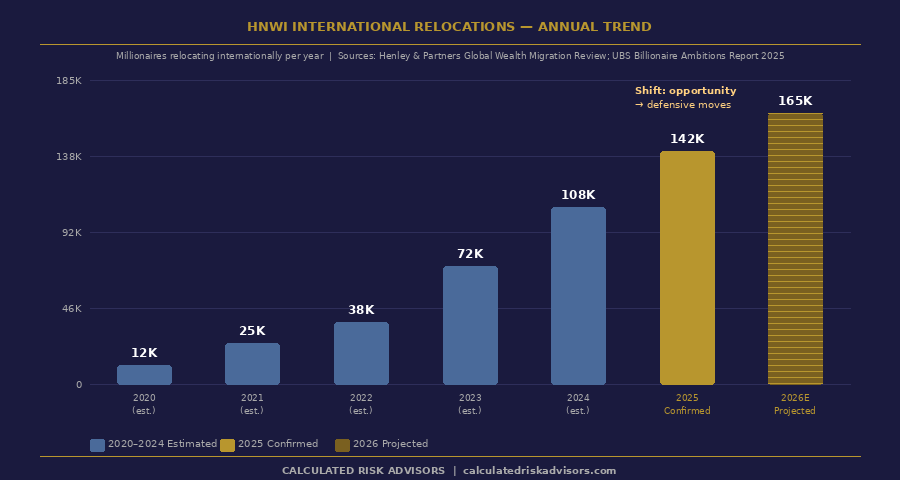
HNWI International Relocations 2020-2026E | Sources: Henley & Partners; UBS | calculatedriskadvisors.com
What Mainstream Is Missing
Financial media has one answer to geopolitical risk: portfolio allocation. Add gold. Hedge currencies. Diversify alternatives. Useful. Not enough. What receives almost no institutional attention is the physical and human dimension of resilience: where your family actually operates, who surrounds them when pressure arrives, and whether the principal at the center has invested in the cognitive and physical capacity to lead clearly when clarity costs something.
Three sovereign advantages sit entirely outside that conversation. Each is actionable now. None requires a crisis to justify the investment. Together, they complete what geographic diversification alone cannot provide.
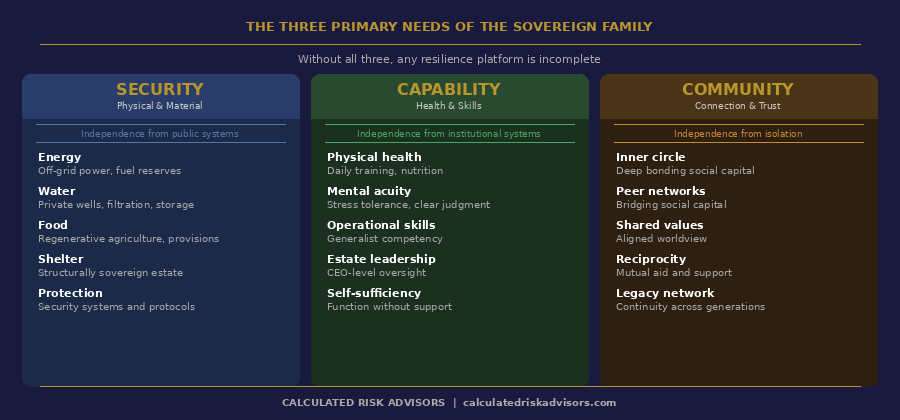
The Three Primary Needs of the Sovereign Family | calculatedriskadvisors.com
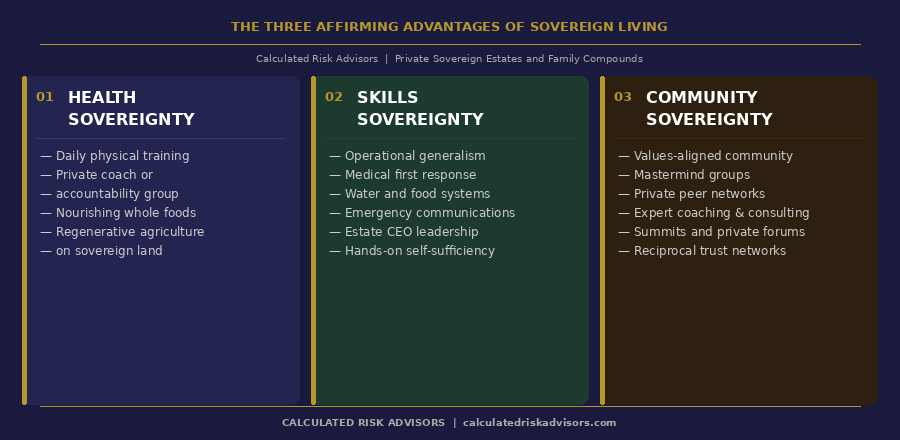
The Three Affirming Advantages of Sovereign Living | calculatedriskadvisors.com
Advantage One: Health Sovereignty
Daily Practice as the Foundation of Sovereign Leadership
The most overlooked asset on any balance sheet is the principal’s physical and cognitive capacity. No estate, compound, or continuity plan functions without a capable leader at its center. Daily physical training, guided by a private performance coach, an accountability partner, or a committed peer group, builds something no financial instrument replicates: stress tolerance, decision clarity, and leadership presence that holds under sustained pressure. Research published in The Lancet Psychiatry (2018), analyzing 1.2 million adults, found that exercise was associated with fewer poor mental health days than any other lifestyle factor examined, including income. This is an operational input. Not a wellness preference.
Nutritional sovereignty follows the same logic. A family that has deliberately removed ultra-processed foods from its daily environment has made a measurable risk reduction. Processed food is a dependency on industrial systems engineered for shelf life and margin, not for the performance and clarity that sovereign living demands. Regenerative agriculture on estate grounds closes this loop entirely: sovereign food, grown on sovereign land, consumed daily as practice rather than principle.
“The families that will lead effectively through the disruption ahead will be the ones who invested in the human hardware, not just the financial architecture.”
Advantage Two: Skills Sovereignty
The Generalist in a Specialist’s World
The coming era rewards the generalist. Deep specialization built most HNWI fortunes. It will not protect them. A sovereign estate is a complex, living operating system. Running it effectively, or overseeing the people who do, requires a principal with functional competency across multiple domains that most executive careers never develop:
- Water sourcing, testing, filtration, and storage management
- Food production, preservation, and nutritional planning
- Emergency communications: satellite systems, encrypted radio, off-grid networks
- Navigation and logistics without digital infrastructure
- Basic structural, mechanical, and electrical systems oversight
- Security assessment, threat modeling, and access protocols
- Agricultural management: soil health, yield planning, seasonal cycles
- Financial operations independent of public banking infrastructure
- Leadership under stress: sound decisions with incomplete information
One dimension consistently underestimated: digital and communications sovereignty. Hardened communications, including encrypted satellite systems, off-grid radio networks, and infrastructure that operates independently of commercial internet and cellular systems, are as foundational as water and power. A family whose digital communications, financial access, and information flow depend entirely on commercial networks is not sovereign. It is merely connected.
The CEO of a Private Resilience Estate
A sovereign estate at scale is a private operating company. Its CEO coordinates infrastructure oversight, staff leadership, supply chain management, security protocols, medical readiness, agricultural production, communications systems, family governance, and external vendor relationships, all under absolute discretion. This cannot be fully delegated. The principal who understands each domain, not as an expert but as a capable overseer, holds a decisive advantage over one entirely dependent on systems and staff they cannot independently evaluate.
Advantage Three: Community Sovereignty
The Bunker Fallacy: Why No Family Thrives Alone
A dangerous misconception circulates in private resilience circles. The ideal outcome, it holds, is a family sealed behind walls: fully stocked, fully equipped, fully isolated. Waiting. It sounds like sovereignty. It is not.
Isolation erodes people. Without genuine human connection, trust networks, and collaborative relationships, even the best-provisioned estate becomes a pressure chamber. Staff become guards. Family members turn against each other. The principal, deprived of honest feedback and genuine peer relationships, begins making decisions that compound quietly into catastrophe. History records no fortress that outlasted the fractures within it.
“Social capital refers to connections among individuals, social networks and the norms of reciprocity and trustworthiness that arise from them. Our stock of social capital, the very fabric of our connections with each other, has plummeted, impoverishing our lives and communities.” (Robert D. Putnam, Bowling Alone, 2000)
What Putnam Documented and What It Means for You
Robert Putnam’s landmark study Bowling Alone drew on nearly 500,000 interviews spanning 25 years to document the systematic collapse of social capital across American life. Putnam identified two distinct forms. Bonding capital: deep trust within a small defined group, the inner circle that functions under pressure without instruction. Bridging capital: connections across different networks, disciplines, and jurisdictions, the wider web that delivers intelligence, resources, and options unavailable inside any single circle. For the HNWI family, both have been structurally weakened by the very success that created their wealth.
The Five Functions Social Capital Performs That Money Cannot Buy
Research from John Cacioppo at the University of Chicago established that social isolation carries health risks equivalent to smoking 15 cigarettes per day and accelerates cognitive decline measurably faster than obesity or inactivity alone. These are not philosophical concerns. They are operational vulnerabilities:
- Distributed intelligence. A trusted network of peers surfaces threats and opportunities that no paid advisory relationship delivers.
- Shared skills and labor. In genuine disruption, the family with five trusted neighbors who can do things outperforms the family with five million dollars of stored provisions and no one they can call.
- Psychological resilience. Social connection is among the strongest predictors of cognitive function under stress and physical longevity. Isolation under pressure degrades judgment.
- Accountability and perspective. A values-aligned peer group provides the honest challenge and outside perspective that prevents compounding errors.
- Continuity across generations. Legacy travels through communities, networks, and shared values that give the next generation a context for who they are and what they are meant to do.
Building the Network: Masterminds, Summits, and Private Peer Groups
The families that maintained wealth, influence, and freedom through prolonged historical disruption operated through networks of deep, reciprocal, values-aligned relationships built before the pressure arrived.
- Private mastermind groups: small, closed cohorts of principals at similar life stages, meeting regularly to share intelligence and hold each other accountable
- Personal coaching and consulting: one-to-one relationships with practitioners who have built and operated sovereign platforms
- Private summits and invitation-only forums: curated gatherings where relationships deepen and intelligence circulates
- Values-aligned peer groups: ongoing networks built around shared principles of sovereignty, legacy, and independent thinking
The quality of your network is determined entirely by the quality of the individuals within it. The estate you build can house your family. Only the community you build can sustain them.
A Timeless Model
Switzerland has demonstrated this model for centuries. One of the world’s highest living standards. Decentralized energy. Strategic national reserves. Universal shelter infrastructure. Not militarization: disciplined, multi-decade planning executed with restraint and elegance. Calculated Risk Advisors applies the same philosophy at the private-family level: sovereign estates and family compounds that do not merely shelter wealth but preserve the agency, capability, and community that generational continuity actually requires.
The Asymmetry of Acting Now
The window is not metaphorical. Permitting regimes in prime agricultural jurisdictions are tightening as sovereign land acquisition draws regulatory attention. Tier-1 construction firms with sovereign infrastructure experience are at capacity. Prime parcels in stable, low-density regions are being acquired ahead of the broader recognition now underway. The families acting now operate in conditions of maximum optionality. Those conditions will not persist.
Geographic diversification is the entry point. Health sovereignty, skills sovereignty, and community sovereignty complete the framework. Together they represent a deliberate positioning: one from which your family can engage, lead, and transmit legacy on terms you have chosen rather than terms imposed by circumstances you failed to anticipate.
“The window is open. It will not remain open indefinitely.”
If you are recognizing the gap between what you have built financially and what you have built structurally, that recognition is the beginning of a very productive conversation. That is precisely the work we do at Calculated Risk Advisors.
About the Author
Limited Availability
Calculated Risk Advisors accepts a limited number of new families each quarter. Each engagement is tailored, confidential, and managed directly by our principals. There is no public intake. All relationships begin by private introduction.
A Note on This Publication
The observations, analysis, and commentary published on this site are produced for general informational and educational purposes only. They represent the research and independent perspective of the author and do not constitute financial, investment, legal, tax, real estate, or any other form of professional advice.
Nothing published here represents a solicitation, recommendation, or offer to acquire or dispose of any security, asset, property, or service. Access to this content does not establish an advisory, fiduciary, or client relationship of any kind between the reader and Calculated Risk Advisors LLC or any of its affiliated entities.
The decisions explored on this site — jurisdictional positioning, estate design, infrastructure strategy, and multi-generational wealth planning — are among the most consequential a family can make. They require qualified legal counsel, licensed tax professionals, credentialed financial advisors, and specialist practitioners who have direct knowledge of your specific circumstances, objectives, and risk profile. No publication, regardless of its depth or specificity, is a substitute for that counsel.
Calculated Risk Advisors LLC and its affiliates expressly disclaim responsibility for any decision made, action taken, or action not taken in reliance on content published here.
If you are seriously evaluating any of the strategies, jurisdictions, or approaches discussed in this publication, engage qualified independent advisors before proceeding. If you would like to explore whether a private advisory relationship with Calculated Risk Advisors is appropriate for your situation, you are welcome to request an introduction.
“The intelligence that protects generational wealth doesn’t make headlines; it circulates quietly among those who know where to look. Subscribe to the Calculated Risk Advisors Daily Brief. No noise. No mass-market advice. Just the signal.”
References
Chekroud, S. R., et al. (2018). Association between physical exercise and mental health in 1.2 million individuals in the USA. The Lancet Psychiatry, 5(9), 739-746.
Cacioppo, J. T., & Patrick, W. (2008). Loneliness: Human nature and the need for social connection. W. W. Norton & Company.
Putnam, R. D. (2000). Bowling alone: The collapse and revival of American community. Simon & Schuster.
Henley & Partners. (2025). Global wealth migration review 2025. https://www.henleyglobal.com/publications/wealth-migration-review
Knight Frank. (2026). The wealth report 2026. https://www.knightfrank.com/wealthreport
UBS. (2025, December 4). Billionaire ambitions report 2025. UBS Global. https://www.ubs.com/global/en/media/display-page-ndp/en-20251204-billionaire-ambitions-report-2025.html
© 2026 Calculated Risk Advisors. All rights reserved. This content is provided for informational purposes only and does not constitute legal, financial, or investment advice.



0 Comments