


The most sophisticated private resilience estate in the world is worthless if it cannot communicate. Not worthless in theory or at some future date, worthless the moment a regional power failure, a government-ordered network throttle, or a single carrier update severs the channel most families depend on for everything. Power, water, food security, and protection mean nothing if the people responsible for your family cannot reach each other or access the accounts and systems that put those resources to use.
This risk is not theoretical. A nationwide Verizon update left thousands of users with phones and numbers completely inaccessible. Those same users could not access critical platforms requiring two-factor authentication tied to that phone. Banks, communications, and secure work systems locked simultaneously without warning during an ordinary business day. One outage. Everything down.
The answer is not a better phone plan. It is a five-layer communications stack, each layer independent, each designed to carry the mission when everything above it fails. What follows is the architecture.
* Pricing Note All hardware prices, subscription rates, and service plan details cited in this brief reflect publicly available industry-standard pricing at the time of publication and are subject to change without notice. Providers frequently offer promotional pricing, bundled plans, and limited-time incentives not captured here. Before making any equipment or service commitment, verify current offerings directly with the provider or conduct a current search using an AI assistant or search engine for the most competitive available terms
Layer One: Satellite Internet for the Compound
Satellite internet is now the baseline standard for any serious private resilience estate or family compound. It bypasses local infrastructure entirely, enabling video calls with advisors, secure file transfer, and continuous VPN operation even during regional outages that leave conventional fiber and cellular connections dark. Two units cover the full operational requirement.
Starlink Gen 3 Standard: The Estate Workhorse
I run Starlink Gen 3 on my primary setup and the performance is consistently excellent. Real-world download speeds in the 150 to 250 Mbps range, latency as low as 20 to 30 milliseconds, and the kind of reliability that makes you forget you are on satellite rather than terrestrial fiber. Streaming is seamless, video conferencing with advisors is lag-free, and the system recovers quickly after brief interruptions. The Gen 3 hardware is priced at approximately $599, draws about 75 watts on average, and runs on the Residential plan at $80 per month or the Residential Max plan at $120 per month for priority data. For a permanent estate installation this is the clear choice.
Starlink Gen 3 Standard at a Glance
- Hardware: $599 | Size: 19 x 11 x 3 inches | Weight: 4.2 kg
- Download speeds: up to 300 Mbps | Real-world: 150-250 Mbps
- Latency: 20-30 ms | Average power draw: 75 watts
- Residential plan: $80/month | Residential Max: $120/month
- Best for: Permanent estate installation, full streaming, VPN, conferencing
Starlink Mini: The Portable Field Unit
The Starlink Mini exists for a different purpose: portability and field deployment. At 1.1 kilograms and a fraction of the size of the Gen 3 dish, the Mini fits in a carry bag, deploys in minutes at a private airfield, a forward operating location, or any secondary site where you need connectivity without permanent infrastructure. Hardware runs approximately $349, and the Roam plan is $95 per month with the ability to pause service between trips. For families who maintain more than one property, travel internationally, or need a deployable backup, the Mini is the second unit in the stack.
Starlink Mini at a Glance
- Hardware: $349 | Weight: 1.1 kg | Highly portable
- Speeds: Strong real-world performance for remote/travel use
- Roam plan: $95/month | Pause when not in use
- Best for: Travel, secondary properties, airfield deployment, mobile backup
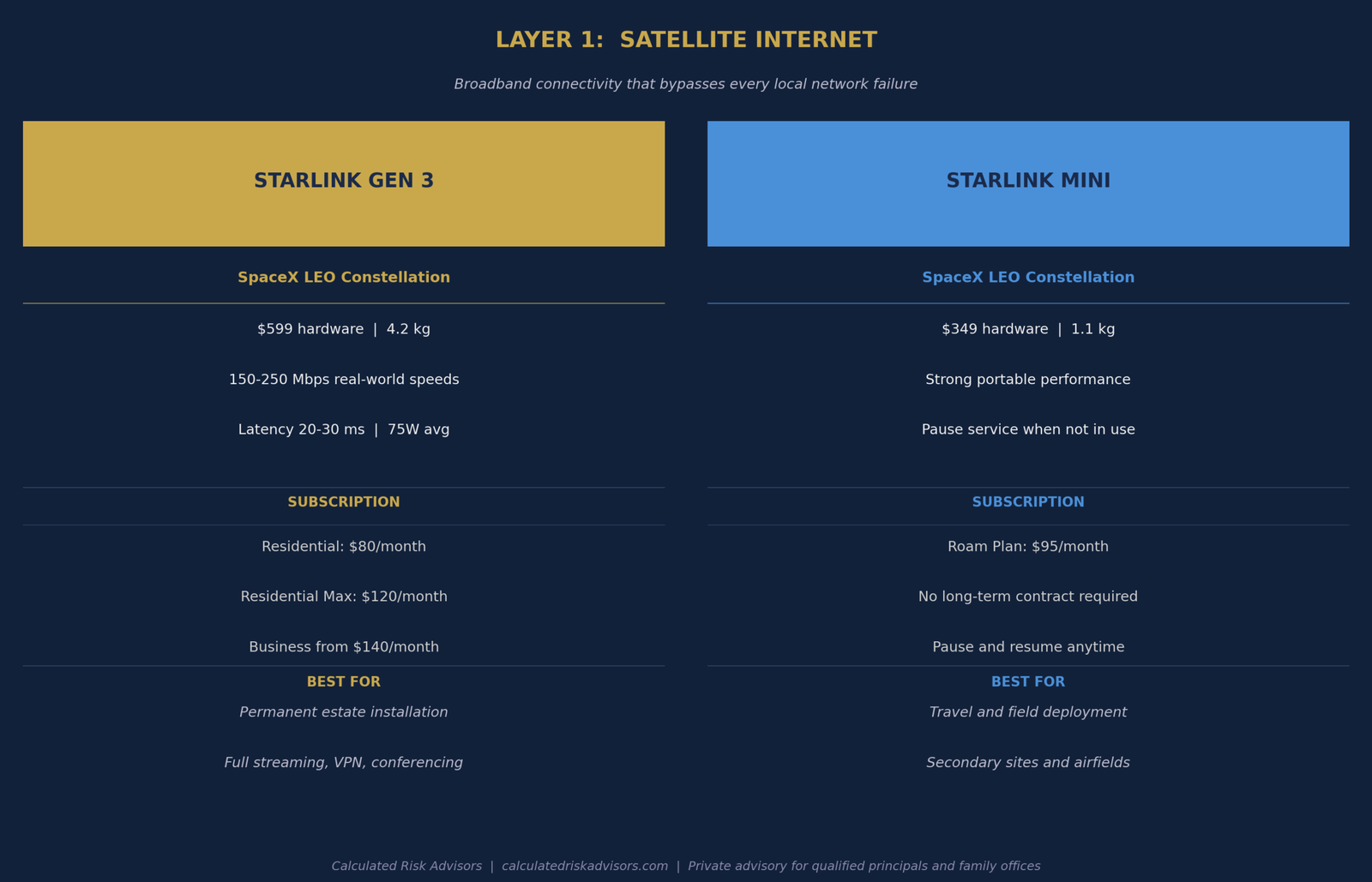
Figure 1. Layer 1, Satellite Internet: Starlink Gen 3 vs Starlink Mini | Calculated Risk Advisors
Layer Two: Satellite Voice When the Internet Layer Fails
Voice still matters. When data connectivity is unavailable or compromised, a satellite phone is irreplaceable. Two systems dominate for serious use, and the right choice depends on your primary operating geography. I carry both, and the distinction between them is meaningful.
Inmarsat IsatPhone 2: My Domestic Choice for the United States
For use within the United States and across North America, I rely on the Inmarsat IsatPhone 2. The performance has been consistently strong: excellent call clarity, reliable connectivity, and the confidence that comes from operating on a network with 99.9 percent documented uptime. The IsatPhone 2 runs on Inmarsat’s I-4 geostationary satellite constellation, which provides coverage from approximately 82 degrees south to 82 degrees north latitude, encompassing the entire continental U.S., Alaska, Hawaii, and Mexico without issue. Voice quality on geostationary systems carries a slight delay compared to low-earth-orbit networks, but in practice the clarity more than compensates. Battery life delivers up to 8 hours of talk time and 160 hours of standby, making it practical for extended field use.
Subscription plans are well-structured for different usage profiles: monthly plans starting around $50 per month include a U.S.-based number and rollover minutes, with six-month, annual, and prepaid airtime options available for families who prefer to hold minutes in reserve. The IsatPhone 2 is also meaningfully more affordable to acquire than competing Iridium handsets, making it the practical first choice for domestic operations.
Inmarsat IsatPhone 2 at a Glance
- Network: Inmarsat I-4 geostationary satellites | 99.9% uptime
- Coverage: -82 to +82 degrees latitude (full US and most of the globe)
- Talk time: 8 hours | Standby: 160 hours
- Features: Voice, SMS, GPS tracking, SOS emergency
- Monthly plan: from ~$50/month with US number and rollover minutes
- Also: 6-month, annual, and prepaid airtime options
- Best for: US domestic use, North America, near-global coverage without polar need
Iridium 9575 Extreme: The International Standard
When travel takes you beyond the continental United States, or when you require coverage in polar regions, remote ocean crossings, or any location where geostationary satellite geometry creates gaps, the Iridium 9575 Extreme is the answer. It operates on Iridium’s 66-satellite low-earth-orbit constellation, providing genuine pole-to-pole coverage with no dead zones anywhere on the planet. Unlike geostationary systems, the LEO network produces virtually no voice delay, delivering calls with the immediacy of a terrestrial line despite operating through satellites 780 kilometers overhead.
The 9575 Extreme is built to military specification MIL-STD-810F and G for shock, vibration, humidity, and dust resistance, and carries IP65 rating for water resistance. It includes built-in GPS with location tracking, an integrated SOS button that transmits distress coordinates to emergency services, and supports both voice and SMS messaging. Hardware prices range from approximately $1,300 to $1,500 new. Airtime plans are available as prepaid units or postpaid monthly commitments, with 100-minute prepaid packages among the flexible short-term options.
Iridium 9575 Extreme at a Glance
- Network: 66-satellite LEO constellation | Pole-to-pole global coverage
- Voice delay: Near zero (LEO advantage over geostationary)
- Durability: MIL-STD-810F/G | IP65 water and dust resistance
- Features: Voice, SMS, GPS tracking, SOS distress with coordinates
- Hardware: ~$1,300-1,500 | Prepaid and postpaid airtime available
- Best for: International travel, polar regions, ocean crossings, true global coverage
ACR Bivy Stick: Global Two-Way Satellite Texting and GPS
The ACR Bivy Stick is the simplest and most compact device in the Iridium ecosystem, purpose-built for two-way satellite messaging and GPS-based location sharing from anywhere on earth. It pairs via Bluetooth to a smartphone running the Bivy app, enabling text messages to be sent and received over the Iridium network without any cellular connection. The Bivy Stick also provides real-time GPS tracking with location sharing, one-touch check-in messages with coordinates, access to weather forecasts, and a dedicated SOS button that routes distress signals with GPS coordinates to ACR’s 24-hour monitoring center. SOS functionality is included in all subscription tiers and does not consume plan credits.
Subscription plans are genuinely accessible for the capability delivered: monthly plans start at $19.99 for Basic, $34.99 for Plus with 60 message credits, and $59.99 for Unlimited. Annual plans reduce those costs to $14.99, $29.99, and $54.99 respectively. An initial three-month commitment is required per device, after which service is month-to-month. The Bivy Go option bundles unlimited messaging with no upfront device cost over a six-month commitment. For families who want global two-way messaging capability at minimum size, weight, and cost, the Bivy Stick belongs in every go-bag and jacket pocket on the property.
ACR Bivy Stick at a Glance
- Network: Iridium LEO | 100% global satellite coverage
- Capabilities: Two-way SMS, GPS tracking, weather, SOS, check-in messages
- SOS: Included in all plans, routes to 24-hour monitoring center
- Monthly plans: Basic $19.99 | Plus $34.99 | Unlimited $59.99
- Annual plans: Basic $14.99 | Plus $29.99 | Unlimited $54.99
- Bivy Go: Unlimited messaging, no device upfront, 6-month term
- Best for: Portable global messaging, GPS tracking, go-bag inclusion
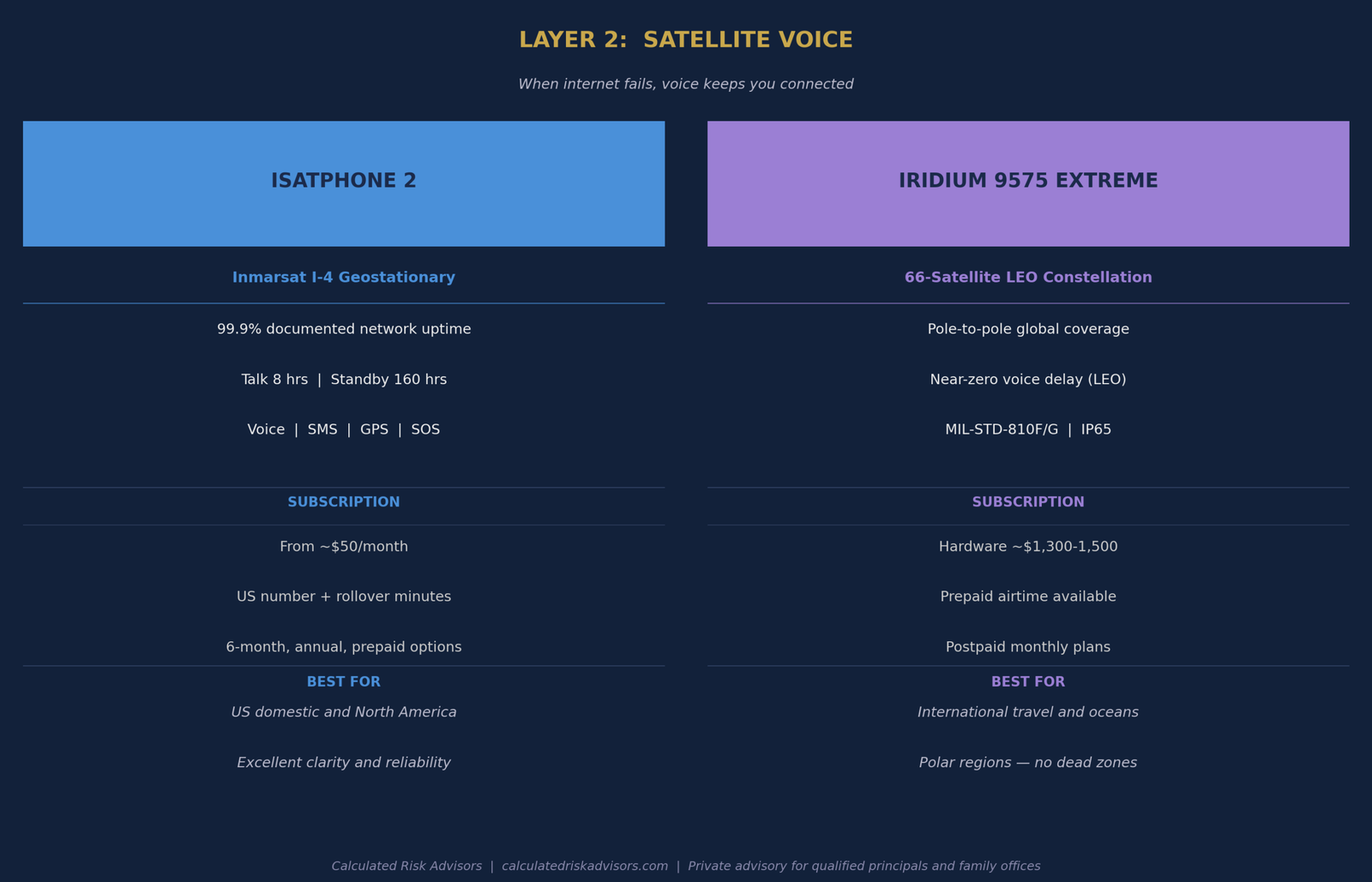
Figure 2. Layer 2, Satellite Voice: Inmarsat IsatPhone 2 (Domestic) vs Iridium 9575 Extreme (International) | Calculated Risk Advisors
Layer Three: Low-Bandwidth Messaging When Voice Is Unavailable
Below the satellite phone layer, two compact devices provide text-based communication and GPS capability when voice is not needed or not possible. These fit in a jacket pocket and operate anywhere on earth.
Iridium GO! Hotspot: Mobile Connectivity Hub
The Iridium GO! converts Iridium satellite coverage into a local WiFi zone that supports up to five devices within a 100-foot radius. Through the Iridium GO companion app, smartphones connected to the hotspot can make global voice calls, send and receive text messages, and trigger SOS alerts using the Iridium network rather than commercial cellular infrastructure. It is the logical companion device for families who want to extend Iridium coverage to multiple smartphones without purchasing individual handsets for every team member. Plans begin at approximately $64.99 per month, with options for monthly, annual, and specialized airtime packages. Gear Junkie documented its performance on the summit of Denali, confirming reliable operation in one of the most remote and extreme environments on the planet.
Iridium GO! Hotspot at a Glance
- Network: Iridium LEO | Global coverage including poles
- Creates local WiFi zone: up to 5 devices within 100 feet
- Capabilities: Voice, SMS, SOS through companion smartphone app
- Plans: From $64.99/month | Monthly and annual options available
- Best for: Multi-device coverage without individual satellite handsets
ACR Bivy Stick: Global Two-Way Satellite Texting and GPS
The ACR Bivy Stick is the simplest and most compact device in the Iridium ecosystem, purpose-built for two-way satellite messaging and GPS-based location sharing from anywhere on earth. It pairs via Bluetooth to a smartphone running the Bivy app, enabling text messages to be sent and received over the Iridium network without any cellular connection. The Bivy Stick also provides real-time GPS tracking with location sharing, one-touch check-in messages with coordinates, access to weather forecasts, and a dedicated SOS button that routes distress signals with GPS coordinates to ACR’s 24-hour monitoring center. SOS functionality is included in all subscription tiers and does not consume plan credits.
Subscription plans are genuinely accessible for the capability delivered: monthly plans start at $19.99 for Basic, $34.99 for Plus with 60 message credits, and $59.99 for Unlimited. Annual plans reduce those costs to $14.99, $29.99, and $54.99 respectively. An initial three-month commitment is required per device, after which service is month-to-month. The Bivy Go option bundles unlimited messaging with no upfront device cost over a six-month commitment. For families who want global two-way messaging capability at minimum size, weight, and cost, the Bivy Stick belongs in every go-bag and jacket pocket on the property.
ACR Bivy Stick at a Glance
- Network: Iridium LEO | 100% global satellite coverage
- Capabilities: Two-way SMS, GPS tracking, weather, SOS, check-in messages
- SOS: Included in all plans, routes to 24-hour monitoring center
- Monthly plans: Basic $19.99 | Plus $34.99 | Unlimited $59.99
- Annual plans: Basic $14.99 | Plus $29.99 | Unlimited $54.99
- Bivy Go: Unlimited messaging, no device upfront, 6-month term
- Best for: Portable global messaging, GPS tracking, go-bag inclusion
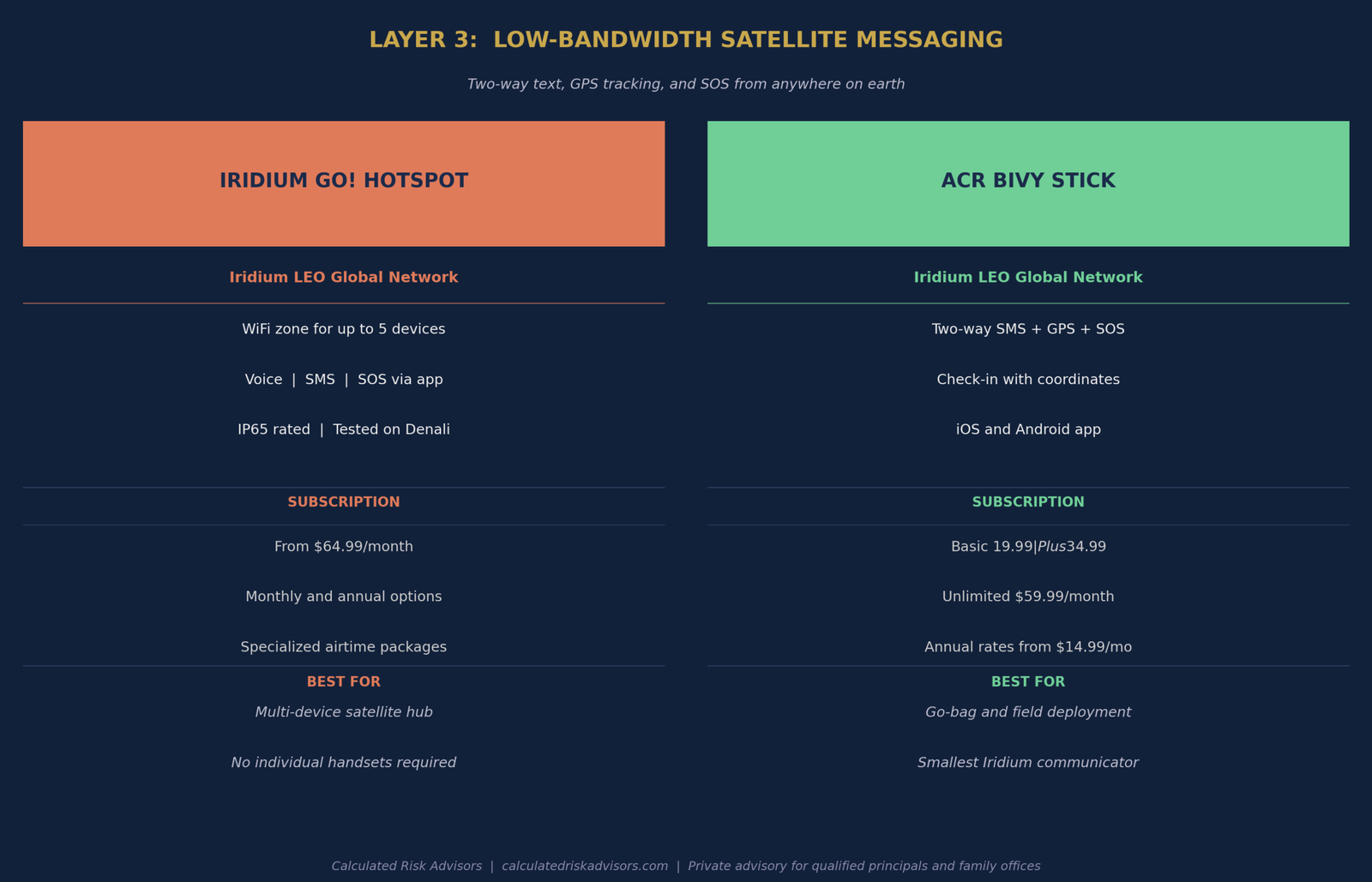
Figure 3. Layer 3, Low-Bandwidth Messaging: Iridium GO! Hotspot vs ACR Bivy Stick | Calculated Risk Advisors
Layer Four: Property-Wide Mesh Networks and Why They Are Non-Negotiable
The first three layers of the communications stack, satellite internet, satellite voice, and low-bandwidth messaging, address connectivity with the outside world. Layer Four addresses something equally critical: the ability to communicate internally across your own property when every external system has failed. This is not a redundancy consideration. It is a primary operational requirement for any private resilience estate or family compound serious about genuine independence.
GMRS Radio: Licensed, Long-Range, and Subscription-Free
General Mobile Radio Service (GMRS) is a licensed radio service in the United States that requires a single FCC license costing approximately $35 for a ten-year term, no ongoing subscription, no carrier dependency, no infrastructure beyond the radios themselves. GMRS handhelds and mobile units operate on dedicated UHF frequencies with effective range from five to fifty or more miles depending on terrain, antenna height, and transmitter power. Repeater stations installed at elevated points on or near the estate can extend range dramatically across valleys, through forested terrain, and along perimeter roads. A properly deployed GMRS network allows security teams, estate staff, and family members to communicate across the full extent of a large property in real time, under any conditions, without any external system involved.
Mesh Radio Networks: A Private Intranet on Your Land
Newer mesh radio devices using protocols such as Meshtastic, deployed on LoRa (Long Range) radio hardware, create a distributed peer-to-peer network across the estate that functions as a private intranet. Each node in the mesh extends the network by relaying messages from other nodes, so that the range of the system grows with each additional device placed at a structure, gate, guard post, or vehicle. Smartphones connected to mesh nodes via Bluetooth can exchange encrypted text messages with any other smartphone on the mesh, across miles of property, with no cellular signal and no internet connection of any kind. The entire network exists on the estate and is not visible or accessible to any external party. For a compound with multiple outbuildings, a perimeter security team, aviation support staff, and resident family members, this private mesh intranet is the communications backbone that holds the entire operation together when the satellite layers are unavailable or reserved for outward-facing communications.
Layer Five: Encrypted Location Intelligence, Seeing Without Being Seen
Location data is one of the most overlooked vulnerabilities in private estate operations. Standard commercial GPS trackers, the kind sold at electronics retailers for tracking vehicles, children, or assets, operate by transmitting coordinates through commercial cellular networks to cloud servers managed by corporations you do not control. Your vehicle’s location, your staff’s movement patterns, and the operational rhythms of your estate are recorded on servers that are subject to subpoena, data breach, corporate policy change, and network failure. This is not a theoretical concern. It is a structural design flaw in commercial tracking infrastructure.
LoRa-Based Private Tracking: Location Data That Never Leaves the Estate
LoRa (Long Range) radio technology enables tracking devices to transmit GPS coordinates at very low power levels over distances of several miles to a private gateway receiver installed on the estate. The gateway collects all position data and displays it on a locally hosted map server, a system that runs entirely on estate infrastructure with no external internet connection required. Vehicles, ATVs, boats, aircraft, equipment, and personnel can all be tracked in real time on a private dashboard that no external entity can access, monitor, or subpoena. Historical movement data is stored locally on estate hardware under your direct control. The system operates continuously regardless of cellular coverage, internet availability, or carrier service status.
Why This Matters for Operational Security
Every commercial GPS tracker broadcasting through a cellular network is a real-time data stream about your operational patterns. When staff leaves the gate. When vehicles move at unusual hours. When the estate is at low occupancy. This information, aggregated over time, creates a comprehensive picture of the estate’s operational rhythms that exists on a corporate server you do not control. A private LoRa tracking network eliminates that exposure entirely. The estate’s operational intelligence stays on the estate.
EMP Hardening of the Location Layer
LoRa gateway hardware and tracking devices, like all electronics, are vulnerable to electromagnetic pulse events whether from natural sources such as solar coronal mass ejections or manufactured EMP weapons. Families operating serious resilience infrastructure should store backup tracking units and a spare gateway receiver in properly rated Faraday enclosures on the estate. This ensures that the location intelligence layer can be restored rapidly following an EMP event that disables unprotected equipment. The investment in EMP-hardened storage for critical electronics is modest relative to the restoration capability it preserves.
The Foundation: Independent Power for Every Layer
None of the stack described above functions without electricity. Every layer, from the Starlink dish to the Bivy Stick charging cable, depends on power. The question for a serious private resilience estate is not whether to invest in backup power but how many independent layers to build. Solar generators paired with battery banks can keep a full communications rack operational for days without a single watt from the commercial grid. Portable solar panels and compact battery banks keep handhelds charged during evacuations, extended field deployments, or operations at private airfields. The principle is continuity: regardless of how long an outage lasts, the communications system keeps functioning.
Operational Security: Protecting What You Communicate
The stack means nothing if the content of communications is exposed. Encrypted applications such as Signal and SimpleX protect messaging. Secure email platforms including StartMail and Tutanota protect correspondence. Hardware security keys protect account access against compromised passwords and cloned devices, particularly during international travel when device inspection risks are elevated.
Every high-net-worth international traveler should carry a clean burner phone through airports. In the United States, U.S. Customs and Border Protection (CBP) has authority to inspect, copy, and review device contents at international ports of entry without a warrant. A burner phone protects sensitive material while keeping you functional in transit. Advanced families pre-stage burner devices for staff and key family members, establishing secure and compartmentalized communications at every node in the network.
Digital platform access requires specific hardening. Authenticator apps and hardware security keys work without cell service. Backup recovery codes stored offline provide emergency platform access. If SMS text message is your only two-factor authentication method, you are exposed to exactly the single-channel failure that leaves thousands of users locked out of everything simultaneously. Diversifying authentication methods eliminates that vulnerability before it manifests.
The Rule: One Is None, Two Is One
If you cannot send a message from your main house to your pilot without commercial infrastructure, you have a gap. If your staff cannot coordinate across the property when cell service drops, you have a gap. If you rely on a single satellite provider or a single device at any layer of the stack, you are living with a point of failure that will eventually reveal itself at the worst possible moment.
The rule that governs every well-designed communications architecture is simple: one is none, two is one. Build multiple layers, power them independently, secure them with discipline, and train every person who uses them. When commercial networks go dark, wealth alone cannot buy a connection. Only preparation can.
“Treat communications like finance: diversify, test, and protect. Build multiple layers, power them independently, secure them with discipline, and train those who use them. When networks go dark, wealth alone cannot buy a connection. Only preparation can.”
Summary: The Five-Layer Stack for Private Resilience Estates and Family Compounds
A complete sovereign communications architecture for a private resilience estate or family compound is not a single device or a single subscription. It is five interdependent layers, each capable of operating independently, each designed to carry the mission when the layer above it fails.
- Layer 1, Satellite Internet: Starlink Gen 3 for permanent estate installation, Starlink Mini for portable and secondary-site deployment. Broadband connectivity that bypasses every local failure.
- Layer 2, Satellite Voice: Inmarsat IsatPhone 2 for domestic and North American use. Iridium 9575 Extreme for international operations and polar coverage. Never rely on a single handset or a single network.
- Layer 3, Low-Bandwidth Messaging: Iridium GO! hotspot for multi-device satellite coverage. ACR Bivy Stick for portable global two-way texting, GPS, and SOS in a jacket pocket.
- Layer 4, Local Mesh Network: GMRS licensed radio for property-wide voice coverage with no subscription. Meshtastic mesh nodes for private encrypted text messaging across the estate as a standalone intranet.
- Layer 5, Location Intelligence: LoRa-based private GPS tracking with a local gateway. No cloud, no corporate server, no external visibility. Operational data that stays on the estate.
Test the system quarterly. Train every person who uses it. Store backup units in Faraday-hardened enclosures. Build independent power for every layer. And remember that the most expensive gap in any private resilience estate is not the one you planned for, it is the one you assumed was covered.
What Calculated Risk Advisors Delivers
Calculated Risk Advisors designs private resilience estates and family compounds with communications resilience integrated from the ground up, not retrofitted as an afterthought. Each engagement evaluates your current connectivity stack, identifies single points of failure, and maps a layered system covering satellite internet, satellite voice, low-bandwidth messaging, local mesh, independent power, and operational security protocols.
Confidential consultations are available exclusively for qualified principals and family offices, by private introduction.
About the Author
Brent Michael Hardin is the founder of Calculated Risk Advisors, a private advisory firm serving ultra-high-net-worth individuals and multi-generational family offices. CRA specializes in sovereign estate development, jurisdictional intelligence, and strategic relocation advisory for families navigating an era of accelerating geopolitical, financial, and technological change. Engagements are by private introduction only.
Limited Availability
Calculated Risk Advisors accepts a limited number of new families each quarter. Each engagement is tailored, confidential, and managed directly by our principals. There is no public intake. All relationships begin by private introduction.
A Note on This Publication
The observations, analysis, and commentary published on this site are produced for general informational and educational purposes only. They represent the research and independent perspective of the author and do not constitute financial, investment, legal, tax, real estate, or any other form of professional advice.
Nothing published here represents a solicitation, recommendation, or offer to acquire or dispose of any security, asset, property, or service. Access to this content does not establish an advisory, fiduciary, or client relationship of any kind between the reader and Calculated Risk Advisors LLC or any of its affiliated entities.
The decisions explored on this site — jurisdictional positioning, estate design, infrastructure strategy, and multi-generational wealth planning — are among the most consequential a family can make. They require qualified legal counsel, licensed tax professionals, credentialed financial advisors, and specialist practitioners who have direct knowledge of your specific circumstances, objectives, and risk profile. No publication, regardless of its depth or specificity, is a substitute for that counsel.
Calculated Risk Advisors LLC and its affiliates expressly disclaim responsibility for any decision made, action taken, or action not taken in reliance on content published here.
If you are seriously evaluating any of the strategies, jurisdictions, or approaches discussed in this publication, engage qualified independent advisors before proceeding. If you would like to explore whether a private advisory relationship with Calculated Risk Advisors is appropriate for your situation, you are welcome to request an introduction.
“The intelligence that protects generational wealth doesn’t make headlines; it circulates quietly among those who know where to look. Subscribe to the Calculated Risk Advisors Daily Brief. No noise. No mass-market advice. Just the signal.”
References
ACR Electronics. (2026). Bivy Stick subscription plans. ACR Bivy Stick. https://bivystick.com/plans/
Blue Cosmo. (2026). Inmarsat IsatPhone 2 satellite phone. BlueCosmo Satellite. https://www.bluecosmo.com/inmarsat-isatphone-2-satellite-phone/
Blue Cosmo. (2026). IsatPhone global monthly service plans. BlueCosmo Satellite. https://www.bluecosmo.com/isatphone-global-monthly-service-plans/
Gear Junkie. (2025). Testing the Iridium GO! satellite hotspot on Denali. GearJunkie. https://gearjunkie.com/technology/iridium-go-review
Iridium. (2026). ACR Bivy Stick satellite communicator. Iridium Communications. https://www.iridium.com/products/bivy-stick-satellite-communicator
Outdoor Tech Lab. (2026). Iridium satellite phone vs IsatPhone 2 (2026 tested best). OutdoorTechLab. https://www.outdoortechlab.com/iridium-satellite-phone-vs-isatphone-2/
Satellite Internet. (2026). Starlink Mini review 2026. SatelliteInternet.com. https://www.satelliteinternet.com/resources/starlink-mini-review/
SatSpeedCheck. (2026). Starlink dish comparison 2026: Gen 3 standard vs Mini vs HP vs Maritime. SatSpeedCheck. https://satspeedcheck.com/blog/starlink-dish-comparison/
© 2026 Calculated Risk Advisors. All rights reserved. This content is provided for informational purposes only and does not constitute legal, financial, or investment advice.



0 Comments