

Geopolitical, financial, technological, and environmental forces are converging at an unprecedented pace. A growing number of accomplished multi-generational families and their family offices are quietly establishing fully independent rural platforms in remote or strategically located regions. These fully independent estates function as far more than a second home. They offer independence, security, peace of mind, and agency for legacy-minded individuals and families.
The same forces dismantling global supply chains, straining power grids, and redrawing geopolitical maps are simultaneously closing the window for deliberate, private action, for those paying attention.
The Evidence Has Entered the Mainstream
What was once considered conspiracy, the creative imagination of the tin-foil-hat theorist, is now mainstream institutional discourse. Many of the world’s leading organizations, such as BlackRock, the World Economic Forum, UBS, Knight Frank, and McKinsey, now routinely model scenarios once considered remote.
Current conditions on the radar of governments, organizations, and companies signal the real possibility of prolonged grid interruptions, fragmented supply chains, cyber-induced liquidity events, nuclear war, and sustained volatility in energy and food markets.
Five Years of Fractured Systems
The American power grid has been showing stress and deterioration before AI became a topic of discussion. In February 2021, the Texas grid collapsed, leaving 4.5 million homes and businesses without power and killing hundreds. Over the past five years, data centers have been exploding across the grid map. What was a median time of 22 months to connect a new power plant in 2000 now takes over 54 months today. The power grid was never designed or intended to carry such exponentially larger loads and was built in an era with hardware and software systems now decades old.
Now that AI has become a global phenomenon of interest to multi-polar global powers, both public and private, AI investment rose from roughly $10 billion in 2020 to $45 billion in 2026. The North American Electric Reliability Corporation (NERC) now forecasts summer peak demand to grow by 224 GW over the next decade, a 69% upward revision from its prior forecast. Those communities that rely on their local power company are finding themselves soon to be without power as these facilities become priority over residential energy services.
Artificial intelligence data centers and the digital economy account for most of the projected load growth… large loads inherently add volatility to load forecasts as project timelines and commitments can vary with factors related to construction, permitting approvals, grid development, and data center owner decisions.
North American Electric Reliability Corporation (NERC), Long-Term Reliability Assessment, January 2026
Europe’s Energy Wake-Up
For decades, Europe built a gas-dependent economy relying on Russian energy supply lines. It should be a lesson to all. The September 2022 sabotage of Nord Stream 1 and Nord Stream 2, destroyed by underwater explosions that permanently severed the pipelines, demonstrated that the loss of critical infrastructure can incapacitate entire markets. Regions without independent backup energy place a population at risk of extreme hardship or death should grid-tied supply lines become incapacitated or destroyed. The structural lesson was plain: supply concentration is a strategic liability.
War as Global Supply Chain Weapon
Two wars and two man-made disasters are rippling through global markets. It’s clear the Russia-Ukraine war isn’t just disrupting energy markets. It is also fracturing the global food supply system at the same time. Now the Iran war has compounded that fracturing at a scale that removed any remaining doubt about systemic interdependence. Russia and Ukraine together supply 29% of global wheat exports, 80% of the world’s sunflower oil, and 40% of its barley. Russia’s Black Sea blockade created immediate scarcity and record commodity prices, hitting import-dependent nations in Africa and the Middle East hardest. Meanwhile, Russia supplied 30% of U.S. platinum group element imports, 13% of titanium, and 11% of nickel, critical inputs for batteries and electronics.
Then came the Strait of Hormuz. When the United States and Israel launched strikes against Iran in February 2026 and Iran retaliated by effectively closing the Strait, through which roughly 20% of the world’s oil trade passes, the International Energy Agency characterized the resulting disruption as the largest supply shock in the history of the global oil market.
Over 30% of global urea fertilizer, produced from natural gas and exported through the Gulf, was suddenly stranded. This triggered planting cutbacks from Thailand to Australia and a concurrent food emergency across Gulf states that rely on the Strait for over 80% of their caloric intake. Consumer food prices in the region spiked 40 to 120% within weeks.
Looking at this from a 30,000-foot view, it’s clear these two conflicts, one in Eastern Europe and one in the Middle East, prove the same point twice: a single regional incident can detonate energy, food, fertilizer, and materials supply chains across the globe. The systems and how they operate have never been separate. They are interconnected, and always were.
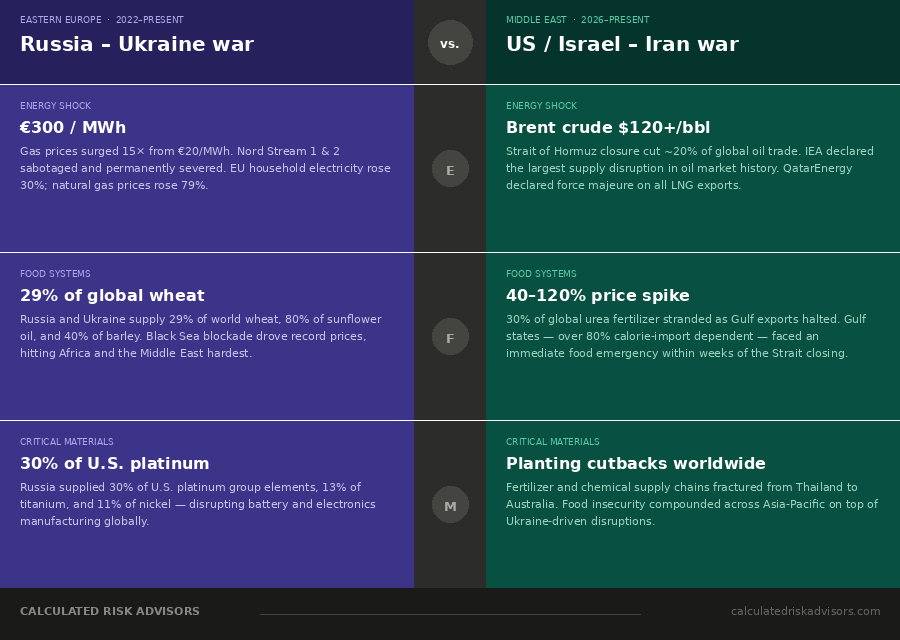
Conflict Comparison | calculatedriskadvisors.com
Three Conditions That Can No Longer Be Assumed
- Grid Capacity Will Keep Pace With Demand
The era of cheap, abundant, reliably available electricity is over for large portions of the country. PJM, the grid serving 65 million people across 13 states, projects a 6 GW shortfall against its own reliability requirements by 2027. NERC’s January 2026 Long-Term Reliability Assessment identified multiple regions at high risk of supply shortfalls. Data centers are simultaneously the cause and the most vulnerable victim: they require uninterruptible power at scale, yet their proliferation is precisely what is pushing the grid toward its limits.
- Geographically Concentrated Energy Supply Is a Manageable Risk
Europe’s experience demolished this assumption in real time. The combination of just-in-time supply chains and single-source dependency turned a geopolitical rupture into an economic crisis affecting hundreds of millions of people. Wholesale electricity prices in some U.S. markets near major data center clusters have already risen as much as 267% over five years, a domestic version of the same concentration dynamic.
- Food and Energy Markets Are Separable Systems
The wars proved they are deeply entangled. Fertilizer prices, which follow natural gas prices, spiked simultaneously with grain shortages caused by the Black Sea blockade, producing a compounding cascade that no single-system model predicted. Energy shocks are now food shocks, and vice versa, particularly for the developing world.
A Timeless Model: Swiss-Style Private Resilience
Switzerland has long combined one of the world’s highest standards of living with decentralized energy production, strategic reserves, and universal shelter capacity. This is not militarization; it is disciplined, multi-decade planning executed with restraint and elegance.
Calculated Risk Advisors brings the same philosophy to the private-family level: legacy-grade rural platforms incorporating independent power generation, secure water sovereignty, regenerative agriculture, hardened communications, medical capability, and discreet aviation access, always delivered as livable, aesthetically distinguished compounds and never as bunkers.
Legacy Beyond Financial Capital
You have prudently structured trusts, diversified globally, and retained best-in-class counsel. A parallel discipline now merits equal rigor: establishing the physical estate on which your family, staff, and operating companies will depend for generations.
History repeatedly rewards early, deliberate action. European banking families in the 1930s, Hong Kong industrialists in the 1980s and 1990s, and Latin American families ahead of their respective currency and infrastructure crises all preserved wealth, influence, and freedom by securing independent rural positions before conditions deteriorated.
The Current Window of Execution
Right now, permitting regimes remain workable. Equipment, materials, and Tier-1 expertise are readily available. Prime agricultural and forested parcels in stable jurisdictions continue to trade at valuations well below long-term replacement cost.
Acting with deliberation today, while global systems remain intact, allows for unhurried, institutionally executed implementation and maximum future optionality.
We deliver the following complete end-to-end solutions:
- Sovereign infrastructure design and implementation
- Jurisdictional and site-selection analysis integration
- Master planning with Tier-1 architectural practices and former Tier-1 infrastructure specialists
- Phased, discreet implementation under absolute confidentiality
These are not contingencies or retreats. They are institutional-grade private resilience estates and autonomous family compounds, the ultimate expression of risk-adjusted, multi-generational diversification. The capital commitment is modest within the context of a nine or ten-figure balance sheet. The preservation of agency, continuity, and legacy is enduring. For those with discernment, recognizing the opportunity now allows you to shape your family’s future with purpose and assurance. The global forces are converging: a potential global economic correction, escalating geopolitical conflict, food insecurity, and the possible diminishment of reliable grid-tied energy.
The evidence is no longer theoretical. Grids fail, pipelines get sabotaged, straits get closed, and harvests get held hostage, sometimes all at once. At Calculated Risk Advisors, we help organizations move from awareness to action: identifying the concentrations, dependencies, and single points of failure before the next disruption makes them impossible to ignore.
About the Author
Brent Michael Hardin is the founder of Calculated Risk Advisors, a private advisory firm serving ultra-high-net-worth individuals and multi-generational family offices. CRA specializes in autonomous rural estate development, jurisdictional intelligence, and strategic relocation advisory for families navigating an era of accelerating geopolitical, financial, and technological change. Engagements are by invitation and private introduction only.
A Note on This Publication
The observations, analysis, and commentary published on this site are produced for general informational and educational purposes only. They represent the research and independent perspective of the author and do not constitute financial, investment, legal, tax, real estate, or any other form of professional advice.
Nothing published here represents a solicitation, recommendation, or offer to acquire or dispose of any security, asset, property, or service. Access to this content does not establish an advisory, fiduciary, or client relationship of any kind between the reader and Calculated Risk Advisors LLC or any of its affiliated entities.
The decisions explored on this site — jurisdictional positioning, estate design, infrastructure strategy, and multi-generational wealth planning — are among the most consequential a family can make. They require qualified legal counsel, licensed tax professionals, credentialed financial advisors, and specialist practitioners who have direct knowledge of your specific circumstances, objectives, and risk profile. No publication, regardless of its depth or specificity, is a substitute for that counsel.
Calculated Risk Advisors LLC and its affiliates expressly disclaim responsibility for any decision made, action taken, or action not taken in reliance on content published here.
If you are seriously evaluating any of the strategies, jurisdictions, or approaches discussed in this publication, engage qualified independent advisors before proceeding. If you would like to explore whether a private advisory relationship with Calculated Risk Advisors is appropriate for your situation, you are welcome to request an introduction.
“The intelligence that protects generational wealth doesn’t make headlines; it circulates quietly among those who know where to look. Subscribe to the Calculated Risk Advisors Daily Brief. No noise. No mass-market advice. Just the signal.”
References
International Energy Agency. (n.d.). Russia’s war on Ukraine. https://www.iea.org/topics/russias-war-on-ukraine
North American Electric Reliability Corporation. (2026, January). Long-term reliability assessment. https://www.nerc.com/globalassets/our-work/assessments/nerc_ltra_2025.pdf
© 2026 Calculated Risk Advisors. All rights reserved. This content is provided for informational purposes only and does not constitute legal, financial, or investment advice.


0 Comments