


Volatility is no longer a phase we pass through. It is the environment we live in. Geopolitical unrest, digital surveillance, brittle supply chains, and the slow-motion erosion of trust in institutions have pushed one reality into sharp focus for anyone paying attention. True resilience has replaced flash as the ultimate luxury. It does not photograph well for Instagram, but it sleeps better at night.
Solitude. Security. Peace of mind. Those three words are not marketing copy. They are the only metrics that still matter when everything else stops working.
You Already Know This Is Coming
You have spent a career diversifying assets, yet almost no one you know has diversified the single asset they actually live on: the ground beneath their feet. Wealth has always bought options, until the day it does not. History is brutally consistent on that point.
A private resilience estate is not an escape. It is insurance written in dirt, water, and watts. It places you and the people you are responsible for outside the single points of failure that now define modern life: aging city grids, just-in-time food delivery, hospitals at capacity, and governments whose first instinct in crisis is control, not competence.
Relying on bottled water, the grocery store, municipal water supply, and restaurants is a fairy tale that can come at catastrophic cost. It is comfortable until it is not, and when it stops working, it stops working everywhere at once. Those who understood this did not wait for a crisis to teach them.
The Quiet Land Rush Is Already Underway
The buyers are not the loudest voices on social media. They are the same families who moved capital out of Russia in 2013, out of Hong Kong in 2019, and out of coastal California in 2021. They do not talk about it. They act. The land rush is quiet by design, because the families executing it understand that visibility in this context is a liability, not an asset.
These are not people motivated by fear. They are motivated by pattern recognition, by the same instinct that built their wealth in the first place: the ability to read the environment as it is rather than as they wish it to be, and to position accordingly before the consensus arrives at the same conclusion.
How These Platforms Actually Work
Nothing here is theoretical. These places already exist and already run. The following is not a vision of what could be built. It is a description of what has been built, by families who did not wait for certainty before acting.
- Site selection is everything. The sweet spot is typically 75 to 150 miles from the nearest major city, close enough for a day trip, far enough to be irrelevant in a regional crisis. Natural barriers, proven water tables, four-season growing potential, and distance from obvious target sets are non-negotiable. The Ozarks, the Inland Northwest, and certain stretches of the Appalachian chain have been quietly checked off that list for decades.
- Power is layered, never singular. High-efficiency solar with oversized battery banks, micro-hydro or geothermal if the site allows, and propane or diesel backups that are exercised monthly. One is none. Three is barely adequate.
- Water is treated like currency. Deep wells, protected springs, 50,000 to 100,000-gallon cisterns, and medical-grade filtration. When the municipal pumps stop flowing, you do not even notice.
- Food is part of the balance sheet. Orchards planted for staggered harvests, rotational grazing for cattle and sheep, dual-season high tunnels, geothermal greenhouses, a walk-in cooler with two years of calories, seed banks, soil biology programs, and a full-time grower mean the grocery store becomes optional, not existential.
- Medical capability is no longer an afterthought. A dedicated trauma room, pharmacy stock rotated every six months, surgical instruments, dental suite, telemedicine backbone, and at least two people on-site who can start an IV in the dark. The events of the last several years should have removed any debate about whether this is overkill.
- Security is invisible until it is not. The properties that last are the ones that look like working farms from the county road. Long driveways, dogs that earn their keep, cameras that record without transmitting unless asked, and a small group of trained individuals who already know which fields of fire matter. Nothing screams target because nothing looks like it is hiding anything.
- People are the real asset. A platform without a loyal, trained crew is just expensive real estate. Pilots, growers, mechanics, medics, and teachers all live on the land. Everyone trains together. Everyone understands that the goal is to keep the outside world irrelevant, not to fight it.
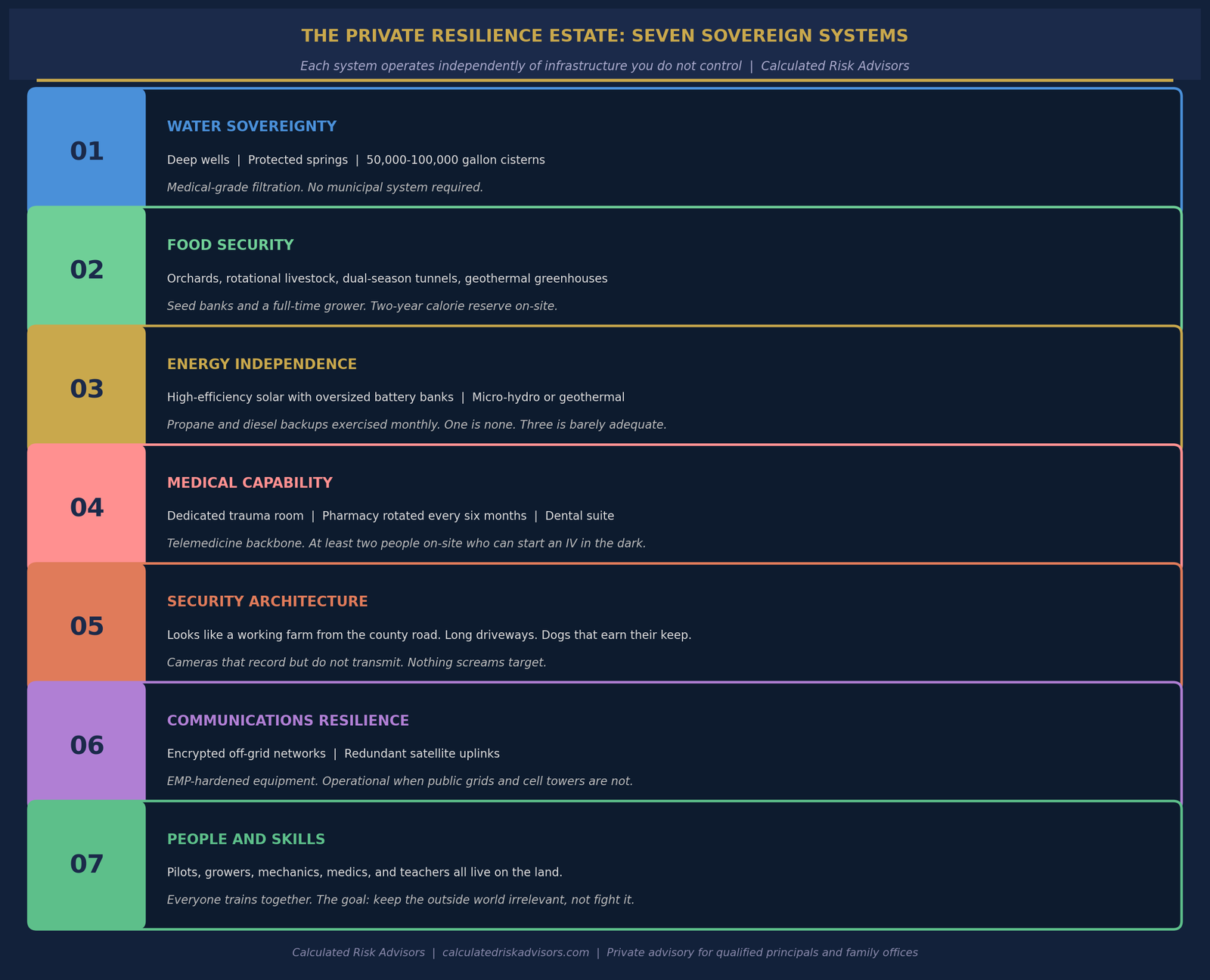
Figure 1. The Private Resilience Estate: Seven Sovereign Systems | Calculated Risk Advisors
What History Records When Governments Stop Feeding Their People
The most important word in food security is not “shortage.” It is “policy.” Throughout recorded history, the most catastrophic famines were not caused by failed harvests or natural disaster. They were caused by governments that had food and chose not to distribute it, or actively seized it from the people who grew it. This is not a conspiracy theory. It is documented history, taught in universities and recorded in peer-reviewed research.
The Holodomor (Ukraine, 1932-1933)
Between 3.5 and 10 million Ukrainians died by starvation in two years. Stalin’s Soviet regime implemented forced grain collectivization, requiring farmers to surrender every grain of what they produced. When quotas were not met, organized groups of police and Communist officials ransacked homes, seizing crops, livestock, seeds, and personal food stores, down to the last potato. Ukraine was the most fertile agricultural region in Europe. The starvation was not caused by drought or failed harvests. It was caused by the deliberate, systematic removal of food from the people who produced it. The goal was to destroy Ukrainian identity and independence. Food was the weapon. Today, more than 30 countries have formally recognized the Holodomor as genocide (Britannica, 2024).
The Great Chinese Famine (1959-1961)
Between 15 and 45 million people died during Mao Zedong’s Great Leap Forward, making it one of the deadliest peacetime events in human history. Agricultural collectivization removed incentives for production, while local officials falsified crop yields upward to avoid punishment for underperformance. The government taxed grain based on those inflated numbers, seizing the actual food. Farm labor was simultaneously redirected to backyard steel furnaces, collapsing agricultural output. In 1959, at the height of the famine, China exported 4.2 million tonnes of grain, enough to feed approximately 16 million people for a year. The food existed. The policy decision was made to export it while the population starved. Frank Dikotter’s landmark work, Mao’s Great Famine, based on four years of research in Chinese provincial, county, and city archives, concluded that decisions from Beijing were the direct cause, and that government officials actively increased food procurement quotas from the countryside while millions died (Dikotter, 2010).
The Bengal Famine (1943)
Between 2 and 3 million people died in Bengal, British India. A 2019 study published in Geophysical Research Letters established conclusively that this famine was not caused by drought. Rainfall was above average. The famine was the result of deliberate policy: Churchill’s wartime government restricted grain imports to Bengal while diverting existing food supplies to British soldiers and European stockpiles. Colonial administrators had the resources and the distribution infrastructure. The decision was made to prioritize other recipients. Three million civilians died of starvation in a region with functioning agriculture because the people in control of the food supply chose not to feed them (Al Jazeera, 2019).
The North Korean Arduous March (1994-1998)
Between 500,000 and 3.5 million North Koreans died during a famine the Kim regime named the “Arduous March.” Soviet aid collapsed, Chinese food assistance was cut following the 1994 nuclear crisis, and the public distribution system that had kept the population fed disintegrated. The government’s response was to continue prioritizing military expenditure while instructing citizens to subsist on pine bark, grass, and corn husks. The resources to address the crisis existed elsewhere in the system. Feeding the population simply was not the priority. The Wilson Center documents this as a state-induced famine, one of the most thoroughly documented cases of a government allowing its own population to starve in the modern era (Wilson Center, 2023).
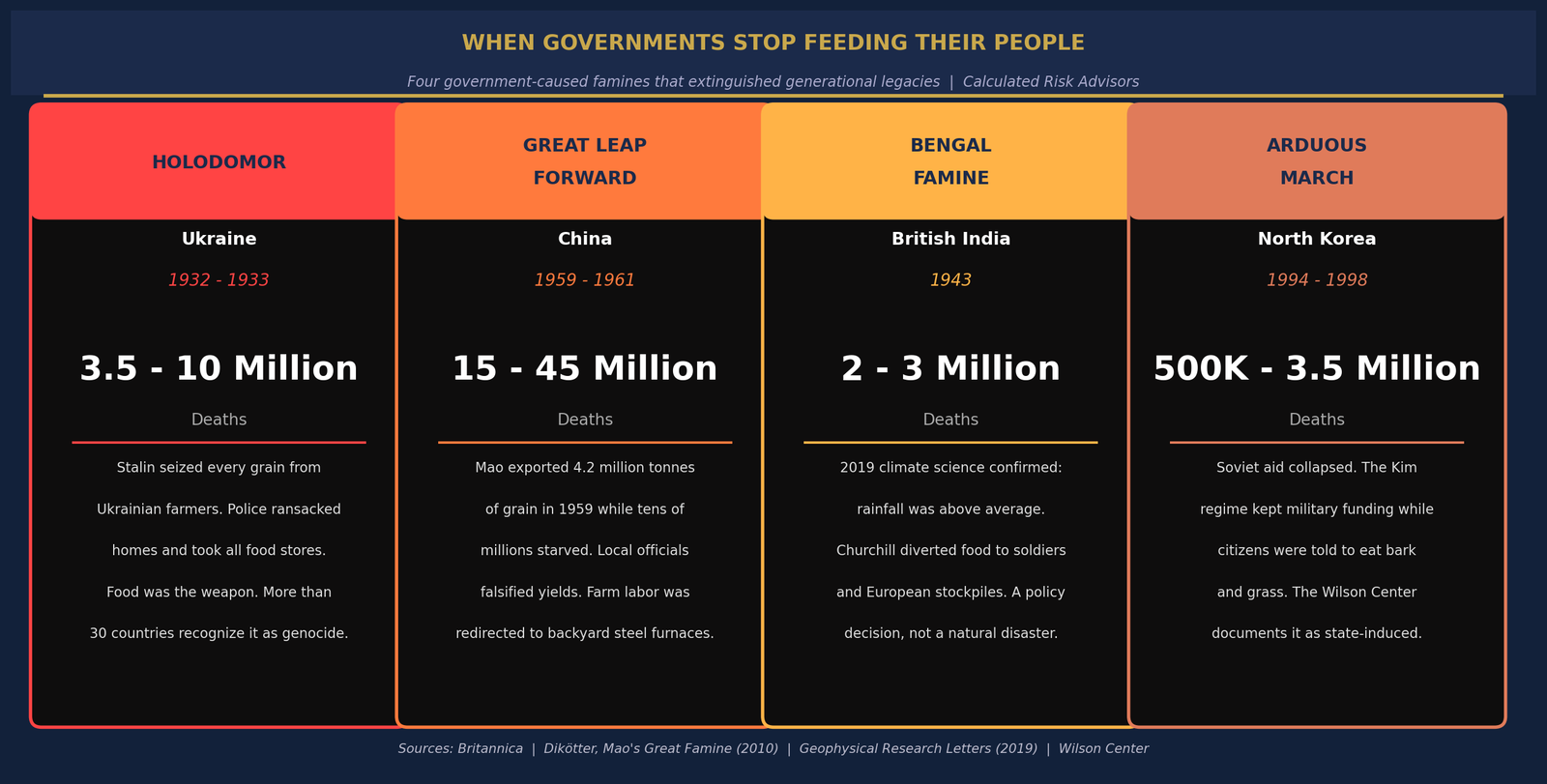
Figure 2. When Governments Stop Feeding Their People: The Historical Record | Calculated Risk Advisors
When the Money Itself Resets: Three Lessons Every Legacy Must Absorb
Food is not the only system governments have weaponized against private wealth. Every monetary system in history has eventually been reset, restructured, or collapsed, and the families who survived those transitions intact were the ones who held real assets, productive land, and sovereign infrastructure, not paper claims on institutions that failed.
The Weimar Hyperinflation (1921-1923)
The German mark collapsed from approximately 4.2 marks per dollar in 1914 to 4.2 trillion marks per dollar by November 1923. Middle-class wealth that had taken generations to accumulate was erased in months. Families who held savings in the national currency lost everything. Those who held title to productive farmland, physical commodities, and hard assets denominated outside the failing currency retained their position. The lesson was not that the Weimar Republic was uniquely incompetent. The lesson is that when a government cannot service its obligations, the currency bears the cost, and the people who trusted that currency bear it with it.
The Nixon Shock (August 15, 1971)
President Nixon unilaterally ended the convertibility of the U.S. dollar to gold, collapsing the Bretton Woods system that 44 nations had agreed to in 1944 and which had organized the global monetary order for 27 years. No consultation. No referendum. One announcement. The entire global financial architecture was restructured overnight by a single government decision. This set in motion the Great Inflation of the 1970s and permanently severed the dollar from any physical anchor. The State Department’s own historical record describes this as “the beginning of the end” for Bretton Woods. Every dollar-denominated asset held by private families was repriced without their consent (U.S. Department of State, Office of the Historian).
The Pattern That Repeats
The Weimar Republic lasted 14 years. The Bretton Woods system lasted 27. The current fiat monetary order, unanchored to any physical asset since 1971, is now in its 55th year with sovereign debt in the United States approaching $39.2 trillion and growing at $6 billion per day. No monetary system in history has been permanent. The question is not whether the current system will be restructured. The question is whether your family holds assets that retain value through the restructuring. Land with water. Land with food production. Land with independent energy. These things have held value through every monetary reset in recorded history because they produce something real regardless of what the currency printed on top of them is worth.
The Psychological Operation Running in Real Time
Less than 15 percent of the global population is currently conscious of the battle they are in with regard to artificial intelligence, data centers, created food shortages, financial and economic dangers, and the intentional resource battles taking place to manufacture shortages for assorted agendas. The remaining 85 percent is occupied with entertainment, political theater, and the algorithmically curated content specifically designed to keep attention away from the decisions that matter.
Electronics, media, and politics continue to distract with topics that carry no survival weight, placing you in grave danger while intentional resource battles reshape the supply chains your family depends on. The question is direct: should you allow the media to distract you instead of taking proactive measures to ensure your family’s legacy and survival? Because if you do, your bloodline will face consequences that no amount of financial sophistication can reverse after the fact.
This is a psychological operation as well as a physical one. The distraction is not accidental. The noise is engineered. And the families who allow that noise to substitute for preparation are the families who will discover too late that the window to act was open and they chose not to walk through it.
Your Region, Your Responsibility, Your Legacy
You need to concentrate on your specific area of influence. Understand your region and its ability to provide food, water, fishing, hunting, farmers, ranchers, and local food producers. These are not abstract concepts. They are the network that keeps your family alive when centralized systems fail, and that network must be built before it is needed, not during the crisis that makes it necessary.
Get to know your neighbors. Offer to help them when they are in need. The families that survive disruption at the community level are the ones who invested in relationships before the disruption, not the ones who tried to build them after. A neighbor who trusts you is infrastructure. A neighbor who resents you is a liability.
- Water. Stop depending on municipal systems and bottled supply. Stock significant water reserves and understand your local water table. Know where the wells are. A family without independent water access is one infrastructure failure from a catastrophe.
- Food. Stock dry goods, canned provisions, and long-shelf-life staples in quantities that reflect a real disruption, not a long weekend. Know which local farmers and ranchers will still have product when commercial grocery logistics fail.
- Medicines and pharmaceuticals. Stock essential medications and rotate them. Understand which pharmaceutical needs in your household require continuous supply and plan accordingly. Medical access in a regional disruption will not look like it does today.
- Security. If legal and permissible in your jurisdiction, own a firearm and know how to use it. This is not a political statement. It is the same logic that underlies every other layer of preparedness: when systems fail, the responsibility for protection falls on you.
- Electronics protection. Have necessary EMP protection systems for critical equipment and vehicles. An electromagnetic pulse event, whether natural or manufactured, will disable unprotected electronics. This is a documented vulnerability with documented solutions.
- Climate-appropriate gear. If you live in a cold-weather climate, have sufficient cold-weather clothing and equipment for extended periods without commercial heating. This is among the simplest preparations and among the most neglected.
- Stop being a spectator. The next stage of what is unfolding is visible to those who choose to see it. Take necessary action and applied change. Adaptability and using the time afforded before the event will determine whose legacy survives into the next generation.
The Bottom Line
Passive wealth is dying. The next generation of leadership will be measured by who still has options when the crowd has none. A well-executed private resilience estate is not about waiting for the end of the world. It is about removing any chance that the world can end yours.
The families who build these platforms are not the ones who believe civilization is collapsing. They are the ones who understand that resilience and dependence cannot coexist, that sovereignty is a designed condition, and that the time to design it is before you need it, not after the need has made the options disappear.
Use your discernment to see beyond the illusions and the empty promises. The world is about to make a significant change on a global scale, and the evidence for that assessment is not hidden. It is available to anyone willing to look past the distraction long enough to read it. Adaptability and action taken now, while the window is open, will be the determining factor in whose legacy survives into the next generation.
“The most dangerous assumption is that the systems which created your prosperity will protect it. They were never built for that purpose. You were.”
What Calculated Risk Advisors Delivers
Calculated Risk Advisors specializes in designing private family compounds, private resilience estates, and resilient estate infrastructure within stable, low-surveillance jurisdictions including Switzerland, New Zealand, Panama, and other thoroughly vetted locations. We also provide guidance for North America following a comprehensive threat-modeling discussion.
Each engagement delivers a confidential assessment structured around the specific dimensions that determine whether a sovereign estate performs as intended under real-world conditions: jurisdictional stability, legal environment, infrastructure independence, climate and resource considerations, privacy architecture, long-term geopolitical position, energy independence, food security, communications resilience, and multi-generational habitation design.
Confidential consultations are available exclusively for qualified principals and family offices, by private introduction.
About the Author
Brent Michael Hardin is the founder of Calculated Risk Advisors, a private advisory firm serving ultra-high-net-worth individuals and multi-generational family offices. CRA specializes in sovereign estate development, jurisdictional intelligence, and strategic relocation advisory for families navigating an era of accelerating geopolitical, financial, and technological change. Engagements are by private introduction only.
Limited Availability
Calculated Risk Advisors accepts a limited number of new families each quarter. Each engagement is tailored, confidential, and managed directly by our principals. There is no public intake. All relationships begin by private introduction.
A Note on This Publication
The observations, analysis, and commentary published on this site are produced for general informational and educational purposes only. They represent the research and independent perspective of the author and do not constitute financial, investment, legal, tax, real estate, or any other form of professional advice.
Nothing published here represents a solicitation, recommendation, or offer to acquire or dispose of any security, asset, property, or service. Access to this content does not establish an advisory, fiduciary, or client relationship of any kind between the reader and Calculated Risk Advisors LLC or any of its affiliated entities.
The decisions explored on this site — jurisdictional positioning, estate design, infrastructure strategy, and multi-generational wealth planning — are among the most consequential a family can make. They require qualified legal counsel, licensed tax professionals, credentialed financial advisors, and specialist practitioners who have direct knowledge of your specific circumstances, objectives, and risk profile. No publication, regardless of its depth or specificity, is a substitute for that counsel.
Calculated Risk Advisors LLC and its affiliates expressly disclaim responsibility for any decision made, action taken, or action not taken in reliance on content published here.
If you are seriously evaluating any of the strategies, jurisdictions, or approaches discussed in this publication, engage qualified independent advisors before proceeding. If you would like to explore whether a private advisory relationship with Calculated Risk Advisors is appropriate for your situation, you are welcome to request an introduction.
“The intelligence that protects generational wealth doesn’t make headlines; it circulates quietly among those who know where to look. Subscribe to the Calculated Risk Advisors Daily Brief. No noise. No mass-market advice. Just the signal.”
References
Al Jazeera. (2019, April 1). Churchill’s policies to blame for 1943 Bengal famine: Study. Al Jazeera. https://www.aljazeera.com/news/2019/4/1/churchills-policies-to-blame-for-1943-bengal-famine-study
Britannica. (2024). Holodomor. Encyclopaedia Britannica. https://www.britannica.com/event/Holodomor
U.S. Department of State, Office of the Historian. (n.d.). Nixon and the end of the Bretton Woods system, 1971-1973. Milestones in the History of U.S. Foreign Relations. https://history.state.gov/milestones/1969-1976/nixon-shock
U.S. Senate Joint Economic Committee. (2025, December). National debt hits $38.40 trillion, increased $2.23 trillion year over year. JEC Republicans. https://www.jec.senate.gov/public/index.cfm/republicans/2025/12/national-debt-hits-38-40-trillion-increased-2-23-trillion-year-over-year-6-12-billion-per-day
Dikotter, F. (2010). Mao’s great famine: The history of China’s most devastating catastrophe, 1958-1962. Walker & Company. [Samuel Johnson Prize, 2011; based on Chinese provincial and county archives]
Wilson Center. (2023). How did the North Korean famine happen? Wilson Center. https://www.wilsoncenter.org/article/how-did-the-north-korean-famine-happen
© 2026 Calculated Risk Advisors. All rights reserved. This content is provided for informational purposes only and does not constitute legal, financial, or investment advice.


0 Comments