


The Map Everyone Is Reading
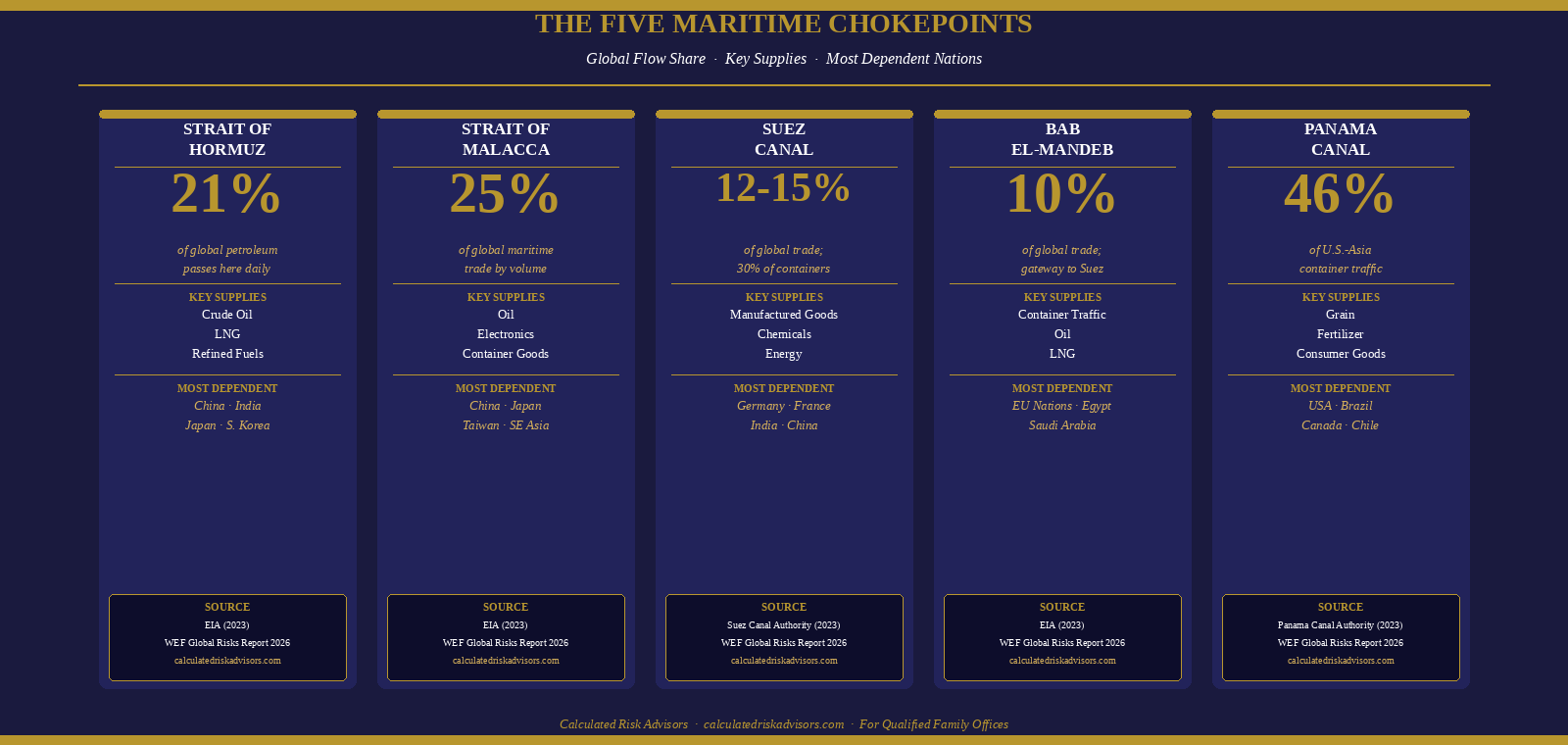
Geopolitical analysts have spent decades mapping the straits. The Strait of Hormuz channels roughly 21 percent of the world’s daily petroleum consumption through a corridor 21 miles wide at its narrowest point. The Strait of Malacca moves approximately 25 percent of global trade and historically close to the majority of China’s imported oil, with estimates ranging from 60 to 80 percent depending on the period. The Suez Canal handles roughly 12 to 15 percent of global maritime commerce and approximately 30 percent of container traffic. The Bab el-Mandeb links the Indian Ocean to the Red Sea; without it, the Suez loses most of its value for Asian-to-European trade. The Panama Canal connects the Pacific and Atlantic economies and carries an estimated 46 percent of U.S. container traffic to and from Asia.
These corridors are active pressure points right now, not theoretical risks. When the World Economic Forum published its Global Risks Report in January 2026, 18 percent of expert respondents identified geoeconomic confrontation as the single most likely trigger of a worldwide crisis, with state-based armed conflict ranked second — and within weeks, both arrived at once: U.S. and Israeli forces launched operations against Iran on February 28 under the code name Operation Epic Fury, and Iran responded by closing the Strait of Hormuz to commercial traffic beginning March 4. According to World Trade Organization data, commercial vessel transits through the strait fell more than 90 percent. Crude oil shipments dropped approximately 95 percent. LNG shipments fell by 99 percent. Iran simultaneously established a new Persian Gulf Strait Authority requiring vessels to obtain permits, submit to inspections, and pay tolls — including fees denominated in cryptocurrency — before transiting. Brent crude exceeded $100 per barrel. War-risk insurance costs surged. This is not a hypothetical risk. It is a documented event that happened in 2026 (Britannica, 2026; House of Commons Library, 2026; UANI, 2026).
This is the geographic layer. It is real, it is measurable, and it is only one of three layers of chokepoint risk that families with significant assets should understand.
“Food is a weapon. It is now one of the principal tools in our negotiating kit.” — Earl Butz, U.S. Secretary of Agriculture, Time, November 11, 1974
The Layer Nobody Maps
Beneath the geography sits an ownership structure that has concentrated control over global food, energy, and logistics into a remarkably small number of hands. No single entity planned it this way. Over four decades, a handful of companies quietly absorbed competitors, cultivated relationships with the regulators meant to oversee them, and grew large enough that governments found them easier to work with than to challenge.
In grain, four trading companies — Archer-Daniels-Midland, Bunge, Cargill, and Louis Dreyfus, collectively known in the trade as the ABCD — have historically controlled an estimated 70 to 90 percent of global grain trade. Oxfam’s Cereal Secrets research report documented this concentration in depth, and a 2024 European Parliament study on agricultural market structure confirmed it remains largely intact (Oxfam Research Reports, 2012; European Parliament, 2024). The recent merger of Viterra with Bunge narrows the competitive field further.
In fertilizer, three inputs — nitrogen, phosphate, and potash — underpin virtually all commercial agriculture at scale. Russia supplies approximately 15 percent of global nitrogen fertilizer exports. Russia and Belarus together supplied approximately 40 percent of global potash exports before 2022 sanctions disrupted those flows. Canada’s Nutrien controls roughly 25 percent of global potash production capacity. The top five producers collectively account for the majority of the world’s potash supply (Financial Times, 2022).
In container shipping, the dominant carrier groups collectively control approximately 80 percent of global container capacity. Following the dissolution of the 2M Alliance in 2025, the landscape reorganized around three power centers: the Gemini Cooperation, formed by Maersk and Hapag-Lloyd; the Ocean Alliance of CMA CGM, COSCO, and Evergreen; and MSC, now operating independently as the world’s largest carrier by fleet size. The top two carriers alone account for roughly 35 to 40 percent of all containerized freight. When these firms blank a sailing, re-route a vessel, or adjust rates, the downstream effects reach every supply chain within weeks.
In port infrastructure, state-linked entities hold significant ownership positions at nodes across every major trade route. One state-owned shipping company has stakes or operational positions in more than 50 ports globally, including positions across Europe, the Middle East, and Southeast Asia. The critical point is this: disrupting these supply chains does not require a navy. It requires a boardroom decision, a sanctions regime, or a regulatory action.

The Policy Template That Already Exists
The third chokepoint layer is institutional. And it has already been field-tested on a global scale.
During the COVID period, 181 of 194 World Health Organization member states implemented some form of travel restriction, business closure, or emergency public health measure. The average time from the declaration of a public health emergency to the implementation of major restrictions was approximately 11 to 14 days. Across those 181 countries, emergency authorities overrode normal legislative processes in the vast majority of cases. Assets were frozen. Businesses were closed by decree. Movement was restricted without judicial review in most jurisdictions (ACAPS, 2020).
Iran, under layered sanctions regimes and financial isolation, demonstrates what a country looks like when all three layers operate simultaneously: geographic access constrained, financial transactions blocked, and emergency authority concentrated at the state level. More than 90 percent of nations that participated in Iran-related sanctions did so within existing treaty or executive frameworks, without new legislation.
COVID and Iran are two examples, not the full picture. In virtually every jurisdiction on earth, governments already have the legal mechanism to restrict movement, close commerce, and freeze financial activity within days. The next trigger will look different. The mechanism will be the same.
“The pandemic represents a rare but narrow window of opportunity to reflect, reimagine, and reset our world.” — Klaus Schwab, The Great Reset, World Economic Forum, 2020
The Convergence Chain
Economists and security analysts have begun using the word polycrisis to describe what happens when multiple independent systems fail at the same time and amplify each other. That is the scenario these three layers are capable of producing. Once the sequence starts, it tends to follow the same pattern.
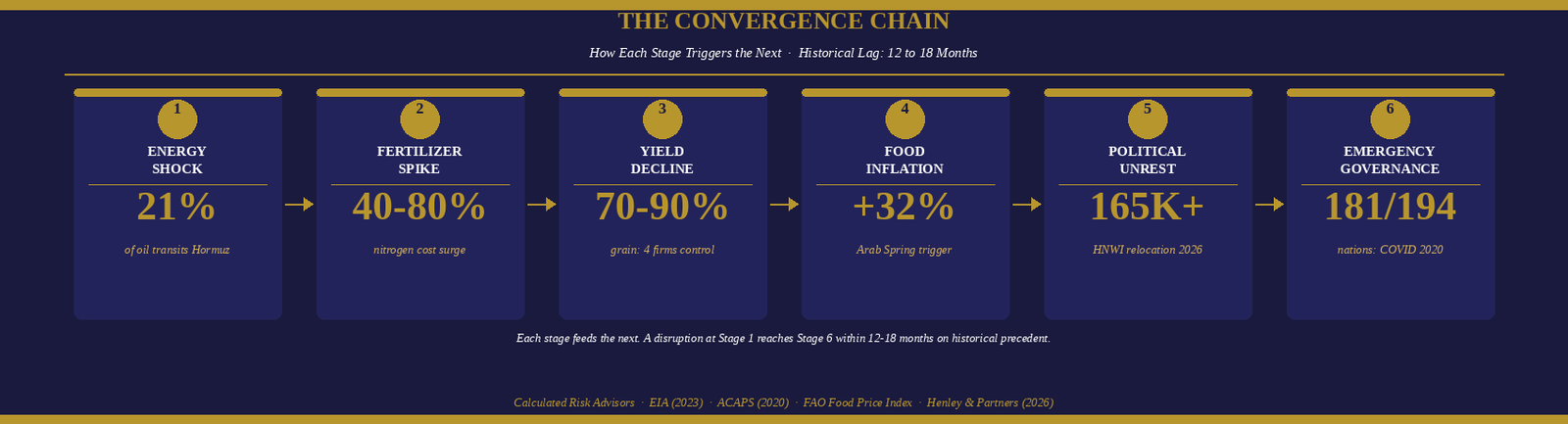
An energy disruption raises the cost of nitrogen fertilizer production, because natural gas is the primary feedstock for the Haber-Bosch process that produces synthetic nitrogen. Higher fertilizer costs reduce agricultural yields in import-dependent countries. Reduced yields raise food prices. Food price inflation is among the most historically consistent precursors to political instability and migration pressure. The Arab Spring of 2010 to 2012 was preceded by a 32 percent spike in global food prices. Political instability produces emergency governance. Emergency governance activates the policy chokepoint layer.
This chain can be initiated at any point. An extended disruption to the Strait of Hormuz does not merely create an oil shortage. It creates a fertilizer shock, an agricultural shock, a migration event, and a justification for emergency government intervention. The lag between initiation and full systemic effect runs approximately 12 to 18 months. That is not enough time to relocate, restructure finances, or establish legal residency in a new jurisdiction if the planning has not already begun.
The pattern is not theoretical. Russia’s sustained strikes on Ukrainian energy infrastructure through winter 2025 to 2026 tripled attack frequency compared to prior averages in key measured periods. Each strike compresses European energy supply, elevates industrial input costs, and places additional strain on the fertilizer-to-food chain. Simultaneously, Houthi disruptions to Red Sea shipping have re-routed vessels around Africa, adding weeks of transit time and further tightening container economics. These are not isolated events. They are the convergence chain operating in parallel across multiple corridors simultaneously.
What Families With Means Are Asking — and Should Be Asking
The strategic question for HNWI and UHNWI families has shifted. A decade ago, the question was where to allocate assets. Five years ago, it was which jurisdictions offered favorable tax treatment. Today, the question has become more fundamental: which locations sit outside the most critical dependency chains, and which can maintain function when two or more layers of disruption activate simultaneously.
When families at this level commit to a location, three geographic factors consistently separate the prepared from the exposed. Population density below 50 people per square mile lowers the risk of civil unrest, resource competition, and the migration pressure that tends to follow urban breakdown. A buffer of at least 150 miles from active military bases, major ports, ICBM fields, refineries, and LNG terminals reduces first-strike exposure. And a reading of seasonal prevailing winds and jet-stream patterns, mapped against radiological scenarios, identifies areas where topography and weather work for you rather than against you. Measured against all three factors, select counties in the Intermountain West — the Idaho panhandle, western Montana, northern Wyoming, eastern Utah — and stretches of the rural Midwest — the western Dakotas, western Nebraska, western Kansas — hold up well.
Something measurable is happening at the top of the wealth spectrum. Henley and Partners projects 135,000 to 165,000 millionaires relocating globally across 2025 to 2026 — a record. What has changed is the reason. Earlier migration waves were mostly about taxes and lifestyle. What is moving people now is a direct calculation about distance: from unstable cities, from active conflict zones, and from the strategic infrastructure that ends up on adversaries’ target lists first (Henley and Partners, 2026).
The families that navigated the COVID period with the most optionality were not necessarily the wealthiest. They were the ones who had established legal presence, financial accounts, and transportation access in multiple jurisdictions before restrictions were implemented. The difference between families who completed those arrangements in 2019 and those who attempted it in April 2020 was measured in weeks. The difference in outcomes was substantial.
The Wealth Trap Most Families Never See Coming
There is a distinction that does not get discussed at the family office level, and it matters more than location selection, passport strategy, or asset allocation. The distinction is between net worth and operational access to that wealth. In a crisis, those two things can stop being the same overnight.
Lebanon froze more than 120 billion dollars in bank deposits beginning in October 2019. Depositors who had left funds in Lebanese banks watched their balances become inaccessible, regardless of how large the balance was. Cyprus imposed a one-time levy of 47.5 percent on bank accounts above 100,000 euros in 2013 to fund its bailout — a legal confiscation, not a hack, not a failure, executed through normal government authority. Greece capped ATM withdrawals at 60 euros per day during its 2015 capital controls, regardless of account size. In each case, wealth existed on paper. Access did not.
The next iteration of this risk has a new layer. Central bank digital currencies, now in active development across more than 130 countries according to the Bank for International Settlements, are programmable by design. Programmable money means that restrictions — on what can be purchased, where, and when — can be implemented without a bank holiday, without a court order, and without advance notice. This is not a theoretical future risk. The architecture for it is being built now, and several pilot programs are already operational.
Families at the highest wealth tier tend to assume their scale provides insulation. Lebanon and Cyprus demonstrate that scale is exactly what made depositors targets. The bail-in structure in Cyprus specifically applied only to accounts above the 100,000 euro threshold. Wealth concentration in a single jurisdiction, a single currency, or a single banking system is not a defense. It is an exposure that happens to be legal right up until the moment it is not.
The Window Is Shorter Than It Appears
The convergence chain from energy shock to full systemic disruption runs 12 to 18 months on historical lag. The decision window — the period during which a family can still act effectively — is much shorter. Based on documented historical precedents, that window typically runs 30 to 90 days from the first visible signals.
After 90 days, the pattern is consistent: real estate prices in low-density resilient areas have already moved. Citizenship and residency programs in stable jurisdictions have raised prices, extended processing times, or closed their doors to new applicants. Capital controls — announced without advance notice, as they always are — have gone into effect. The families that established legal presence, financial accounts, and transportation access in multiple jurisdictions before restrictions were implemented kept their options open. The families that attempted it 60 days later found a different market.
On March 11, 2020, the World Health Organization declared COVID-19 a pandemic. Within 14 days, the majority of international borders had closed or imposed severe restrictions. Families who had pre-positioned property, residency, and accounts in multiple jurisdictions before March 2020 navigated that period with options. Families who began planning in April 2020 found borders closed, flights grounded, and timelines that were measured in months rather than weeks. The signal and the window are rarely separated by more than a few weeks.
About the Author
Limited Availability
Calculated Risk Advisors accepts a limited number of new families each quarter. Each engagement is tailored, confidential, and managed directly by our principals. There is no public intake. All relationships begin by private introduction.
A Note on This Publication
The observations, analysis, and commentary published on this site are produced for general informational and educational purposes only. They represent the research and independent perspective of the author and do not constitute financial, investment, legal, tax, real estate, or any other form of professional advice.
Nothing published here represents a solicitation, recommendation, or offer to acquire or dispose of any security, asset, property, or service. Access to this content does not establish an advisory, fiduciary, or client relationship of any kind between the reader and Calculated Risk Advisors LLC or any of its affiliated entities.
The decisions explored on this site — jurisdictional positioning, estate design, infrastructure strategy, and multi-generational wealth planning — are among the most consequential a family can make. They require qualified legal counsel, licensed tax professionals, credentialed financial advisors, and specialist practitioners who have direct knowledge of your specific circumstances, objectives, and risk profile. No publication, regardless of its depth or specificity, is a substitute for that counsel.
Calculated Risk Advisors LLC and its affiliates expressly disclaim responsibility for any decision made, action taken, or action not taken in reliance on content published here.
If you are seriously evaluating any of the strategies, jurisdictions, or approaches discussed in this publication, engage qualified independent advisors before proceeding. If you would like to explore whether a private advisory relationship with Calculated Risk Advisors is appropriate for your situation, you are welcome to request an introduction.
“The intelligence that protects generational wealth doesn’t make headlines; it circulates quietly among those who know where to look. Subscribe to the Calculated Risk Advisors Daily Brief. No noise. No mass-market advice. Just the signal.”
References
ACAPS. (2020). COVID-19 government measures dataset. https://www.acaps.org/en/thematics/all-topics/covid-19
Bank for International Settlements. (2023). CBDCs: An opportunity for the monetary system. BIS. https://www.bis.org/publ/arpdf/ar2021e3.htm
Britannica. (2026). 2026 Iran war. https://www.britannica.com/event/2026-iran-war
Butz, E. (1974, November 11). Food as a foreign policy tool. Time.
EIA. (2023). World oil transit chokepoints. U.S. Energy Information Administration. https://www.eia.gov/international/analysis/special-topics/World_Oil_Transit_Chokepoints
European Parliament. (2024). Agricultural market concentration and food security. European Parliamentary Research Service.
Financial Times. (2022, February 28). Potash sanctions and fertilizer market disruption. Financial Times.
Henley and Partners. (2026). Global wealth migration review 2026. https://www.henleyglobal.com
House of Commons Library. (2026). Israel/US-Iran conflict 2026: Reopening the Strait of Hormuz. CBP-10636. https://commonslibrary.parliament.uk/research-briefings/cbp-10636/
Oxfam Research Reports. (2012). Cereal secrets: The world’s largest grain traders and global agriculture. Oxfam International. https://www.oxfam.org/en/research/cereal-secrets
Panama Canal Authority. (2023). Annual report 2023. https://www.pancanal.com
Schwab, K., & Malleret, T. (2020). COVID-19: The great reset. World Economic Forum.
Suez Canal Authority. (2023). Annual report 2023. https://www.suezcanal.gov.eg
United Against Nuclear Iran. (2026, April 2). Iran war shipping update. https://www.unitedagainstnucleariran.com/blog/iran-war-shipping-update-april-2-2026
World Economic Forum. (2026, January). The global risks report 2026. WEF. https://www.weforum.org/reports/global-risks-report-2026
Copyright 2026 Calculated Risk Advisors LLC. All rights reserved. Reproduction without written permission is prohibited.


0 Comments