


For many families, generational wealth has been protected by the ability to reside in First World nations, with the wealthy using these regions as buffers against chaos. The current global situation suggests that this paradigm is shifting, and that shift should alert high-net-worth individuals to the emerging risks to their wealth security that were once unthinkable in advanced economies.
Today’s headlines reveal nations slipping into conditions once associated with less stable regions, as populations from the developing world migrate into the developed world at unprecedented scale. In major cities across America and Europe, high-net-worth individuals are realizing that wealth and status no longer protect them from realities once confined to the Third World.
“The dividing line between First World security and Third World volatility is thinner than ever. The assumptions that protected generational wealth for decades are failing in real time.”
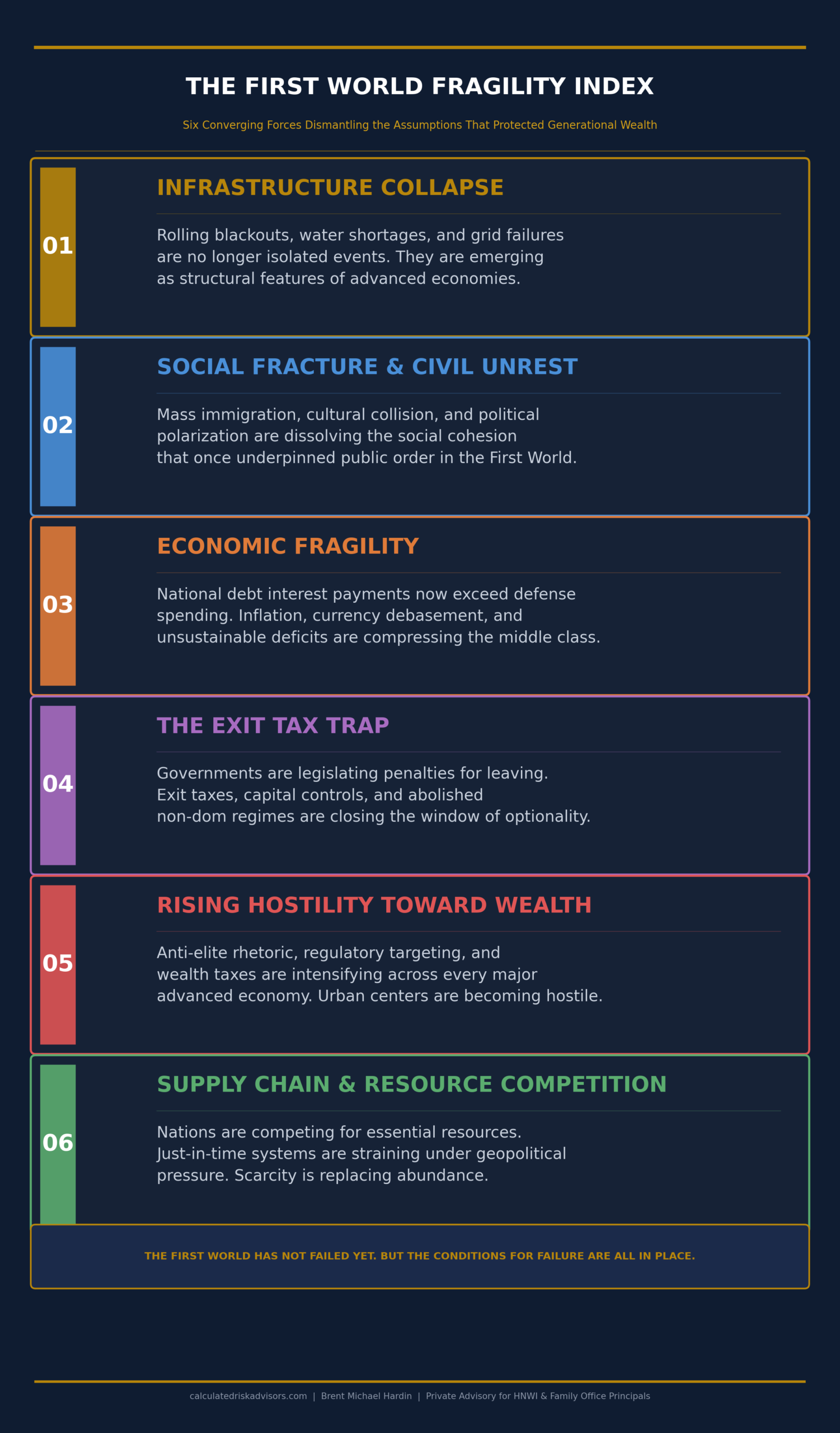
The First World Fragility Index | calculatedriskadvisors.com
The Cracking Foundation of First World Stability
The First World has always been the bastion of stability, characterized by reliable public services, functioning utilities, effective courts, prestigious institutions, and safe, thriving neighborhoods. Those pillars are cracking. Systemic failures within institutions are now visible in rolling blackouts in California, water shortages in Arizona, and surging urban crime from San Francisco to Chicago, from Detroit to Washington, D.C., and in nearly every major American metropolitan city.
I have personally witnessed roving gangs of 100 to 200 young men in Miami riding four-wheelers and dirt bikes, menacing the city while police stood idle. These same groups have shut down Interstate 95, one of the most critical transportation arteries in the southeastern United States, bringing traffic to a complete standstill while law enforcement declined to intervene. Chicago is seeing open-air robberies and gunfights in the streets, where gun violence and homicide remain persistent features of daily life. These are not isolated events. They reflect systemic failures in infrastructure, governance, and social cohesion that should make high-net-worth individuals feel vulnerable and compel them to consider resilience strategies now, before those strategies become unavailable.
For high-net-worth individuals, this means exposure to risks once unthinkable in advanced economies. Prime neighborhoods are not immune to power outages. Private security budgets are climbing as law enforcement is stretched thin. Supply chains are growing increasingly strained as nations compete to secure essential resources, and what was once reliably abundant is becoming a contested commodity.
Importing Instability: The Cultural and Social Fracture
At the same time, we are witnessing the First World importing instability through mass immigration across both America and Europe. The result is a clash of civilizations that fuels political polarization, cultural disruption, and fragmentation. Communities that once projected order and confidence are fracturing as differing belief systems and ethnic backgrounds collide, bringing incompatible values, customs, and expectations into societies built on shared norms.
This ideological and cultural clash erodes the social cohesion that underpins public order. Once-unified neighborhoods are becoming zones of tension where trust between groups dissolves and parallel societies begin to form. Protests, riots, and ideological clashes are no longer occasional events. They are spreading across nearly every developed nation. Based on current trajectory, 2026 is shaping up to be a year of widespread civil unrest across many global nations, including the United States. Many governments are operating at unsustainable deficits, and the promises of a social safety net can no longer be kept. Layer onto this an escalating array of regional conflicts and geopolitical pressures moving toward broader confrontation among major powers, and the picture becomes deeply concerning for any family with significant assets in a single jurisdiction.
The Economic Fragility Beneath the Surface
Why does this matter to wealth holders? Public hostility toward affluence is intensifying, driven by tax hikes, regulatory targeting, and anti-elite rhetoric that frames wealth as a threat rather than an accomplishment to be respected. The very urban centers that once offered opportunity now feel increasingly hostile toward those who built and preserved wealth.
Beneath this social tension lies another risk: the fragility of First World economies themselves. The 2008 financial crisis proved that advanced markets are not immune to collapse. In 2020, the pandemic exposed the vulnerability of supply chains. Today, inflation, currency debasement, and ballooning national debts are revealing that governments have been borrowing against the future at levels that cannot be sustained, and the middle class is being crushed by the consequences.
The numbers confirm what many already sense. According to the Congressional Budget Office, interest payments on the U.S. national debt reached approximately $1 trillion in 2025, surpassing the entire defense budget for the first time in modern history (Congressional Budget Office, 2025). Every dollar spent servicing debt is a dollar unavailable for the public services, infrastructure, and institutions that underpin the stability wealthy families once took for granted.
The much-discussed promise of artificial intelligence as an economic savior remains speculative. Its enormous energy demands are already straining power grids, and its productivity gains are concentrated in a small number of sectors, leaving many families to question whether it will truly offset deepening structural weaknesses or simply widen inequality without resolving the core instabilities.
The Exit Tax Trap: When Governments Lock the Door
This is the priority risk most high-net-worth families are not accounting for. Geographic diversification and jurisdictional optionality are the correct strategies for the environment described above. But there is a closing window, and it is closing faster than most families recognize.
As wealth migration has accelerated, governments across the developed world have responded not by improving conditions but by legislating penalties for leaving. Germany, Norway, and Belgium are actively redesigning exit taxes specifically to prevent wealthy residents from departing with their assets (Bloomberg, 2025). The United Kingdom abolished its non-domicile tax regime in 2025, eliminating one of the last remaining legal shelters for international wealth held by UK residents. The EU has commissioned formal studies on expanding wealth taxes, including net wealth levies, capital taxes, and exit taxes, across member states.
The pattern is unmistakable. Governments facing unsustainable deficits and political pressure to redistribute wealth are using the legal apparatus to trap capital inside their borders. What begins as a policy discussion becomes legislation. What becomes legislation becomes enforcement. A family that waits until the social deterioration described above becomes personally undeniable will also discover that the legal tools needed to execute a diversification strategy have already been compromised or closed.
“A family that waits too long will not only face a deteriorating environment. It will face a legislated penalty for attempting to leave it.”
The time to establish jurisdictional optionality, second residency, and autonomous infrastructure is before it is politically inconvenient for governments to allow it. The families who act now are not reacting to a crisis. They are making a decision. That distinction will matter enormously over the next five years.
What the First World Can Learn from the Third
Paradoxically, the First World can learn from the Third. Where governments have historically failed, the wealthy survived by building redundancy: backup power, private water systems, satellite communications, and fortified estates. They did not rely on the state. They depended on themselves. That mindset, long dismissed as extreme in the context of advanced economies, is now the most rational framework available to high-net-worth individuals in New York, Miami, London, or Zurich.
Wealth must now be paired with resilience, with estates designed to function independently of the public grid, portfolios positioned to hedge currency risk across multiple jurisdictions, and families equipped with relocation plans that ensure operational continuity when systems fail. These are not indulgences or exercises in paranoia. They are the structural requirements of wealth preservation in an era of accelerating instability.
What the Wisest Are Already Doing
The wisest wealthy are already acting. They are building parallel lives: mountain retreats in Wyoming, fortified villas in Europe’s countryside, island estates with independent power and water. They are acquiring second and third citizenships not as tax strategies but as genuine optionality. They are moving assets across multiple legal jurisdictions before legislative windows close. And they are doing it quietly, deliberately, and on their own terms.
These moves align with data. According to the Henley Private Wealth Migration Report 2025, a record 142,000 millionaires relocated internationally in 2025 alone, with projections climbing to 165,000 by 2026 (Steffen, 2025). The great wealth migration is not theoretical. It is already underway, and those who execute early do so with the broadest range of options available to them.
For family offices in particular, the mandate is clear and urgent. Legacy planning can no longer be limited to asset allocation, trust structures, and succession timelines. The environment those plans were designed to navigate has fundamentally changed, and the plans themselves must change with it. Forward-thinking family offices are now integrating autonomous compound development as a core component of multi-generational legacy strategy. A properly designed autonomous rural estate, engineered for energy independence, food security, water self-sufficiency, and communications resilience, is not a lifestyle asset. It is an operational continuity platform. It ensures that regardless of what the surrounding systems do, the family retains the ability to function, protect its members, and preserve what has been built across generations. For family offices serious about the decades ahead, this is no longer an optional consideration. It is a foundational one.
The days of assuming the First World will always protect wealth and lifestyle are over. The same conditions once attributed to developing nations, including political instability, unreliable services, rising crime, and economic fragility, are becoming embedded features of advanced societies. For high-net-worth individuals, the path forward is clear: comfort must be paired with resilience, lifestyle with redundancy, and wealth with foresight.
“The Third World has come to the First. The question is no longer whether it will affect you, but whether you are prepared when it does.”
About the Author
Brent Michael Hardin is the founder of Calculated Risk Advisors, a private advisory firm serving ultra-high-net-worth individuals and multi-generational family offices. CRA specializes in sovereign estate development, jurisdictional intelligence, and strategic relocation advisory for families navigating an era of accelerating geopolitical, financial, and technological change. Engagements are by private introduction only.
Limited Availability
Calculated Risk Advisors accepts a limited number of new families each quarter. Each engagement is tailored, confidential, and managed directly by our principals. There is no public intake. All relationships begin by private introduction.
A Note on This Publication
The observations, analysis, and commentary published on this site are produced for general informational and educational purposes only. They represent the research and independent perspective of the author and do not constitute financial, investment, legal, tax, real estate, or any other form of professional advice.
Nothing published here represents a solicitation, recommendation, or offer to acquire or dispose of any security, asset, property, or service. Access to this content does not establish an advisory, fiduciary, or client relationship of any kind between the reader and Calculated Risk Advisors LLC or any of its affiliated entities.
The decisions explored on this site — jurisdictional positioning, estate design, infrastructure strategy, and multi-generational wealth planning — are among the most consequential a family can make. They require qualified legal counsel, licensed tax professionals, credentialed financial advisors, and specialist practitioners who have direct knowledge of your specific circumstances, objectives, and risk profile. No publication, regardless of its depth or specificity, is a substitute for that counsel.
Calculated Risk Advisors LLC and its affiliates expressly disclaim responsibility for any decision made, action taken, or action not taken in reliance on content published here.
If you are seriously evaluating any of the strategies, jurisdictions, or approaches discussed in this publication, engage qualified independent advisors before proceeding. If you would like to explore whether a private advisory relationship with Calculated Risk Advisors is appropriate for your situation, you are welcome to request an introduction.
“The intelligence that protects generational wealth doesn’t make headlines; it circulates quietly among those who know where to look. Subscribe to the Calculated Risk Advisors Daily Brief. No noise. No mass-market advice. Just the signal.”
References
Bloomberg. (2025, June 24). Germany, Norway and Belgium rethink exit taxes to stem wealth exodus. Bloomberg. https://www.bloomberg.com/news/articles/2025-06-24/germany-norway-and-belgium-rethink-exit-taxes-to-stem-wealth-exodus
Congressional Budget Office. (2025). The budget and economic outlook: 2025 to 2035. https://www.cbo.gov/publication/61172
Steffen, J. (2025). The great wealth flight: Millionaires relocate in record numbers. In Henley Private Wealth Migration Report 2025. Henley & Partners. https://www.henleyglobal.com/publications/henley-private-wealth-migration-report-2025/great-wealth-flight-millionaires-relocate-record-numbers
© 2026 Calculated Risk Advisors. All rights reserved. This content is provided for informational purposes only and does not constitute legal, financial, or investment advice.


0 Comments