


Recently, I was standing on the balcony of a friend’s high-rise overlooking Miami, Florida, and it struck me how easy it is to believe the city is unshakable. The skyline glows with lights, markets remain stocked, and the steady flow of people never seems to slow. Airliners from around the world land one after another at Fort Lauderdale International Airport with precise regularity. Yet behind that appearance of permanence lies a fragile reality. From Miami to Palm Beach, every city depends on stretched-thin systems. Power grids already strain under demand, supply chains can unravel in days, and public security depends on maintaining order in an increasingly unstable world. A single disruption, whether a war abroad, a cyberattack, civil unrest, or a climate-driven disaster, could transform comfort into scarcity. When millions compete for the same resources during black swan events, the city shifts from an engine of opportunity into a dangerous liability.
“I went to the woods because I wished to live deliberately, to front only the essential facts of life, and see if I could not learn what it had to teach, and not, when I came to die, discover that I had not lived.”
Henry David Thoreau, Walden (1854)
The Evidence Is Plain: What the Coastal Model Cannot Survive
South Florida’s vulnerabilities are documented, measurable, and accelerating. NOAA’s coastal resilience data for Southeast Florida confirms that by 2040, sea levels are projected to be 10 to 17 inches higher than 2000 levels, with gravity-flow drainage infrastructure already failing under current conditions. Salt water intrusion is affecting groundwater supplies across Miami-Dade and Broward counties. During the 2023 flooding events in Fort Lauderdale, over 25 inches of rain fell in a single day, shutting down the international airport, flooding highways, and demonstrating in real time how a single weather event can paralyze one of the wealthiest metro areas in the country (NOAA Digital Coast, 2024).
Blackouts leave families in the dark for hours. During disruptions, supermarket shelves can empty in less than 48 hours. Fuel shortages and price shocks ripple across every sector. Unlike rural areas, urban centers amplify risk: dense populations compete for limited resources, conflicts escalate quickly, and exposure to crime increases. Wealth may offer temporary solutions, but when everyone is chasing the same scarce essentials, wealth alone is not enough.
The Strategic Military Exposure Nobody Is Discussing
There is a dimension of South Florida risk that rarely surfaces in real estate conversations but belongs in every serious security analysis for families of means. U.S. Southern Command, known as SOUTHCOM, is the unified combatant command responsible for all U.S. military operations and intelligence activity across Latin America and the Caribbean. Its headquarters is located in Doral, Florida, a suburb within the Greater Miami metropolitan area. In any major peer-adversary conflict involving Russia or China, SOUTHCOM would be an immediate, high-priority military target. Families residing within the Greater Miami metro are, by proximity, within the target radius of one of America’s six primary military command centers.
The strategic exposure is compounded by hypersonic missile technology. Both Russia and China have fielded operational hypersonic weapons capable of traveling at Mach 5 or faster, specifically designed to defeat existing U.S. missile defense architecture. Current Patriot and THAAD systems are not engineered to intercept hypersonic glide vehicles. The U.S. Army War College and independent defense analysts have documented this gap explicitly. A hypersonic strike on a U.S. mainland military headquarters would arrive with minimal warning and zero reliable intercept capability under current defensive posture. PortMiami, one of the largest cargo and cruise ports in the hemisphere and a critical military logistics node, adds further strategic significance to the target profile.
Russia’s demographic position adds urgency to this assessment. Analysis from Russia Matters, published by Harvard Kennedy School, confirms that Russia’s military-age male population aged 20 to 34 is projected to decline approximately 20 percent through the 2020s. This creates what defense analysts describe as a “use it or lose it” strategic window: Russia has greater incentive to leverage its current military capacity before its demographic position weakens further in the 2030s. The 2025 to 2030 period represents the closing edge of that window, not its opening. For families whose primary residence or significant asset concentration sits within the greater Miami metro area, this is not a hypothetical scenario. It is a documented strategic reality that belongs in the same risk matrix as sea level rise and supply chain fragility.
Four Regions Compared: What Each Offers and What Each Demands
Not all mountain locations are equal. The decision to establish a private resilience estate outside an urban center requires comparing strategic factors across regions: climate stability, water security, grid independence potential, access to major cities, land cost, and long-term geopolitical position. Three western states dominate serious discussion among families making this move. The financial case begins with one comparison: prime Wyoming ranch land averages $1,100 to $1,920 per acre. Prime Miami waterfront transacted at approximately $57 million per acre in 2025 when 1.84 acres at Indian Creek Village sold for $105 million. The same capital that buys one waterfront lot in Miami purchases a working ranch of several thousand acres in Wyoming. The ranch generates food, water, and energy independence. The lot generates ongoing coastal exposure.
Wyoming: Bighorn Basin
In Wyoming’s Bighorn Basin, families have turned vast ranches into self-reliant estates with solar arrays that power entire compounds through winters. The water table is excellent, land costs are among the lowest in the country, and there is effectively no density pressure. The significant tradeoff is remoteness: access to major commercial centers, medical facilities, and aviation infrastructure requires real planning. Wyoming is ideal for families whose primary need is maximum independence and who accept that daily urban convenience is not part of the model. Winters are severe and require well-designed heating systems.
Montana: Bitterroot Valley
Montana’s Bitterroot Valley offers valleys where regenerative grazing sustains livestock year-round without external feed, and water quality and availability are among the best in North America. Like Wyoming, it delivers exceptional independence, affordable land, and stable governance. The constraints are similar: significant remoteness, harsh winters, and limited medical and commercial infrastructure that requires families to plan for air access. Montana additionally faces increasing wildfire risk in certain corridors that must be evaluated at the site level.
Idaho: The Panhandle
Idaho’s Wood River Valley and northern Panhandle have attracted some of the most significant private capital in the country. Sun Valley and surrounding Blaine County draw UHNWI families who value the combination of mountain access, four-season climate, and a private community that develops when serious people choose the same geography. Coeur d’Alene and Sandpoint in northern Idaho offer lakeside estate options with outstanding water, year-round agricultural production capability, and access to Spokane as a regional aviation and medical hub. Idaho’s governance framework, tax structure, and land cost make it among the most favorable estate jurisdictions in the continental United States.
Jackson Hole, Sun Valley, and the Bitterroot Corridor: Where the Smartest Money Already Is
Teton County, Wyoming has held the distinction of the wealthiest county in the United States by per capita income for more than twenty consecutive years. In 2024, that figure reached $532,903, more than six times the national average, with a median household income of $1.3 million and the top one percent earning an average of $16 million annually. Jackson Hole is not an aspirational destination for the wealthy. It is where they already are, and where they have been quietly positioning their most consequential physical assets for decades (Cowboy State Daily, 2024).
Sun Valley, Idaho functions as the American West equivalent of Davos. Since 1983, Allen and Company has hosted what observers describe as more impactful than the World Economic Forum at its annual gathering in the Wood River Valley. Jeff Bezos, Bill Gates, Warren Buffett, Mark Zuckerberg, and Sam Altman attend regularly. The deals made there, including the Washington Post acquisition and the seed for the Disney-ABC transaction, demonstrate that the people who shape global capital chose this corridor as their gathering place. They have also chosen it as their physical anchor. Many own ranch land within range of the conference grounds (Allen & Company, 2025).
Montana’s Bitterroot Valley, Flathead Lake, and the Big Sky corridor have attracted serious private capital in parallel. Average home prices at Big Sky reached $4.05 million in 2024. The Yellowstone Club draws technology founders, CEOs, and media executives who require the combination of access, privacy, and productive land that no coastal market can provide. Hall and Hall documented 110 ranch transactions totaling more than 215,000 Montana acres sold in 2024 alone, including ranches priced between $14 million and $28 million. The working ranch and private estate model is not a future possibility in this corridor. It is operating infrastructure for some of the most capable families in the world.
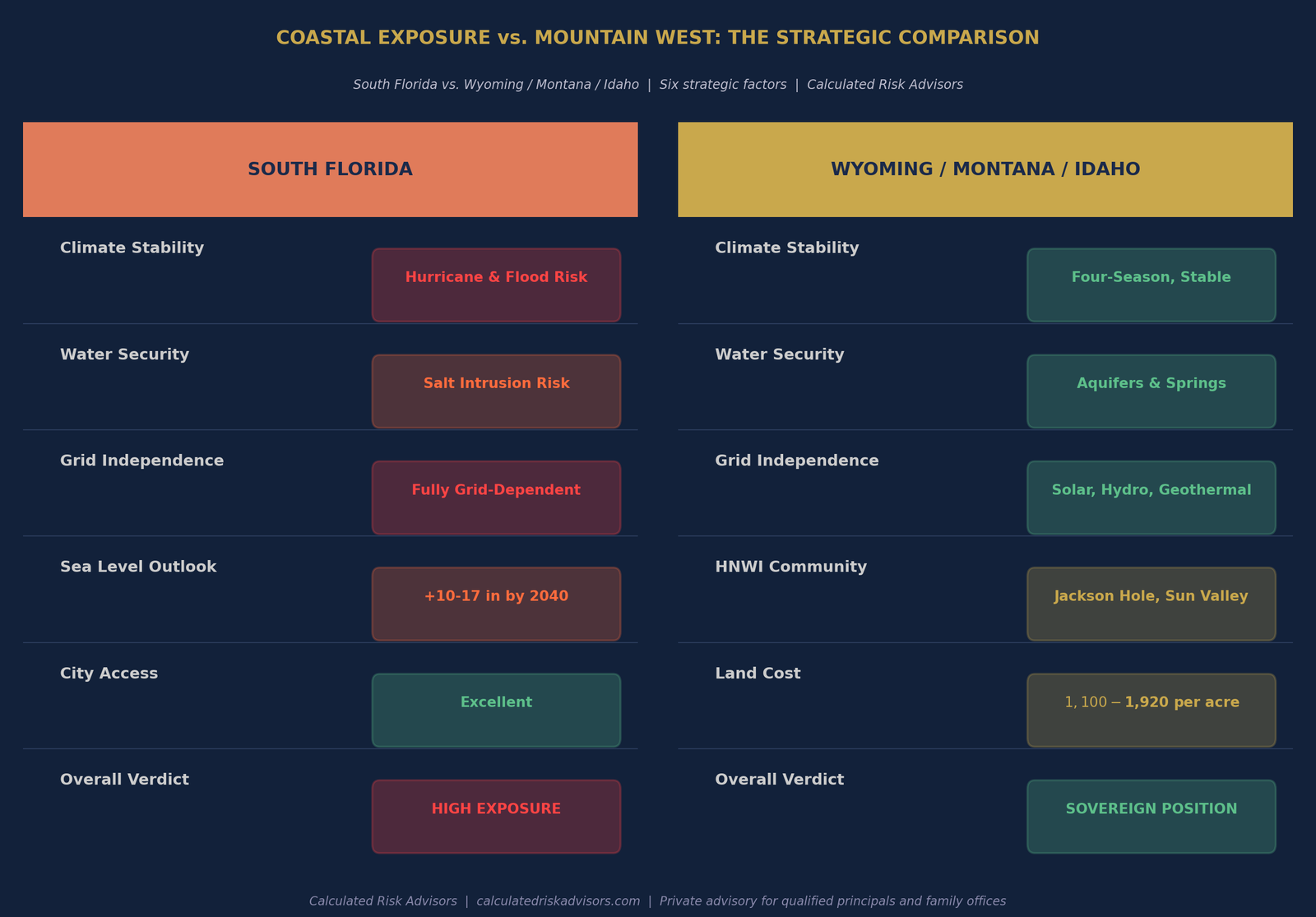
Figure 1. Regional Resilience Comparison: Five Regions Evaluated Across Six Strategic Factors | Calculated Risk Advisors
What a Private Resilience Estate Actually Looks Like
This is not a theory. Platforms are already operating in Wyoming, Montana, Idaho, and the Appalachian foothills, proving to be the model solution to instability. A well-designed mountain property integrates food production through greenhouses and gardens, ranching for meat and dairy, and orchards for a long-term supply. Independent water systems, including wells, springs, storage tanks, and purification facilities, reduce reliance on municipal utilities. Solar, hydro, or wind energy backed by battery storage keeps power running regardless of commercial grid conditions. A kitchen garden immediately outside the home provides fresh herbs, salad greens, and seasonal vegetables. A food forest planted in dense productive layers looks to the outside observer like natural woodland while producing abundant calories year-round.
Families with horses have both recreation and an alternative means of transport if fuel becomes unavailable. Land is not ornamental; it becomes productive, sustaining households throughout the year. A mountain property designed with resilience in mind is less vulnerable to shortages, inflation, and disruption. It is an operating system for survival, continuity, and a quality of life that urban environments cannot replicate.
“The first wealth is health. Sickness is poor-spirited and cannot serve anyone; it cannot sing, nor labor, nor think.”
Ralph Waldo Emerson, Conduct of Life (1860)
The Health Case: A Measurable Advantage Cities Cannot Provide
Health is another factor too often overlooked in estate planning. Cities bring constant stress in the form of noise, congestion, crime, and persistent surveillance. Over time, those pressures erode health: higher blood pressure, weaker immunity, and chronic anxiety. In contrast, living on land resets the system. Physical work, such as gardening, caring for animals, and maintaining property, keeps the body active and purposeful. Clean food reduces exposure to processed and chemical-heavy products commonly found in urban grocery supply chains. Daily contact with nature lowers stress hormones and improves long-term mental health outcomes. Interaction with animals, especially horses, carries proven therapeutic benefits that no city environment can replicate. These are not abstract lifestyle preferences; they are measurable physiological advantages that compound over years and decades.
“Antifragility is beyond resilience or robustness. The resilient resists shocks and stays the same; the antifragile gets better.”
Nassim Nicholas Taleb, Antifragile: Things That Gain from Disorder (Random House, 2012)
Current Conditions: Why Resilience Is No Longer Optional
Geopolitical instability threatens energy flows and supply chains simultaneously. Trade disruptions affect food availability and pricing faster than any individual household can respond. Climate volatility makes agricultural output in low-elevation coastal regions increasingly unpredictable. Civil unrest continues to surface in significant cities around the globe and domestically, with a divided country under increasing structural stress. IRS migration data confirms the directional shift: while Florida still records net domestic in-migration, the rate fell by more than half from its 2022 peak, and approximately 40,000 people moved from Florida to North Carolina alone in 2023, with Tennessee, Alabama, and South Carolina absorbing additional outflow as families seek higher ground, lower cost, and greater long-term stability (IRS Statistics of Income, 2024).
In each of these scenarios, urban residents remain exposed, while those with prepared private estates outside cities can continue their lives with little disruption. That is not an abstraction. It is the documented experience of every family that made this move before the event rather than after it.
The Long-Term Advantage
The long-term advantages extend well beyond crisis protection. A mountain estate offers a healthier environment for children, the teaching of practical skills and values that urban settings rarely provide, and a relationship with the land that builds resilience as a family characteristic rather than a one-time purchase. Families gain direct control over their resources rather than being dependent on fragile supply systems. Even if no crisis ever arrives, the quality of life is superior: clean air, space, autonomy, and long-term security away from the concentrated pressures of urban density. That is a return on investment that cannot be priced by a market.
“The long-term preservation of family wealth requires growth across all five capitals: human, intellectual, social, legacy, and financial. Financial capital is merely the means. Human flourishing is the end.”
Paraphrasing the central framework of James E. Hughes Jr., Family Wealth: Keeping It in the Family (Bloomberg Press, 2004)
What Resilience Actually Requires
Not every property qualifies. Buying land and putting up a house is not enough. To be truly resilient, the estate must be designed as a system. Energy must be redundant and independent. Water must be secured, stored, and protected. Food production must be tailored to the local climate and soil conditions. Security must be discreet but effective. And all of it must be integrated without compromising comfort or aesthetics. That requires planning, expertise, and the ability to bring together agricultural science, engineering, and architecture into a coherent design that operates as a single living system.
The Conclusion
The city offers wealth and access, but no resilience. The mountains provide continuity, security, and autonomy. The most strategic position today is to hold both: maintain presence in the city while securing a private estate in the mountains built for independence. This is not a retreat from modern life. It is a safeguard against its manufactured failures. And among all the mountain corridors available to families of means in the United States, the Appalachian foothills offer the most balanced combination of independence and access that the current landscape can provide.
For those ready to act, the next step is clear. Work with a consultant who can evaluate risks, design systems, and create a property that stands as more than a residence. With the right expertise, an estate becomes a legacy asset, capable of supporting a family through both stable times and crisis, protecting not only wealth but life itself.
What Calculated Risk Advisors Delivers
Calculated Risk Advisors specializes in designing private resilience estates and family compounds across the Mountain West corridor, including Wyoming, Montana, and Idaho, as well as international jurisdictions including Switzerland, New Zealand, Panama, and select Central American territories. Our work spans the full range from Teton County and the Big Sky region to the Bitterroot Valley and the northern Idaho lake country. Each engagement delivers a comprehensive site assessment covering water sourcing, energy independence design, food production planning, access and security architecture, and long-term jurisdictional stability.
Confidential consultations are available exclusively for qualified principals and family offices, by private introduction.
About the Author
Brent Michael Hardin is the founder of Calculated Risk Advisors, a private advisory firm serving ultra-high-net-worth individuals and multi-generational family offices. CRA specializes in sovereign estate development, jurisdictional intelligence, and strategic relocation advisory for families navigating an era of accelerating geopolitical, financial, and technological change. Engagements are by private introduction only.
Limited Availability
Calculated Risk Advisors accepts a limited number of new families each quarter. Each engagement is tailored, confidential, and managed directly by our principals. There is no public intake. All relationships begin by private introduction.
A Note on This Publication
The observations, analysis, and commentary published on this site are produced for general informational and educational purposes only. They represent the research and independent perspective of the author and do not constitute financial, investment, legal, tax, real estate, or any other form of professional advice.
Nothing published here represents a solicitation, recommendation, or offer to acquire or dispose of any security, asset, property, or service. Access to this content does not establish an advisory, fiduciary, or client relationship of any kind between the reader and Calculated Risk Advisors LLC or any of its affiliated entities.
The decisions explored on this site — jurisdictional positioning, estate design, infrastructure strategy, and multi-generational wealth planning — are among the most consequential a family can make. They require qualified legal counsel, licensed tax professionals, credentialed financial advisors, and specialist practitioners who have direct knowledge of your specific circumstances, objectives, and risk profile. No publication, regardless of its depth or specificity, is a substitute for that counsel.
Calculated Risk Advisors LLC and its affiliates expressly disclaim responsibility for any decision made, action taken, or action not taken in reliance on content published here.
If you are seriously evaluating any of the strategies, jurisdictions, or approaches discussed in this publication, engage qualified independent advisors before proceeding. If you would like to explore whether a private advisory relationship with Calculated Risk Advisors is appropriate for your situation, you are welcome to request an introduction.
“The intelligence that protects generational wealth doesn’t make headlines; it circulates quietly among those who know where to look. Subscribe to the Calculated Risk Advisors Daily Brief. No noise. No mass-market advice. Just the signal.”
References
Allen & Company. (2025). Sun Valley conference. Allen & Company LLC. [Annual gathering, Wood River Valley, Sun Valley, Idaho]
Cowboy State Daily. (2024, December 3). Teton County still richest in the nation; wealth hits new high. Cowboy State Daily. https://cowboystatedaily.com/2024/12/03/teton-county-still-richest-in-the-nation-wealth-hits-new-high/
Emerson, R. W. (1860). Conduct of life. Ticknor and Fields.
Hughes, J. E., Jr. (2004). Family wealth: Keeping it in the family. Bloomberg Press.
NOAA Digital Coast. (2024). Understanding vulnerability to sea level rise in Southeast Florida. National Oceanic and Atmospheric Administration. https://coast.noaa.gov/digitalcoast/stories/slr.html
Taleb, N. N. (2012). Antifragile: Things that gain from disorder. Random House.
Thoreau, H. D. (1854). Walden; or, life in the woods. Ticknor and Fields.
Internal Revenue Service. (2024). Statistics of income: State-to-state migration data. IRS SOI Tax Stats. https://www.irs.gov/statistics/soi-tax-stats-migration-data
Russia Matters, Harvard Kennedy School. (2023). The Russian military is facing a looming demography crisis. Russia Matters. https://www.russiamatters.org/analysis/russian-military-facing-looming-demography-crisis
U.S. Army War College. (2025). From hypersonics to alliances: Russia’s emerging threats to U.S. and NATO security. War Room. https://warroom.armywarcollege.edu/articles/hypersonics-and-alliances/
U.S. Department of Defense. (2026). U.S. Southern Command. SOUTHCOM official website. https://www.southcom.mil
© 2026 Calculated Risk Advisors. All rights reserved. This content is provided for informational purposes only and does not constitute legal, financial, or investment advice.



0 Comments