


Most people spend their lives building success inside systems they did not create. The individuals who preserve freedom across generations build their own systems, and the distinction between those two approaches is the single greatest predictor of whether wealth survives beyond the generation that created it.
The assumption that external systems will continue to serve private interests is not a new error. It is a persistent one, and it is more dangerous today than at any point in recent history because the systems most wealthy families depend on are under simultaneous, compounding pressure that no individual’s financial architecture was designed to absorb.
The Dangerous Lie Successful People Still Believe
Many accomplished people quietly carry an assumption they have never examined directly. Markets will stabilize. Institutions will maintain order. The rules will remain predictable enough to protect what they have built. It is a reasonable assumption in calm periods. History shows something different.
Governments preserve institutional stability, not personal prosperity. Corporations pursue returns for shareholders, not clients. Institutions protect their own continuity, not yours. Security, freedom, and long-term prosperity ultimately belong to individuals who build their own systems, and the people best positioned to do that are those who already possess the resources, networks, and capital to act. The greatest risk is not a market crash or a geopolitical crisis. It is the assumption that the systems which created your success will also protect it.
Today, that assumption is being tested on every front simultaneously. Geopolitical tensions across the Middle East, destabilization across parts of South America, strategic realignments throughout Europe, and deepening political polarization within the United States are contributing to an environment in which long-term stability can no longer be assumed as a baseline condition. U.S. sovereign debt now stands at $39.2 trillion, growing at approximately $6 billion per day, raising serious questions about long-term fiscal sustainability, currency stability, and the purchasing power of capital held in dollar-denominated instruments (U.S. Senate Joint Economic Committee, 2025).
History shows that when fiscal pressures intensify, governments respond through monetary expansion, currency debasement, or policies that quietly transfer economic strain onto the broader public. In extreme circumstances, this produces prolonged inflationary cycles and the erosion of real asset values. For individuals who have spent decades building wealth, these dynamics reinforce a critical point: the systems designed to maintain macroeconomic stability are not designed to preserve your individual wealth, your mobility, or your independence.
The Myth of Institutional Security
Success frequently creates the illusion of permanence. Many people believe wealth, professional standing, or institutional relationships naturally produce security. In reality, those advantages depend on the very systems people assume will remain stable, and stability is the one thing no institution can guarantee.
Policies shift. Industries transform. Markets reprice risk without warning, and entire business models disappear inside a single economic cycle. The individuals who endure these cycles are not the ones who trusted the environment to remain favorable. They are the ones who prepared for the possibility that it would not.
The Capgemini World Wealth Report 2025 put a number on this reality: 81% of next-generation HNWIs plan to switch away from their parents’ wealth management firm after inheriting, and 56% of relationship managers report that their firms lack the tools to serve next-generation needs (Capgemini, 2025). That is not a client retention problem. It is evidence that the structures wealthy families have built around their wealth are not designed for the generation that will inherit it. Security is not a static condition that wealth provides automatically. It is something that must be intentionally constructed, continuously maintained, and structurally independent of the systems it is designed to outlast.
Wealth Is Only the Starting Point
Possessing capital is not the same as possessing control. True resilience comes from how individuals structure the systems that support their lives and their families, and the distinction between those two things becomes decisive when external conditions deteriorate.
Ownership matters in a specific and often overlooked sense. Direct ownership of physical assets, ownership of intellectual capital, and ownership of relationships and networks that create opportunity independently of economic conditions. The individuals who maintain influence across decades understand that wealth alone is not the objective. What matters is how the structures surrounding that wealth are designed, because security is not inherited with wealth. It must be architected alongside it.
This is the difference between prosperity that lasts a moment and resilience that extends across generations. Capital without sovereignty is a position that depends on the continued goodwill of systems you did not build and cannot direct.
Agency as the Ultimate Advantage
There is one principle that consistently separates enduring builders from passive beneficiaries of favorable conditions, and it is not capital, timing, or access. It is agency, the willingness to accept responsibility for outcomes rather than waiting for external forces to shape them, the belief that the future is something you influence rather than something you experience.
Agency transforms resources into a force multiplier. Without it, even substantial wealth drifts toward complacency. With it, relatively modest advantages compound into extraordinary results over time, because every decision builds toward a position of greater independence rather than deeper dependency. Those who operate with genuine agency do not simply respond to change. They position themselves before it arrives, which is precisely the posture that defines every multi-generational family of consequence in history.
“The people who shape the conditions of the future are not the ones with the most resources. They are the ones willing to use their resources to build systems that do not require anyone else’s permission to function.”
Freedom Is a Designed System, Not a Condition of Wealth
Freedom is often discussed as though it arrives with financial success, as though a certain level of wealth automatically produces independence. At the individual level, freedom is structural. It depends on how much control you maintain over the key inputs to your life: time, decision-making authority, geographic mobility, and the network of people you trust and collaborate with.
When those elements depend heavily on a single institution, a single employer, a single regulatory framework, or a single country, freedom becomes fragile regardless of how much capital surrounds it. When they are diversified and intentionally structured, freedom becomes durable regardless of what any single system does.
This is why resilient individuals and families prioritize ownership and optionality, building enterprises rather than relying solely on careers, cultivating networks that transcend industries and geographies, and designing their physical environments to expand long-term independence. For a growing number of families and investors, this philosophy has extended deliberately into the physical world through the creation of autonomous rural platforms and multi-generational family compounds, environments intentionally designed to provide resilience, independence, and continuity by controlling the key systems of daily life, including water, energy, food production, communications, and security infrastructure.
The Henley & Partners Private Wealth Migration Report 2025 recorded 142,000 high-net-worth individuals relocating internationally in 2025, a new record, with projections for 2026 pointing to as many as 165,000, which would be the largest movement of private wealth in recorded history (Henley & Partners, 2026). Political risk and personal security now rank alongside tax considerations as the primary drivers. The pattern is not anecdotal. It is structural, and the families who act on it early are not reacting to crisis. They are building ahead of it.
What Most Families of Means Are Still Getting Wrong
The most significant threats to multi-generational wealth preservation are rarely the ones that dominate financial media. Three patterns in particular account for the majority of legacy erosion among families of significant means, and none of them receive adequate attention in conventional wealth management conversations.
The Jurisdiction Trap
Most high-net-worth families believe they have diversified because they hold assets across multiple markets and geographies. What they have not diversified, in most cases, is their legal domicile, their operating businesses, their primary residence, and their family’s physical presence, all of which remain anchored to a single jurisdiction. A single policy change, tax reform, or regulatory shift in that one country can restructure everything simultaneously, and the window between announcement and enforcement is rarely long enough for reactive planning.
Genuine jurisdictional diversification requires legal domicile in more than one stable country, income streams that are not exclusively dependent on one regulatory framework, and physical infrastructure that can be activated in more than one geography. Families who have not built this before conditions deteriorate will find that the options diminish precisely when they are most needed.
The Knowledge Transfer Failure
The intellectual capital, the relationships, and the specific decision-making instincts that created a family’s wealth are almost never formally documented or deliberately transferred. Each generation inherits the financial output of the previous generation’s thinking, but not the thinking itself, and without that, they are left to rediscover through experience what the founding generation learned through failure. This is one of the primary structural reasons why generational wealth erodes, not because heirs are incompetent, but because they were handed assets without the operating system that generated those assets.
The families who preserve and grow multi-generational wealth treat knowledge transfer as deliberately as they treat estate planning: structured, documented, practiced, and revisited as conditions change. A family compound designed with shared governance, defined roles, and regular collaborative sessions is not just a physical asset. It is the environment in which that knowledge transfer happens organically, across generations, in real time.
The Grid-Dependent Energy Exposure
Families and businesses anchored to grid-dependent infrastructure in high-density urban jurisdictions face systematic, growing cost pressure that most family offices have not yet priced into their long-term planning. U.S. data centers consumed 183 terawatt-hours of electricity in 2024, representing more than four percent of total national power consumption, a figure projected to grow 133 percent by 2030 as AI infrastructure scales at a pace the grid was never designed to absorb. The PJM electricity market alone recorded a $9.3 billion price increase in its 2025-2026 capacity market driven primarily by this demand.
Any business or residence connected to the grid is directly competing with industrial-scale AI computing for the same infrastructure, and the families who assume grid reliability and grid affordability are permanent features of modern life are operating on an assumption the data no longer supports. An autonomous estate with independent energy generation is not an environmental statement. It is a hedge against a cost structure that is already moving against you.
Optionality Is the Real Luxury
Luxury is most commonly associated with visible consumption, and that association has made it easy to miss where the most valuable form of luxury actually lives. Optionality, the ability to make decisions without coercion, the freedom to relocate when environments become hostile, and the capacity to pursue opportunities others cannot afford to consider, is the form of wealth that matters most when conditions change.
Optionality allows individuals and families to move early, to experiment intelligently, and to make long-term decisions with a degree of independence that reactive positioning cannot provide. It insulates against the shocks that inevitably disrupt established systems, because the families who can adapt their environments, relocate if necessary, and operate independently of centralized infrastructure have advantages that are difficult to replicate once instability accelerates.
Optionality does not appear automatically with financial success. It must be deliberately built, and it is built in advance, not in response.
The Danger of Passive Prosperity
Wealth carries an unusual paradox. The same comfort that success provides can slowly reduce urgency, and stability discourages the kind of experimentation and forward positioning that created the wealth in the first place. Over time, this produces a subtle but consequential outcome: individuals with the greatest capacity to shape their environment sometimes become the most reluctant to engage with it, while those with less to lose become the ones who reshape industries and create entirely new conditions.
History repeatedly shows that fortunes built during stable periods erode quickly when their owners assume the environment will remain predictable. Prosperity is not preserved by stability; it is preserved through continued, deliberate engagement with the forces that are shaping what comes next. Most fortunes are not destroyed by catastrophe. They are eroded quietly through complacency, through the assumption that tomorrow will resemble yesterday, and through the belief that success itself provides protection. History rarely rewards that belief.
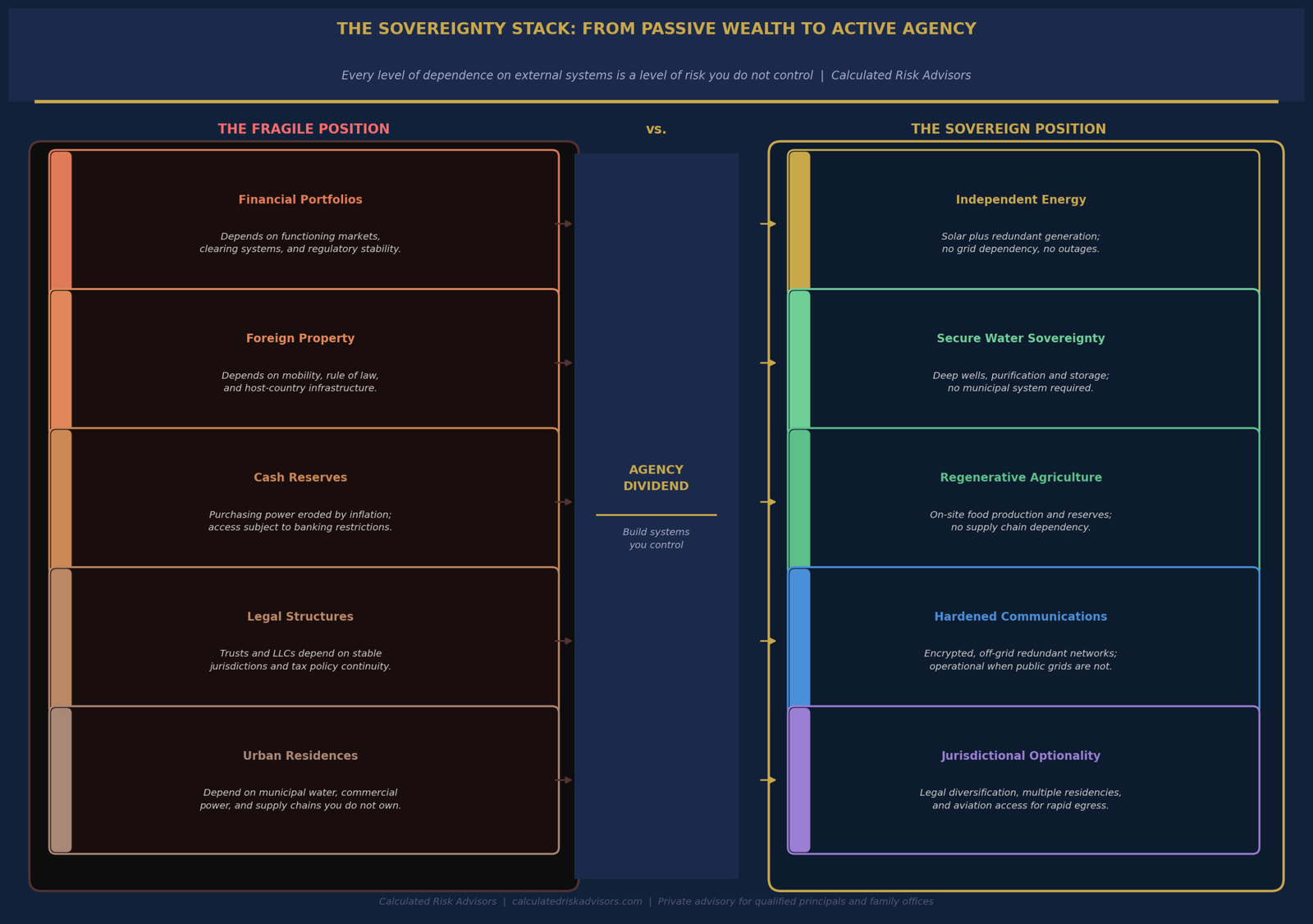
Figure 1. The Sovereignty Stack: From Passive Wealth to Active Agency | Calculated Risk Advisors
Building Personal Sovereignty
When institutional stability cannot be guaranteed, the rational response is not fear. It is construction, the deliberate construction of personal sovereignty across every dimension of your life and your family’s future.
This requires consistent discipline across several dimensions simultaneously. Intellectual capital must evolve continuously, because the knowledge that built today’s wealth is not sufficient to navigate tomorrow’s environment. Trusted networks must span sectors and geographies, because single-jurisdiction relationships are single points of failure. Legal and financial structures must be distributed across stable jurisdictions, because concentrated exposure to one regulatory framework is a concentration risk that most portfolios would reject in any other asset class.
Physical infrastructure plays an increasingly decisive role. Private Resilience Estates and Autonomous Family Compounds designed to integrate resilient water systems, independent energy generation, regenerative food production, and secure communications into a unified physical environment are not luxury retreats. They are operating systems for families who understand that the conditions of the next decade will not resemble the conditions of the last one.
When paired with thoughtful governance structures, clear succession frameworks, and deliberate knowledge transfer between generations, these compounds become powerful anchors of generational stability, operating capability, and continuity. They allow families to maintain independence even during periods when broader economic or infrastructure systems experience strain. These structures do not eliminate risk. They significantly and permanently increase your capacity to navigate it.
The Responsibility of the Wealthy
Those who possess resources and influence have a distinct advantage, and it extends beyond personal security. They have the ability to shape their environment, to build systems that support families, enterprises, and communities even when broader systems become strained, and to demonstrate through action that the future is something you construct rather than something you endure.
That potential only becomes meaningful when it is exercised. Wealth reaches its highest utility when it is used to create systems that strengthen independence, resilience, and opportunity across generations, and the families who act on that understanding are the ones whose names appear in the history books as builders, not as cautionary examples of what happens when capable people assume that circumstances will remain favorable.
Generational legacies are not preserved by staying still. Every dynasty that survived significant periods of disruption intact did so because it moved ahead of the disruption, not in response to it. The families that endured through the financial upheavals of the last century shared one characteristic: they built systems that did not depend on the stability of the systems that were failing around them.
The End of Passive Optimism
The modern world increasingly rewards individuals who understand that stability cannot be assumed and that the future will not be delivered fully formed by policymakers, market forces, or institutional stability. It will be shaped by the people willing to invest their resources, attention, and discipline into building environments that support independence and continuity regardless of what the broader environment does.
This is the agency dividend, the return earned by individuals who choose responsibility over dependence, who build their own systems rather than relying on systems built to serve other interests, and who understand that the most consequential decisions they will ever make are not the ones made under pressure but the ones made in advance.
For those willing to claim it, the rewards extend far beyond financial outcomes. They include autonomy, the ability to operate freely when others cannot, influence that derives from independence rather than affiliation, and the capacity to shape the conditions that future generations inherit rather than simply respond to what they find.
No one else is coming to build the future for your family. The individuals who thrive in the years ahead will be the ones who decided to build it themselves, before the window closed.
“The most consequential decisions rarely occur when certainty is obvious. They occur earlier, when thoughtful individuals recognize emerging change and begin designing the systems that will support their families in the years ahead.”
What Calculated Risk Advisors Delivers
The decision to build a private resilience estate or autonomous family compound is among the most consequential a family of means will ever make. The quality of that decision depends entirely on the depth of analysis that precedes it, and most families discover too late that the assessment they received was either incomplete, optimized for the advisor’s interests, or built around aesthetics rather than function.
Calculated Risk Advisors delivers a comprehensive, independent assessment structured around the specific dimensions that determine whether a sovereign estate performs as intended under real-world conditions. Each engagement is built from the ground up around your family’s objectives, timeline, and definition of continuity. Our work covers the following disciplines in full:
- Jurisdictional Stability: A rigorous analysis of legal frameworks, government structure, historical consistency, treaty relationships, and the demonstrated capacity of each candidate jurisdiction to maintain rule-of-law conditions across political cycles.
- Legal Environment: Assessment of property ownership rights for foreign nationals, trust and entity recognition, estate and succession law, asset protection frameworks, and the regulatory predictability that determines whether structures built today will function as intended for the next generation.
- Infrastructure Independence: Engineering review of the estate’s capacity to operate entirely off public utilities, covering power generation redundancy, water sourcing and purification, waste management, and the systems integration required for continuous operation under all conditions.
- Climate and Resource Considerations: Long-range analysis of regional climate stability, freshwater availability, agricultural carrying capacity, natural disaster exposure, and the resource sustainability that determines whether a location remains viable across the planning horizon.
- Privacy Architecture: Design of the estate’s physical, digital, and legal footprint to minimize discoverability, reduce targeting exposure, and ensure that the family’s presence, movements, and operations remain discreet and protected from both public and institutional visibility.
- Long-Term Geopolitical Position: Threat modeling of the jurisdiction’s alignment with major power blocs, proximity to conflict corridors, diplomatic relationships, and the geopolitical trajectory most likely to define conditions in that region over a ten to thirty year horizon.
- Energy Independence: Full integration of independent power generation, storage, and redundancy systems designed to operate the estate at full capacity indefinitely without any connection to commercial grid infrastructure.
- Food Security: Site planning and agricultural design to support on-site food production through regenerative systems, long-term storable reserves, and deliberate relationships with local producers that function as a reliable supply network when commercial logistics are disrupted.
- Communications Resilience: Implementation of encrypted, redundant communication systems that operate independently of public telecommunications infrastructure, ensuring the family’s ability to coordinate, access information, and maintain external relationships under any conditions.
- Multi-Generational Habitation: Compound design that accommodates the evolving needs of multiple family branches and generations, with scalable living and production zones, shared governance frameworks, and physical environments that strengthen family bonds rather than create points of friction over time.
Each assessment is delivered as a confidential, actionable roadmap tailored to your family’s specific objectives. Engagements are available exclusively for qualified principals and family offices, by private introduction.
About the Author
Brent Michael Hardin is the founder of Calculated Risk Advisors, a private advisory firm serving ultra-high-net-worth individuals and multi-generational family offices. CRA specializes in sovereign estate development, jurisdictional intelligence, and strategic relocation advisory for families navigating an era of accelerating geopolitical, financial, and technological change. Engagements are by private introduction only.
Limited Availability
Calculated Risk Advisors accepts a limited number of new families each quarter. Each engagement is tailored, confidential, and managed directly by our principals. There is no public intake. All relationships begin by private introduction.
A Note on This Publication
The observations, analysis, and commentary published on this site are produced for general informational and educational purposes only. They represent the research and independent perspective of the author and do not constitute financial, investment, legal, tax, real estate, or any other form of professional advice.
Nothing published here represents a solicitation, recommendation, or offer to acquire or dispose of any security, asset, property, or service. Access to this content does not establish an advisory, fiduciary, or client relationship of any kind between the reader and Calculated Risk Advisors LLC or any of its affiliated entities.
The decisions explored on this site — jurisdictional positioning, estate design, infrastructure strategy, and multi-generational wealth planning — are among the most consequential a family can make. They require qualified legal counsel, licensed tax professionals, credentialed financial advisors, and specialist practitioners who have direct knowledge of your specific circumstances, objectives, and risk profile. No publication, regardless of its depth or specificity, is a substitute for that counsel.
Calculated Risk Advisors LLC and its affiliates expressly disclaim responsibility for any decision made, action taken, or action not taken in reliance on content published here.
If you are seriously evaluating any of the strategies, jurisdictions, or approaches discussed in this publication, engage qualified independent advisors before proceeding. If you would like to explore whether a private advisory relationship with Calculated Risk Advisors is appropriate for your situation, you are welcome to request an introduction.
“The intelligence that protects generational wealth doesn’t make headlines; it circulates quietly among those who know where to look. Subscribe to the Calculated Risk Advisors Daily Brief. No noise. No mass-market advice. Just the signal.”
References
Capgemini. (2025). World wealth report 2025. Capgemini Research Institute. https://www.capgemini.com/insights/research-library/world-wealth-report/
Henley & Partners. (2025). Henley private wealth migration report 2025: Global wealth migration 2025. Henley & Partners. https://www.henleyglobal.com/publications/henley-private-wealth-migration-report-2025/global-wealth-migration-2025
Henley & Partners. (2026, January). Global mobility report 2026. Henley & Partners. https://www.henleyglobal.com/publications/global-mobility-report/2026-january
International Energy Agency. (2025). AI is set to drive surging electricity demand from data centres. IEA News. https://www.iea.org/news/ai-is-set-to-drive-surging-electricity-demand-from-data-centres-while-offering-the-potential-to-transform-how-the-energy-sector-works
U.S. Senate Joint Economic Committee. (2025, December). National debt hits $38.40 trillion, increased $2.23 trillion year over year. JEC Republicans. https://www.jec.senate.gov/public/index.cfm/republicans/2025/12/national-debt-hits-38-40-trillion-increased-2-23-trillion-year-over-year-6-12-billion-per-day
© 2026 Calculated Risk Advisors. All rights reserved. This content is provided for informational purposes only and does not constitute legal, financial, or investment advice.

0 Comments