


IF YOU READ NOTHING ELSE IN THIS BRIEF
Martin Armstrong of Armstrong Economics advises a minimum of two years of storable food. Not twelve months. Two years. His geopolitical analysis explains why the timeline is that long.
A household spending $150K per year on food at sustained 6% inflation will spend $2.52 million more over twenty years than it would at flat prices. On-property production eliminates the baseline.
Your net worth cannot buy priority access at a farm that does not know your name. Build these relationships before your region reaches saturation. The window is open now.
Your net worth cannot buy you priority access at a farm that doesn’t know your name.
That single sentence contains the entire argument of this brief. If it landed with any weight at all, you already know where this is going.
The Confidence Gap
Wealth stored as digits in a financial institution is only as durable as the institution, the network it runs on, and the political environment governing it. Central bank digital currencies are already in active pilot across the EU, UK, and BRICS+ nations. A programmable digital currency can be issued with conditions attached to its use, restricted by geography or merchant category, assigned an expiration date, or frozen at the account level by regulatory or geopolitical action without judicial process. A colleague with a ten-figure net worth recently admitted that his single greatest fear is waking up to find the balance on his screen has been revalued by an algorithm he has no access to. That is not paranoia. It is a rational reading of where the financial architecture is going.
Most families at this wealth level have built excellent financial defenses: diversified portfolios, offshore structures, hard asset allocation, precious metals, real estate across multiple jurisdictions. What they have not built is a food position. The assumption is that money solves the food problem. Drive to the store. Order from the restaurant. Have it delivered. That assumption does not survive serious scrutiny when the systems money depends on come under pressure.
Food cannot be frozen, revalued, or remotely deleted. There is no digital wallet for a root cellar. No regulatory framework has ever successfully confiscated a functioning food forest at scale. The family that builds a sovereign food position has a form of wealth that operates entirely outside the systems its other assets depend on. The privacy dimension compounds the case: no loyalty card, no subscription data, no corporate visibility into household consumption. The local food network leaves no digital footprint.
Why the Bunker Mentality Fails
When high-net-worth families encounter serious systemic risk, the first instinct is often isolation. Build the bunker. Stock it alone. Trust no one outside the immediate family. That instinct is understandable and wrong. The families and communities that survive genuine hardship are not the ones who isolated themselves best. They are the ones who maintained functional relationships with other people.
Nassim Nicholas Taleb’s framework from Antifragile is precise on this point. Isolation makes a system brittle. A single point of failure in an isolated household, whether illness, injury, equipment breakdown, or security breach, becomes catastrophic with no network to absorb it. A family embedded in a web of producer relationships has structural redundancy: multiple farms, multiple product categories, multiple human connections, each able to provide what the others cannot in a given moment (Taleb, 2012).
The farmer who knows your family will call you first when he has an extra half cow available. The Mennonite market that recognizes you will prioritize your order when supply tightens. The CSA farmer who has received your check every spring for five years will solve your family’s problem before he solves a stranger’s. The family with genuine abundance — a chest freezer stocked with grass-finished beef, a root cellar built for two years, a food forest producing more than it consumes — can give from that position. That generosity is a form of community standing no wire transfer can replicate: the neighbor who shows up in a hard month with actual food has purchased something money alone does not buy. Position yourself inside that network before you need what it provides.
What Leading Economic Voices Are Actually Saying
Martin Armstrong of Armstrong Economics, whose Economic Confidence Model has guided institutional and private capital through multiple economic cycles, does not equivocate on food storage. His advisory to private clients and subscribers specifies a minimum of two years of storable provisions. Not twelve months. Two years. His published analysis on the Ukraine and Russia conflict, which includes a detailed peace framework submitted to policymakers, makes a structural argument that bears directly on every family’s food planning: the conflict has permanently restructured fertilizer supply chains, energy pricing corridors, and grain availability across three continents (Armstrong, 2022-2024). The 2022 Russian naval blockade of Ukrainian Black Sea ports removed roughly 10 to 12 percent of global wheat exports from the market and triggered fertilizer price spikes that have not fully reversed (UN Food and Agriculture Organization, 2022). Ukraine supplied 10 percent of global wheat and 50 percent of global sunflower oil before the disruption. Armstrong’s two-year benchmark was written against exactly this kind of structural supply shock, not a temporary shortage.
Joel Salatin has spent decades documenting how the industrial food system’s apparent efficiency is actually profound fragility: a system requiring continuous cheap energy, cheap synthetic nitrogen, and cheap long-haul trucking to produce food that travels an average of 1,500 miles before reaching a plate (Salatin, 2011). Wendell Berry identified the core problem a generation earlier: we separated eating from agriculture, and in doing so surrendered sovereignty over the most fundamental act of daily life (Berry, 1990). Armstrong has quantified the geopolitical timeline. Salatin documented the mechanical fragility. Berry named the cultural loss. Together they make one argument: the time to build is now, and the benchmark is two years.
What History Actually Teaches
“When the city went under siege, gold meant nothing for weeks at a time. The only things with real value were food, clean water, and the people who were willing to share them.”
Selco Begovic, The Dark Secrets of SHTF Survival (2016)
Selco Begovic survived more than a year inside a besieged Bosnian city during the 1990s Balkan war. Precious metals held as crisis currency became worthless for extended periods. Neighbors who had neither relationship capital nor food stores did not survive. The survivors were not the best equipped. They were the best connected (Begovic, 2016). Armstrong’s two-year benchmark finds its historical anchor in accounts like Begovic’s: the duration of serious disruption consistently exceeds what most families plan for.
Contrast that with the American experience of 1929. Roughly one in four Americans still lived and worked on farms, with multi-generational knowledge of subsistence agriculture and root cellars stocked for winter. A broken supply chain was an inconvenience for that population. Today the average American household holds three to four days of food on hand, according to household preparedness research. When conditions shift from inconvenient to serious, that gap becomes the entire equation.
Build Before Your Region Reaches Saturation
Local food networks are not infinitely scalable. A CSA farm has a finite number of shares. A regenerative beef farmer with twelve animals has twelve shares, and when they are committed they are committed for the cycle. An Amish market that serves a loyal customer base does not expand production because a new wave of families discovered it. The window to enter these networks on your own terms is before the people around you decide they need to.
Food price inflation is structural, not cyclical. Regional supply chain events continue to compress what families can rely on from commercial sources. When these pressures reach a threshold visible to the general public, the CSA waitlists will be full, the beef shares will be committed, and the Amish market’s regulars will already be taken care of. The family that arrives at that moment is not a customer. It is a stranger.
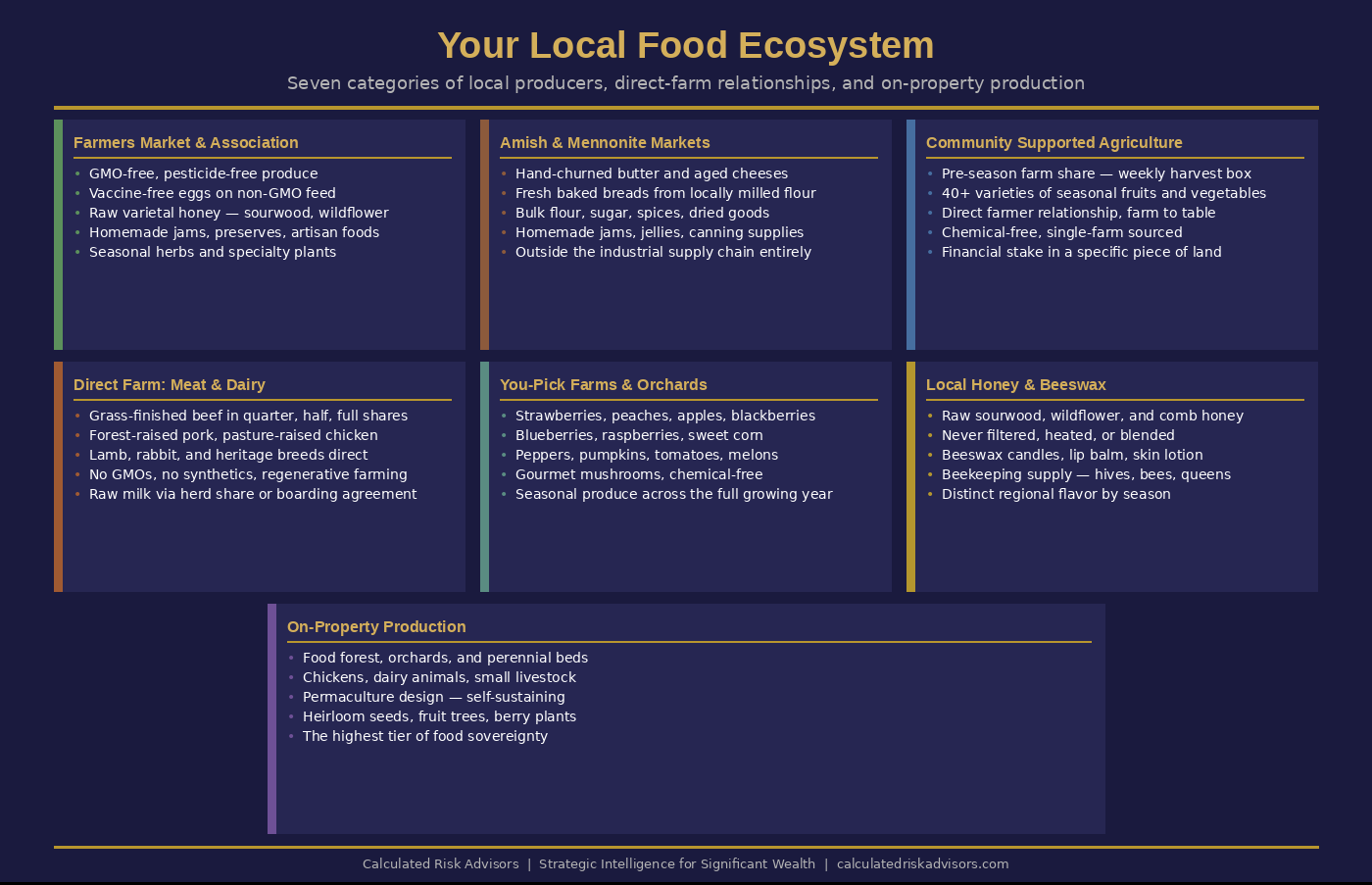
Figure 1. Seven categories of local food sourcing, direct-farm relationships, and on-property production available to families building a sovereign food position.
The Relationships I Have Built, and Why They Matter
I am not making a theoretical argument. I built this network. Over several years I developed working relationships with my local farmers market association and a roster of independent producers covering every major food category my family consumes. Locally grown produce free of GMOs and synthetic pesticide. Eggs from vaccine-free chickens raised on non-GMO feed. Raw honey. Homemade jams and preserves. Artisan foods made entirely from local ingredients.
I hold an active CSA membership, a beef share agreement with a regenerative farm raising grass-finished cattle without GMO feed or synthetic inputs, and a herd share arrangement providing raw dairy access outside the commercial pasteurization system. I have established ongoing relationships with Amish and Mennonite communities in my region for bulk staples, artisan dairy, fresh baked goods, and preserved foods produced entirely outside the industrial food supply chain.
If commercial food systems face serious disruption, I am not starting from zero. I am calling people who know me, who will work with me because we have been working together for years. That relationship capital is worth something Armstrong, Taleb, and Begovic all agree on: it may be worth more than the digits on the screen.
What the Farmers Market Really Offers
Treat a farmers market as a strategic relationship network, not a premium grocery run. The vendor who has seen your face every Saturday for two years will set something aside for you when supply tightens. The vendor who sees you for the first time at a crisis moment will not. Categories worth building relationships around: GMO-free, pesticide-free produce; vaccine-free eggs on non-GMO feed; raw varietal honey including sourwood and wildflower; homemade jams and preserves; and seasonal specialty items the commercial supply chain does not carry. The relationship is the product.
The Amish and Mennonite Advantage: Outside the Commercial System
These communities operate almost entirely outside the industrial food supply chain and produce at a quality commercial markets structurally cannot match. They do not depend on diesel-fueled distribution networks, industrial cold chain, or commercial processing infrastructure. I have built genuine, ongoing relationships with Amish and Mennonite communities in my region. That took consistent, respectful patronage over time. It cannot be replicated quickly by a family arriving for the first time when conditions are difficult.
The signature products that distinguish these markets: hand-churned butter and aged cheeses produced in small batches with no industrial additives; fresh baked breads made the same day from locally milled flour; and bulk staples including flour, sugar, and dried goods in quantities commercial grocery does not carry. These are not premium versions of commercial products. They are a different category entirely.
Local Meat: Beef Shares and the Direct Farm Model
A beef share is a direct purchase of a portion of a specific animal from a specific farm before slaughter. Quarter shares yield roughly 100 to 130 pounds of finished cuts. Half shares yield 200 to 250. Full shares yield 400 to 500 pounds, representing a full year of beef for most households. A full share of grass-finished beef at direct-farm pricing runs $2,400 to $4,000. The same quantity of comparable quality beef at a premium butcher runs $8,000 to $10,000. The share delivers complete provenance and superior traceability at roughly half the price, with a personal relationship to the farm that no retail transaction can replicate.
Grass-finished means the animal ate only forage for its full life. No GMO feed, no synthetic hormones, no prophylactic antibiotic regimen. Forest-raised pork, pasture-raised chicken, lamb, and heritage breeds are available through the same direct-farm channel. The industrial supply chain does not produce this product category. It produces a substitute.
Raw Milk: Herd Share Access
Raw milk is unprocessed milk consumed without pasteurization. Direct human consumption is prohibited or restricted in a number of jurisdictions. Verify the specific laws for your state and county before pursuing any access method below. This is informational, not legal advice.
A herd share agreement allows a consumer to purchase an ownership interest in a specific animal. You are not buying milk. You own a share of the cow or goat, and the milk follows your ownership. A boarding agreement works similarly: you own the animal, and the farm milks and maintains it under a service agreement. Both structures are established legal frameworks in many restricted jurisdictions. Seasonal Jersey cow and goat herd shares provide raw dairy and aged cheeses that commercial systems cannot match in quality or origin traceability.
The Private Chef and the Household Table
Many principals at this level have a private chef or household culinary staff. A chef sourcing from your own grass-finished beef share, your CSA box, your farm eggs, your Amish butter is operating at a level no restaurant supply house can reach. That is a lifestyle statement and a quality-of-table statement that resonates immediately with this audience. The kitchen stops being defined by what a distributor delivered. It is defined by what the land is producing, what came out of the ground this week, what arrived from the farm that morning. The menu becomes a seasonal document responsive to the land itself.
What this looks like operationally: the CSA box arrives Tuesday. The chef builds the week’s menu from what came in, not from what the Sysco catalog can deliver. The beef share in the freezer determines what gets braised on Sunday. The Amish butter is what goes on the table. The farm eggs are what the pastry is built around. The calendar driving the kitchen is the farm’s calendar, not a restaurant supply house’s availability sheet. This is not an aesthetic preference. It is a complete reorganization of how the household kitchen operates, and the result is food of a quality and traceability that no amount of restaurant spending replicates.
Every plate carries complete provenance: the specific farm, the specific animal, the specific harvest date. No Michelin-starred restaurant can honestly offer that on every item. The chef working from your own supply network is not constrained by a supply house catalog. The constraint becomes the season and the land, which is exactly the right constraint for cooking of this quality.
Serving your guests beef from your own farm, honey from your own land, bread from Mennonite hands you shook yourself: that is a form of hospitality a Michelin-starred restaurant cannot replicate. The food has a story, and the story is yours. HNWI entertain. This angle lands. The family with a food forest, a beef share, and a private chef working with both is not serving dinner. It is serving provenance. No private dining room at any price offers what that table offers.
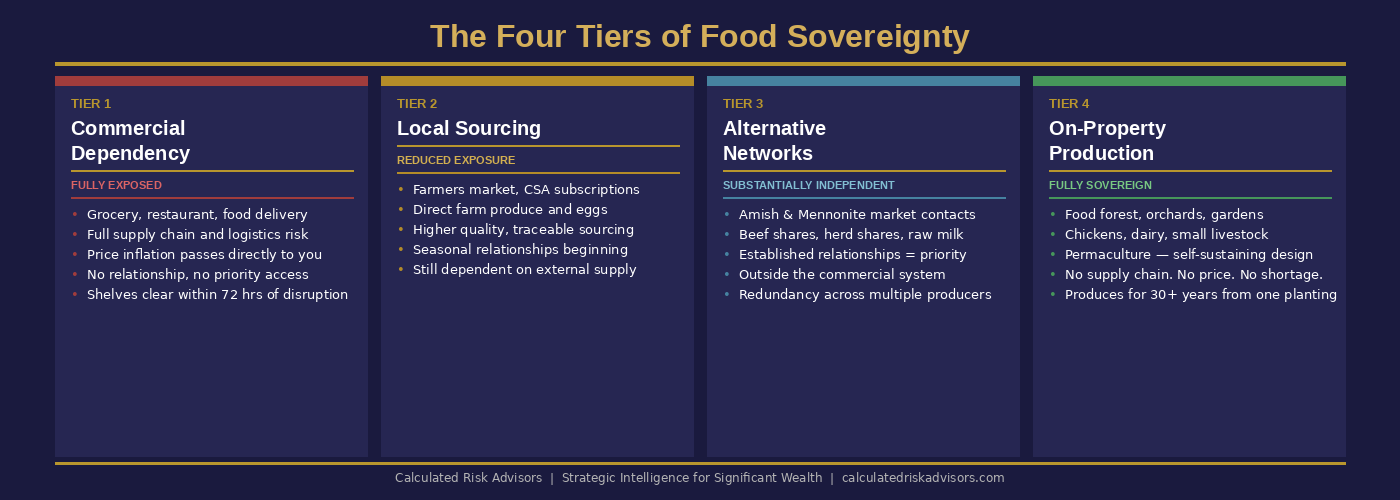
Figure 2. The four tiers of food sovereignty, from full commercial dependency to on-property production.
The Deep Pantry: Two Years Is the Benchmark
Martin Armstrong’s two-year standard is the right starting point for a family serious about this. Twelve months is the floor. Our grandparents maintained cellar shelves that could carry a household through an entire winter. Every mason jar of home-canned tomatoes represented labor, foresight, and sovereignty over the season ahead. We replaced it with just-in-time delivery and called the exchange progress. Rebuilding the larder is a rational response to a risk environment any previous generation would have recognized immediately.
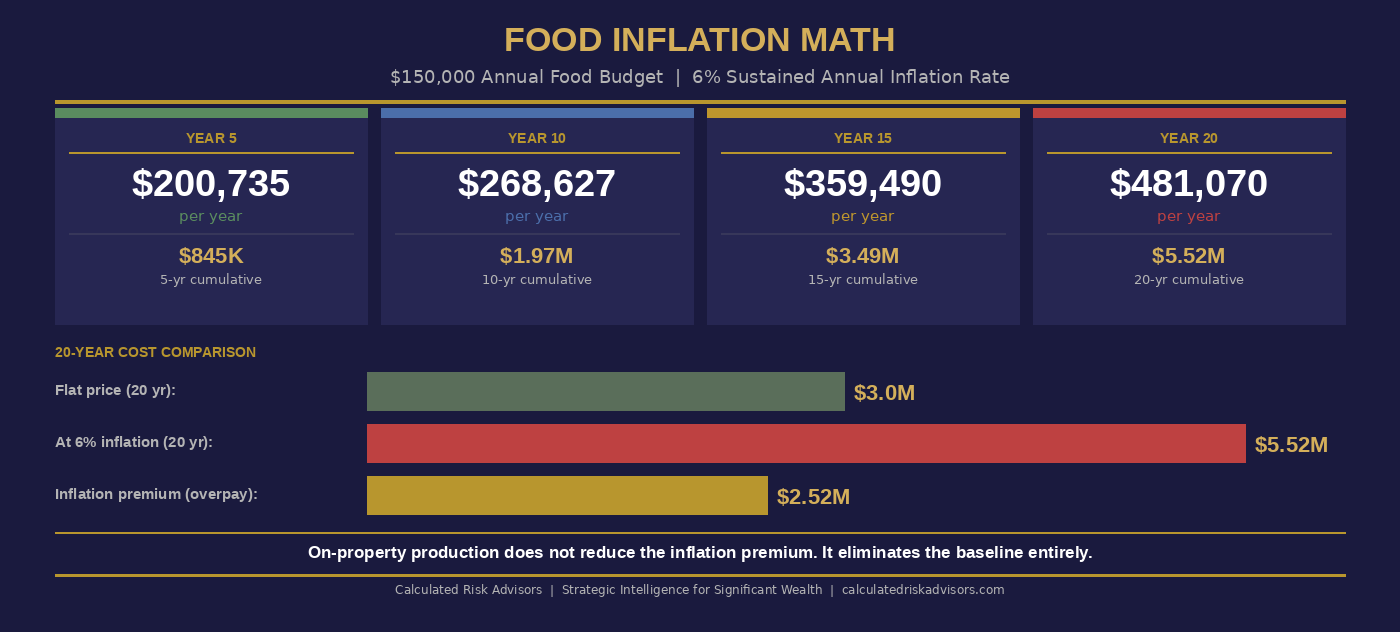
A household spending $150,000 per year on food at a sustained 6 percent annual rate is spending $268,000 per year by year ten. Over a decade, that household will have spent $1.97 million on food versus $1.5 million at flat prices — nearly $480,000 more, driven entirely by inflation. HNWI understand compounding. Show them the number. Over twenty years the premium reaches $2.52 million. On-property production does not reduce that number. It eliminates the baseline.
Target 2,200 kilocalories per person per day, balanced across 45 percent complex carbohydrates, 30 percent protein, and 25 percent fats. Include iodized salt, quality multivitamin powder, and powdered milk to cover micronutrient gaps that staples alone do not address. Eat what you store, store what you eat, consume the oldest inventory weekly and replace it at the back of the queue immediately.
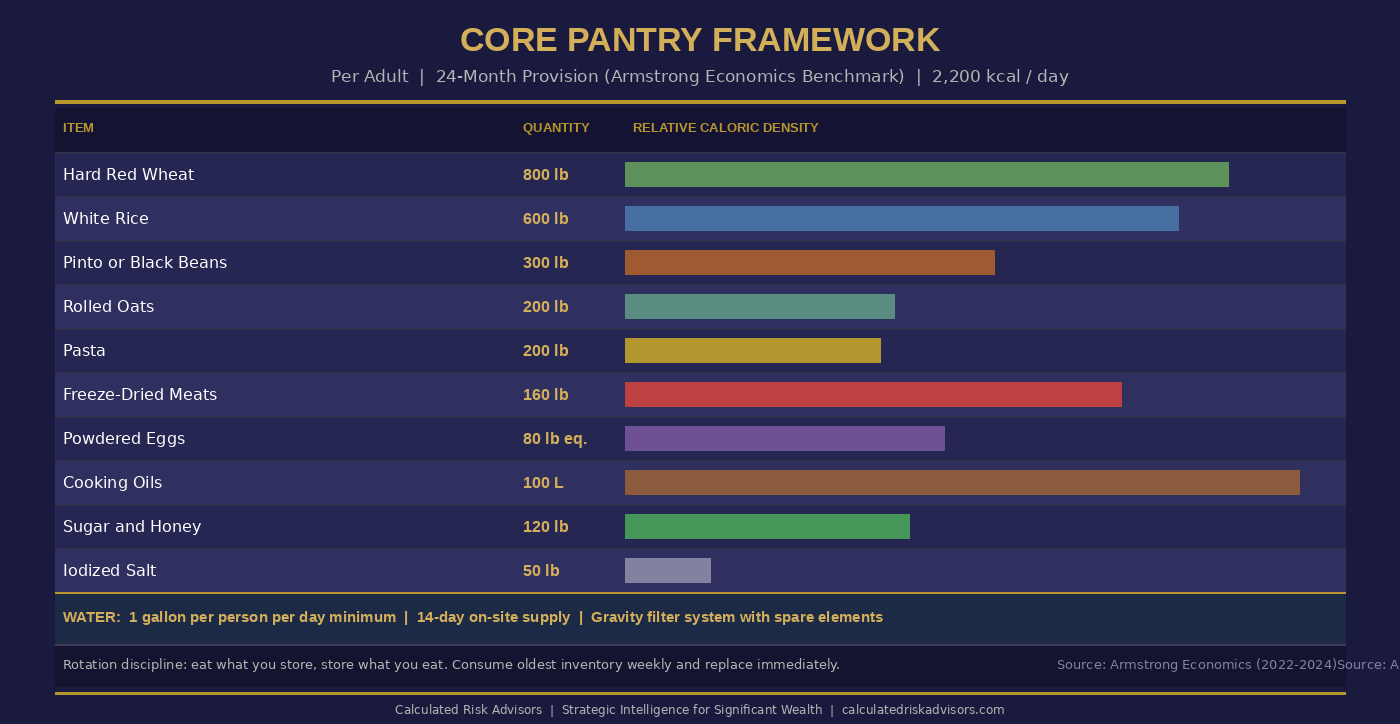
Storage hierarchy: primary is a climate-controlled interior room at 55 to 65 degrees Fahrenheit, relative humidity below 60 percent. Secondary is an off-site hardened position, either a rural property or a trusted relationship’s premises. Tertiary is 72-hour kits staged in vehicles for every principal. A manual grain mill, a gravity water filter with spare elements, and a heirloom seed bank matched to your bioregion close the loop.
CRA Site-Specific Intelligence: Boots on the Ground in Your Region
A general framework for local food sourcing is a starting point. A specific guide built for your county, your state’s raw milk laws, the farms within a practical drive of your primary and secondary residences, and the exact hours and seasonal availability of each producer is something entirely different. Calculated Risk Advisors provides that. Our research team conducts boots-on-ground local food intelligence for qualified clients: every meaningful producer, CSA, herd share program, and direct farm in your relevant geography, verified, documented, and delivered as a personalized producer guide you can act on immediately.
Action Protocol: What to Do in the Next Thirty Days
1. Audit your current position. Photograph every pantry shelf. Map actual days of supply against Armstrong’s two-year benchmark. Most families discover they are under-provisioned by 90 percent.
2. Identify your relationship gaps. Note every food category with no local or direct-farm relationship. Contact your local farmers market association this week and visit the nearest Amish or Mennonite market.
3. Enter a CSA and a beef share. Contact CSA farms about upcoming season availability and identify a regenerative farm for a quarter or half cow share. Both lists fill quickly. Get on them now.
4. Brief your household staff. Initiate the conversation with your chef or estate manager about integrating local producer relationships into household sourcing and the operating calendar.
5. Brief your family office. Reclassify food reserves and productive land as a distinct asset class. Investigate agricultural land tax classification for any property with food production potential.
Strategic Summary: Relationships, Production, and Storage
- Armstrong’s benchmark is two years, not twelve months. The 2022 Black Sea disruption and ongoing fertilizer supply restructuring explain why the timeline is that long. Build to the benchmark.
- A family at $150K annual food spend faces a $2.52M inflation premium over twenty years at 6% sustained inflation. On-property production eliminates the baseline, not just reduces it.
- Bunker isolation is brittle. The farmer, the Mennonite market, and the beef share producer each provide redundancy a solo pantry cannot. The family with abundance gives from it. That generosity is social capital money alone does not purchase.
- A private chef briefed on this framework reorganizes the household kitchen around the farm’s calendar, not the supply house’s. Every plate carries provenance. No restaurant at any price offers what that table offers.
- Herd share and boarding agreements provide raw milk access in most jurisdictions. Verify your state’s legal framework before proceeding.
- Local networks have finite capacity. Enter the CSA, the beef share, and the Amish market relationship before your region reaches saturation. The window is open. It will not stay open.
About the Author
Brent Michael Hardin
Brent Michael Hardin is the founder of Calculated Risk Advisors, a private advisory firm serving ultra-high-net-worth individuals and multi-generational family offices. CRA specializes in sovereign estate development, jurisdictional intelligence, and strategic relocation advisory for families navigating an era of accelerating geopolitical, financial, and technological change. Engagements are by private introduction only.
Limited Availability
Calculated Risk Advisors accepts a limited number of new families each quarter. Each engagement is tailored, confidential, and managed directly by our principals. There is no public intake. All relationships begin by private introduction.
A Note on This Publication
The observations, analysis, and commentary published on this site are produced for general informational and educational purposes only. They represent the research and independent perspective of the author and do not constitute financial, investment, legal, tax, real estate, or any other form of professional advice.
Nothing published here represents a solicitation, recommendation, or offer to acquire or dispose of any security, asset, property, or service. Access to this content does not establish an advisory, fiduciary, or client relationship of any kind between the reader and Calculated Risk Advisors LLC or any of its affiliated entities.
The decisions explored on this site — jurisdictional positioning, estate design, infrastructure strategy, and multi-generational wealth planning — are among the most consequential a family can make. They require qualified legal counsel, licensed tax professionals, credentialed financial advisors, and specialist practitioners who have direct knowledge of your specific circumstances, objectives, and risk profile. No publication, regardless of its depth or specificity, is a substitute for that counsel.
Calculated Risk Advisors LLC and its affiliates expressly disclaim responsibility for any decision made, action taken, or action not taken in reliance on content published here.
If you are seriously evaluating any of the strategies, jurisdictions, or approaches discussed in this publication, engage qualified independent advisors before proceeding. If you would like to explore whether a private advisory relationship with Calculated Risk Advisors is appropriate for your situation, you are welcome to request an introduction.
“The intelligence that protects generational wealth doesn’t make headlines; it circulates quietly among those who know where to look. Subscribe to the Calculated Risk Advisors Daily Brief. No noise. No mass-market advice. Just the signal.”
References
Armstrong, M. (2022-2024). Ukraine-Russia conflict analysis and peace framework. Armstrong Economics. https://www.armstrongeconomics.com/
Armstrong, M. (2022-2024). Food preparedness and storage advisories. Armstrong Economics. https://www.armstrongeconomics.com/
Begovic, S. (2016). The dark secrets of SHTF survival. SurvivalSullivan / Backdoor Survival.
Berry, W. (1990). What are people for? North Point Press.
Henderson, E., & Van En, R. (2007). Sharing the harvest: A citizen’s guide to community supported agriculture (rev. ed.). Chelsea Green Publishing.
Pollan, M. (2008). In defense of food: An eater’s manifesto. Penguin Press.
Salatin, J. (2011). Folks, this ain’t normal. Center Street.
Taleb, N. N. (2012). Antifragile: Things that gain from disorder. Random House.
UN Food and Agriculture Organization. (2022). The importance of Ukraine and the Russian Federation for global agricultural markets and the risks associated with the current conflict. FAO Information Note.
Copyright 2026 Calculated Risk Advisors LLC. All rights reserved. Reproduction without written permission is prohibited.

0 Comments