

A Living Standard That Built the Great Estates
The families who built lasting estates over centuries shared something the modern era has quietly forgotten. Before global supply chains, before refrigerated shipping, before the grocery store became the default answer to every food question, those families grew their own. Not as a hobby and not as a statement. As a matter of course. It was the living standard of anyone with land and the sense to use it.
That standard has slipped away. The average American household today holds roughly three to four days of food on hand, according to FEMA preparedness data. Families with significant wealth and multiple properties are, in most cases, no better positioned. They depend on the same supply chains, the same distribution networks, and the same industrial food system as everyone else. A system that is efficient when it functions, and catastrophic when it does not.
There are three distinct reasons a family of means should be thinking about a food forest right now. The first is security: what happens when the supply chain breaks. The second is safety: what is actually in the food that commercial systems produce. The third is legacy: what a well-designed perennial food system adds to an estate that time and money alone cannot replicate. This brief addresses all three, and then the financial case that ties them together.
What a Food Forest Actually Is
A food forest is a perennial garden built around useful trees, designed to mimic the structure and ecology of a natural forest ecosystem. It operates across seven distinct vertical layers, from the tallest canopy trees all the way down to root crops growing underground, and once it is established, it sustains itself with minimal intervention from the people who own it.
This is not a vegetable garden. It is not raised beds or annual planting or a row crop that needs equipment and chemicals every season. Rick Austin describes it in direct terms: plant it once, and it produces food for thirty years. No pesticide. No fertilizer. No weeding to speak of. Five times more food per square foot than conventional gardening (Austin, 2012, p. 16). And because it is designed to look like overgrown nature rather than a cultivated garden, it is effectively invisible to anyone who does not already know it is there.
Darrell Frey and Michelle Czolba note in their foundational work that the food forest is ‘perhaps the oldest way to garden,’ rooted in the practices of indigenous peoples across every continent who learned to cultivate and manage forest edges for sustained abundance (Frey and Czolba, 2017, p. xiii). Less than a century ago, the average family maintained a full year of food in storage to bridge one harvest to the next (Austin, 2012, p. 14). That knowledge was not lost. It was abandoned in the era of cheap energy and the assumption that the store would always be stocked.
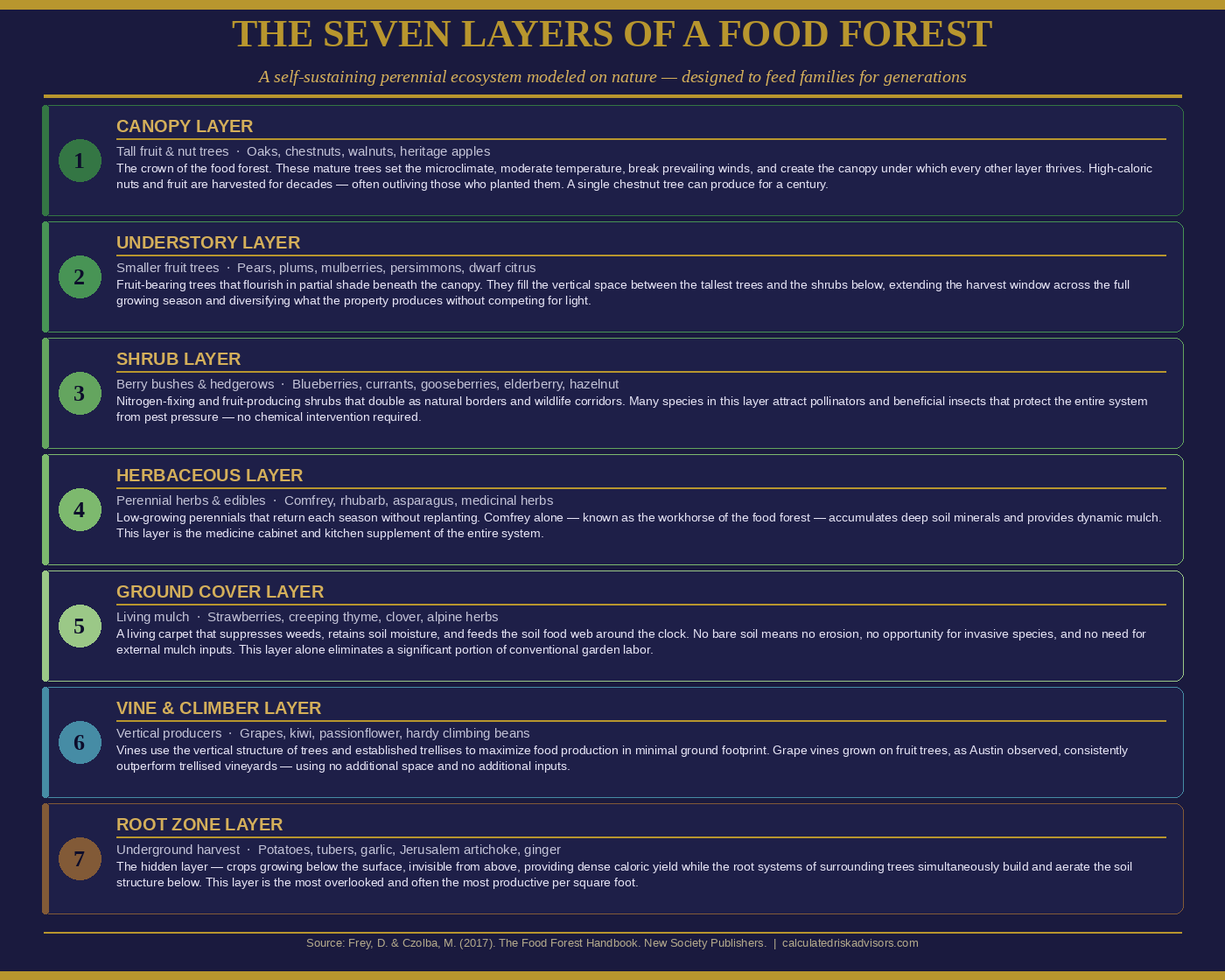
Figure 1. The seven structural layers of a food forest, from canopy to root zone. Source: Frey and Czolba (2017).
“The best time to plant a tree was 20 years ago. The second best time is now.”
Traditional Proverb, cited in Frey and Czolba, The Food Forest Handbook (2017)
The Risk Environment Driving the Conversation
The commercial food supply chain is one of the most sophisticated systems ever built. It is also one of the most brittle. Every link in that chain depends on the reliable function of something else, and any one of those dependencies can break independently of the others.
Diesel sets the price of every mile of food transport, every acre of mechanical planting, and every cubic foot of refrigerated storage. When energy costs spike, as they have during every major geopolitical episode in recent years, grocery prices follow within weeks. Supply chain disruptions require no natural disaster to trigger. A port labor dispute, a bridge closure, or a software failure in a logistics network can empty grocery shelves of perishables within seventy-two hours.
The economic mechanism is less visible but equally dangerous. Letters of credit are the lubricant of global commodity trade, and when credit conditions tighten, as they did during the 2008 financial crisis, commodity trades freeze before a single truck moves. The grocery store is directly downstream from the banking system. A food forest on private property is not downstream from any of this.
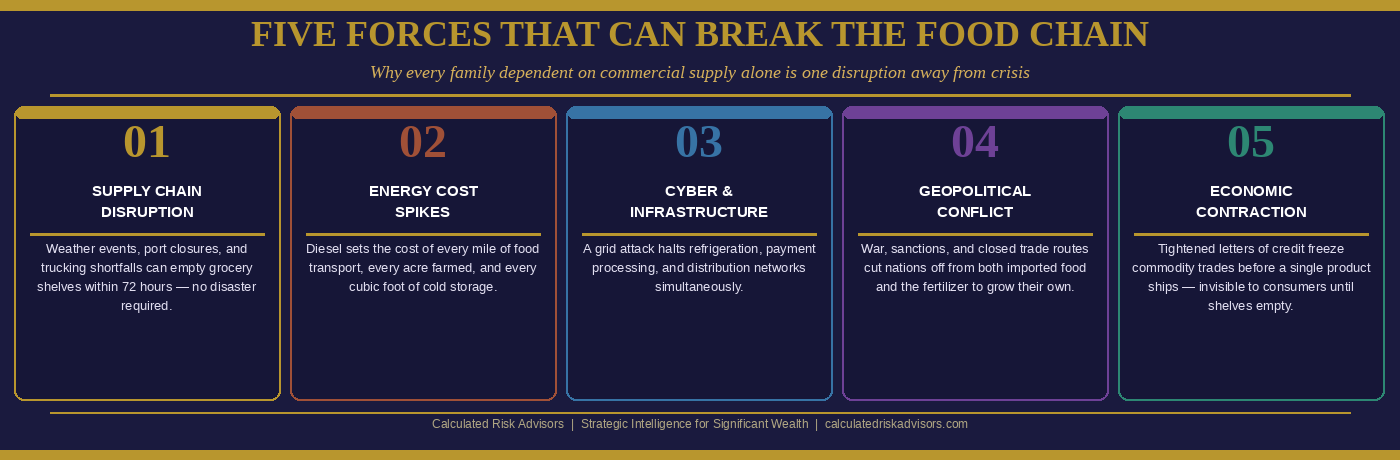
Figure 2. Five systemic forces capable of disrupting commercial food access. A food forest is insulated from all five.
The Fertilizer Fault Line: A Supply Chain Nobody Discusses
There is one vulnerability in the global food system that almost never surfaces in mainstream financial analysis, despite the fact that it underpins virtually every acre of commercial farmland on the planet. John Klar identifies it directly in his examination of structural agricultural risk:
“Roughly half of the world’s food production is now dependent on synthetic nitrogen fertilizer use.”
John Klar, The Coming Food Crisis (2023)
Synthetic nitrogen fertilizer is manufactured through the Haber-Bosch process, which requires natural gas as its primary feedstock. That natural gas moves through global shipping lanes, including the Persian Gulf. Writing in Fortune, Professor Aya Chacar of Florida International University confirmed the scope of the exposure: shipping traffic through the Strait of Hormuz carries roughly a third of internationally traded fertilizer, which is key to bountiful crops around the world (Chacar, 2026). When that waterway was closed beginning March 2026, the disruption extended well beyond oil.
The closure interrupted the natural gas supply chains that feed fertilizer production for nations across Asia, Europe, and North Africa. Countries that cannot access synthetic nitrogen at planting season cannot produce commercial crops at scale. The timeline from fertilizer shortage to food shortage is roughly one growing season.
A food forest requires no synthetic nitrogen. It builds its own fertility through nitrogen-fixing trees and shrubs, through the decomposition of its own organic matter, and through the biological activity of a living soil ecosystem that has been developing for years. It is entirely insulated from the Haber-Bosch supply chain and from every geopolitical event that threatens it.
The Safety Argument: What You Do Not Know Is on Your Food
Food security and food safety are two different problems. Security is about access. Safety is about quality: whether what reaches your table is actually good for you. John Klar’s central argument on this point is that the displacement of natural food by industrially processed and chemically treated products carries a cost that does not appear on any nutrition label:
“Human health is deteriorating as man-made food products tainted with chemicals and deprived of nutritional value have replaced natural provisions.”
John Klar, The Coming Food Crisis (2023)
The specific evidence supporting that concern is well-documented. Herbicides, fungicides, and synthetic pesticides are applied at every stage of commercial crop production. Certain compounds are lipid-soluble and can accumulate in fatty tissue over time. Residues from multiple chemical compounds are routinely detected in commercially grown produce even after washing, a pattern confirmed year after year by the USDA Pesticide Data Program. The regulatory framework sets tolerances for individual compounds in isolation, not for the cumulative load consumed across a lifetime of eating from industrial systems.
A food forest grown without synthetic inputs carries none of this. No herbicide residue, no synthetic fungicide, no accumulated chemical load. It is not certified organic by a government agency. It is something more fundamental than certification. It is food grown the way food was grown for the entirety of human history before the industrial era: in living soil, in ecological balance, without chemical intervention. For a family that already spends meaningfully on premium organic produce, a food forest is the permanent, irreplaceable form of that same commitment.
The Financial Case: Food Inflation Nobody Is Going to Escape
Here is the financial argument that every advisor in this space should be making and almost none are. Food inflation is not a short-term anomaly that corrects when supply chains normalize. It is a structural condition driven by forces compounding simultaneously: fertilizer shortages from the Hormuz closure, energy costs embedded permanently into transport and production economics, and geopolitical fractures that have broken the trading relationships that once kept global food prices stable. These conditions are not going away on a timeline that matters to a family planning its finances across the next decade.
PBS NewsHour reported in June 2026, citing Michigan State University food economist David Ortega, that grocery prices face sustained inflationary pressure in the months ahead: ‘There is still a good deal of uncertainty about how the reopening will unfold, and it will take time for fuel, diesel and retail fertilizer prices to come back down.’ Once prices go up, the same analysis found, it takes a long time for them to come back down (Anderson, 2026). This is not a crisis that resolves at the checkout counter within a quarter or two.
A high-net-worth household with a principal residence, multiple properties, large-scale entertaining, and a household staff can reasonably spend $60,000 to $150,000 or more per year on food. At a sustained 6 percent annual food inflation rate, that baseline doubles within twelve years. Over the thirty-year productive life of a mature food forest, the compounding effect on food cost is substantial regardless of the starting number.
The food forest inverts that equation. The initial investment, covering site design, earthworks, plant stock, and establishment, is a one-time cost. The system then produces for decades at essentially zero marginal cost. No fuel inputs. No supply chain premium. No organic certification markup. The produce it yields would retail at premium organic prices in any market, arriving at the family table at the cost of nothing but the time already spent planting it. Against a backdrop of food prices that have nowhere to go but up, that is a hedge with a horizon most financial instruments cannot match, and unlike a commodity contract, it also feeds the family.
The Perennial Advantage: Why This System Is Different
The distinction between a conventional garden and a food forest comes down to one word: perennial. Most commercial food and most home gardens are annuals. You plant, tend, harvest, and start over the following spring. That cycle costs something every single year: soil preparation, seed input, fertilizer, water, and labor.
Indigenous communities that sustained themselves from the land for generations did so primarily on perennials: fruits, nuts, roots, and small animal protein from ecosystems they managed rather than created (Austin, 2012, p. 9). A well-designed food forest does the same, adapted for a modern private estate. Canopy trees deliver high-caloric harvests in late summer and fall. Understory fruit trees extend production across spring and summer. Berry shrubs produce early. Perennial herbs provide year-round material. Once established, typically three to five years in, it requires no replanting, no chemical inputs, and very little labor. It runs itself.
The Legacy and Estate Dimension
For a family with significant property, the food forest carries a dimension that goes well beyond food production. It is a permanent living asset embedded in the estate itself.
A chestnut tree planted this season will still be producing in seventy-five years. When the estate transfers to the next generation, the food forest transfers with it: productive, self-maintaining, chemically clean, and impossible to replicate quickly. There is no shortcut to fifty years of established canopy. You cannot buy it. You can only plant it and let time do what time does.
Designed well, a food forest is also beautiful. It is layered, textured, alive with seasonal change, a landscape that enhances the visual character of the estate while quietly producing real food. Successive generations inherit the shade trees their great-grandparents planted, fruit varieties adapted to the specific microclimate of the property, and a living relationship with the land that no financial instrument can replicate or replace.
How to Begin: What This Looks Like in Practice
For any family with property, whether a rural estate, a working farm, or even a generous suburban lot, a food forest is almost always achievable. The starting point is a site assessment covering sun exposure, water flow, existing soil quality, prevailing winds, and what is already growing. Swales, shallow earthworks that capture and slow rainfall, are often integrated early to build the water table and support deep-rooted trees through dry periods.
Plant selection follows universal principles: seven layers populated from canopy to ground cover, each species chosen for both food production and ecosystem function. Nitrogen-fixing species are woven throughout from the beginning. Guild planting, which places companion species that support each other’s growth, dramatically reduces the need for external fertilizer as the system matures.
For most temperate properties, the first perennial harvests arrive in year two or three. The system reaches productive maturity around year seven. That timeline is the single most important thing to understand: a food forest planted this season will be producing abundantly when the next generation inherits the property. The window to build this kind of resilience closes the moment the next crisis makes the need obvious to everyone. By then, it is too late to plant. This is a decision that belongs to now.
The Water Dimension: A Resilience Advantage Nobody Talks About
Food is the conversation most families have first. Water is the one they rarely have at all, and it is equally vulnerable. Municipal water systems depend on functioning electrical grids, pressurized infrastructure, and chemical treatment supply chains. A grid failure, a cyber attack on water treatment controls, or a prolonged drought that exceeds reservoir capacity are all scenarios that a family dependent on tap water cannot address by driving to a store.
A food forest, properly designed with swales and water-harvesting earthworks, builds its own water retention capacity directly into the land. Swales slow and sink rainfall across the property rather than allowing it to run off. Over several seasons, this raises the local water table and creates a subsurface reserve that deep-rooted trees draw from independent of municipal supply. A mature food forest with swale infrastructure can sustain itself through extended dry periods that would devastate a conventional garden requiring regular irrigation.
For estate properties that already have wells, a food forest’s water-harvesting design recharges those aquifers passively. The property becomes, in effect, its own small watershed: capturing what falls from the sky, storing it in living soil, releasing it slowly through deep root systems, and requiring far less external water input than any annual planting ever would. Food independence and water independence, built into the same system.
Strategic Summary: Security, Safety, and Legacy
- A food forest produces five times more food per square foot than conventional gardening, requires no replanting, no pesticide, and no synthetic fertilizer. Thirty years of production from a single planting.
- Food inflation is structural, not cyclical. Fertilizer shortages, energy costs, and geopolitical fractures are compounding. Food prices globally have nowhere to go but higher.
- At a sustained 6% annual food inflation rate, household food spend doubles in 12 years. A food forest converts that into a one-time cost and 30 years of zero-marginal-cost production.
- Half of global food production depends on synthetic nitrogen. The 2026 Hormuz closure threatens fertilizer supply chains for three continents, one growing season from food shortfall (Klar, 2023; Chacar, 2026).
- Industrial food carries chemical residue at every stage, confirmed by USDA Pesticide Data. A food forest delivers food in living soil, in ecological balance, without chemical load.
- Swale-integrated food forests build their own water retention, raising the local water table and reducing dependence on municipal supply. Food independence and water independence in the same system.
- A chestnut tree planted today may still produce when grandchildren inherit the property. You cannot buy 50 years of established canopy. You can only plant it now.
- The decision window closes the moment the next crisis makes the need visible to everyone. That window is open right now.
ENGAGE CALCULATED RISK ADVISORS
Estate resilience planning for qualified families and family offices.
Food forest design. Supply chain independence. Generational asset structure.
About the Author
Brent Michael Hardin
Brent Michael Hardin is the founder of Calculated Risk Advisors, a private advisory firm serving ultra-high-net-worth individuals and multi-generational family offices. CRA specializes in sovereign estate development, jurisdictional intelligence, and strategic relocation advisory for families navigating an era of accelerating geopolitical, financial, and technological change. Engagements are by private introduction only.
Limited Availability
Calculated Risk Advisors accepts a limited number of new families each quarter. Each engagement is tailored, confidential, and managed directly by our principals. There is no public intake. All relationships begin by private introduction.
A Note on This Publication
The observations, analysis, and commentary published on this site are produced for general informational and educational purposes only. They represent the research and independent perspective of the author and do not constitute financial, investment, legal, tax, real estate, or any other form of professional advice.
Nothing published here represents a solicitation, recommendation, or offer to acquire or dispose of any security, asset, property, or service. Access to this content does not establish an advisory, fiduciary, or client relationship of any kind between the reader and Calculated Risk Advisors LLC or any of its affiliated entities.
The decisions explored on this site — jurisdictional positioning, estate design, infrastructure strategy, and multi-generational wealth planning — are among the most consequential a family can make. They require qualified legal counsel, licensed tax professionals, credentialed financial advisors, and specialist practitioners who have direct knowledge of your specific circumstances, objectives, and risk profile. No publication, regardless of its depth or specificity, is a substitute for that counsel.
Calculated Risk Advisors LLC and its affiliates expressly disclaim responsibility for any decision made, action taken, or action not taken in reliance on content published here.
If you are seriously evaluating any of the strategies, jurisdictions, or approaches discussed in this publication, engage qualified independent advisors before proceeding. If you would like to explore whether a private advisory relationship with Calculated Risk Advisors is appropriate for your situation, you are welcome to request an introduction.
“The intelligence that protects generational wealth doesn’t make headlines; it circulates quietly among those who know where to look. Subscribe to the Calculated Risk Advisors Daily Brief. No noise. No mass-market advice. Just the signal.”
References
Anderson, M. (2026, June 16). Higher prices for gas, groceries and flights will outlast Iran war, analysts say. PBS NewsHour / Associated Press. https://www.pbs.org/newshour/economy/higher-prices-for-gas-groceries-and-flights-will-outlast-iran-war-analysts-say
Austin, R. (2012). Secret garden of survival: How to grow a camouflaged food forest. CreateSpace Independent Publishing Platform.
Chacar, A. S. (2026, April 9). A global food emergency: Why the closed Strait of Hormuz puts half the world’s calories at risk. Fortune. https://fortune.com/2026/04/09/global-food-emergency-how-bad-strait-hormuz-grocery-prices-shortages/
Frey, D., & Czolba, M. (2017). The food forest handbook: Design and manage a home-scale perennial polyculture. New Society Publishers.
Klar, J. (2023). The coming food crisis: How corporations, activists, and climate alarmists are waging war on farmers. Regnery Gateway.
Copyright 2026 Calculated Risk Advisors LLC. All rights reserved. Reproduction without written permission is prohibited.


0 Comments