


There was a time when wealth alone was considered a guarantee of security. A penthouse in the city, a second home in the suburbs, and the comfort of financial instruments promised continuity no matter what was happening in the world outside. That illusion is breaking, and the families who recognize it earliest will be the ones who retain everything they have built.
According to the UBS Billionaire Ambitions Report 2025, 36% of billionaire clients surveyed relocated at least once in the past year, with 44% of those under 54 making the move. The motivation has shifted decisively from opportunity to defense, as geopolitical instability, regulatory exposure, and democratic backsliding are now treated the same way investment risk is treated, as something to hedge against before it is too late (UBS, 2025).
The World Is Telling You Something. Are You Listening?
France and Ireland are telling the same story, and neither is subtle anymore. France, once considered the cultural anchor of Western Europe, continues to fracture under the weight of unchecked migration, institutional overreach, and a government that has lost the confidence of its own citizens, with civil disorder in Paris no longer an occasional event but a recurring feature of political life. Ireland, which once prided itself on stability and civic openness, erupted in October 2025 with riots outside Dublin’s Citywest asylum center, with up to 2,000 demonstrators taking to the streets before police made dozens of arrests over two consecutive nights of unrest. What began as scattered protests in 2022 has become a structured and internationally connected movement that escalates with each new incident. If it can happen in Paris, it can happen in Dublin. If it can happen in Dublin, it can happen anywhere.
In Venezuela, the picture has shifted entirely. Nicolas Maduro was captured by U.S. forces on January 3, 2026, and is now facing criminal charges in New York, ending more than two decades of authoritarian rule that had destabilized an entire region. President Trump has stated publicly that regime change in Cuba is a question of time following the Iran campaign, the U.S. Navy has deployed roughly ten percent of its fleet to the Caribbean, and Cuba has already experienced three nationwide blackouts after Venezuelan oil supplies were cut off following Maduro’s removal. The Western Hemisphere is being reshaped in real time, and the investment and security implications reach further than most family offices have accounted for.
And then there is Iran. The Strait of Hormuz has been largely blocked since February 28, 2026, with daily ship transits fallen to roughly half of pre-war levels and no near-term resolution in sight. The Houthis are threatening to additionally blockade the Bab al-Mandeb, the second major maritime corridor connecting the Red Sea to the Gulf of Aden. Combined, these two chokepoints carry the majority of the world’s seaborne oil and LNG, and if both are compromised simultaneously, the energy market disruption would be unlike anything the modern global economy has experienced. The shipping cost increases, supply chain delays, and price pressure already in motion are not temporary corrections; they are structural, and they are building.
Closer to Home: The Wars Already Underway
The United States is already at war, though many choose not to acknowledge it. The DEA’s 2025 National Drug Threat Assessment is explicit: fentanyl is the leading cause of death for Americans aged 18 to 44, distributed through a supply chain running from Chinese chemical manufacturers through Mexican cartel networks directly into American communities, with more than 40% of Americans knowing someone who has died from an opioid overdose (DEA, 2025).
In January 2025, the White House formally designated the Sinaloa Cartel and the Jalisco New Generation Cartel (CJNG) as Foreign Terrorist Organizations, a legal acknowledgment that these are not ordinary criminal enterprises operating at the border but state-sponsored proxy forces with operational infrastructure running through American cities, their corridors of influence reaching deep into neighborhoods, businesses, and financial networks across the country.
What most high-net-worth families do not recognize is that cartels do not select victims randomly; they research them. Hotel check-in records, private aviation manifests, social media activity, charitable donation filings, and business registration databases are actively mined to build profiles of high-value targets, and visible wealth is not a shield in this equation but a targeting signal that scales with your net worth. A documented case handled by executive protection firm Ackerman Group involved an American businessman abducted in Nuevo León, Mexico, held for ransom, and recovered only through professional crisis intervention (Ackerman Group, 2024). These cases rarely make headlines because families pay quietly and firms are contractually prohibited from disclosure.
The FBI has formally warned that Mexican cartel-connected networks operate virtual kidnapping and extortion schemes against U.S. citizens, using hotel staff informants, surveillance of digital behavior, and social engineering to identify and isolate high-value American targets before any contact is made, with the scheme documented across multiple U.S. cities and consistently targeting individuals whose wealth is visible and traceable through public records (FBI, n.d.).
Mexico is a preview of what controllable money looks like in practice, and it is happening directly on the United States border. President Claudia Sheinbaum has announced mandatory digital payments at all gas stations and highway toll booths by the end of 2026, eliminating cash as a valid form of payment for fuel, while simultaneously rolling out biometric digital IDs incorporating fingerprints, iris scans, and facial recognition for every resident. At Mexico’s 89th Banking Convention in Cancún in March 2026, representatives from the Bank for International Settlements and BlackRock joined Mexican government officials to address multiple panels on the future of digital money and the acceleration of cashless transactions. When 81.5 percent of Mexicans who discussed the policy online opposed it specifically because of government tracking and surveillance, those concerns are not theoretical; they are popular, documented, and being overridden anyway. A country where you cannot buy gas with cash and your identity is biometrically registered is a country where financial independence is not a choice you get to make.
China, Russia, and Iran wage their own parallel campaigns against Western stability, operating in spaces where conventional deterrence does not reach. Those spaces are no longer quiet.
What Most Families of Means Are Not Watching, But Should Be
The most consequential risks are rarely the ones that dominate financial media, and the three areas below represent what most families of significant means are simply not watching closely enough.
The Programmable Money Threat
The Atlantic Council’s 2025 CBDC Tracker confirms that 146 countries and currency unions, representing over 98% of global GDP, are actively exploring central bank digital currencies, and China’s e-CNY is already fully operational with confirmed expiration functionality, geographic restrictions, and merchant category limitations built directly into its architecture (Atlantic Council, 2025).
When money becomes programmable, the government that holds the programming holds the real power, with digital currency able to be frozen, directed, or restricted to specific uses, not as a hypothetical but as a documented design feature already in use. For families whose liquid wealth is held entirely in regulated financial instruments, this is not a distant theoretical concern but a pattern already in motion, and the answer lies in physical ownership of land, infrastructure, and stored value that exists outside any government ledger.
The Digital Targeting of Wealthy Families
Nearly 30% of ultra-high-net-worth families have already experienced a cyberattack, and the industry’s 2026 claims data shows that roughly 28% have been victims of a cyber event in the past five years, but the threat has evolved well beyond digital theft as AI tools can now identify the physical location of wealthy families from their public digital footprints in a matter of hours, aggregating property records, social media, private aviation data, and charitable donation filings into precise profiles used for physical targeting.
For families whose estates, schedules, and access points are discoverable through digital channels, the most dangerous exposure is no longer financial but physical, and most have never taken a serious look at how visible they actually are to someone who wants to find them.
The Speed of Systemic Collapse
Most families of significant means believe they will have time to react when conditions deteriorate, and history consistently proves that belief wrong, because financial systems, supply chains, and civil order do not collapse on a schedule that accommodates preparation but tend to fail simultaneously and faster than any reactive plan can execute. The families who preserved their wealth through the 2008 financial crisis, the 2020 pandemic supply disruptions, and the 2022 energy shocks in Europe shared one attribute: they had already positioned themselves before the event, not after the headline.
The belief that a warning period is coming is itself the vulnerability, because when access to capital freezes, physical movement is restricted, and supply chains stall at the same time, the window to act has already closed.
The Gated Community and Foreign Refuge Illusions
And what of wealthy neighborhoods, the quiet gated communities? They are not immune. As the economy corrects or collapses, they become targets, and when letters of credit are no longer guaranteed and supply chains are disrupted, it will not be only the poor who face shortages of food, fuel, and medicine. Desperation knows no boundaries. Resentment always looks upward.
Some seek refuge abroad, believing other nations offer freedom, yet this path carries its own risks. Unless you speak the language, share the culture, or belong to the same community, you will always be an outsider, and that status alone makes life precarious. Your foreign identity marks you as vulnerable and your wealth amplifies that danger, because acceptance into local communities is rarely automatic and often impossible, and in times of stress, outsiders are the first to be distrusted, resented, or targeted. The safety many imagine in foreign platforms may be nothing more than another illusion.
The New Definition of Wealth
When the financial trigger is pulled, the effects will be global. Food insecurity will rise as supply chains collapse and agricultural markets falter, access to essential services will become unreliable, and what is considered a luxury today, clean water on demand, dependable electricity, consistent supply deliveries, and accessible medical care, will quickly become the fundamentals of survival. The very definition of wealth will shift from currency and credit to land, security, and self-sufficiency.
There is a collision point that most family offices are not tracking. U.S. data centers consumed 183 terawatt-hours of electricity in 2024, more than four percent of the country’s total power, and that figure is projected to grow 133 percent by 2030 as AI infrastructure scales at a pace the grid was never designed to absorb. The International Energy Agency projects global electricity demand from data centers will more than double by 2030, and the PJM electricity market, serving households and businesses from Illinois to North Carolina, already recorded a $9.3 billion price increase in its 2025-2026 capacity market driven primarily by data center demand. At the same time, food prices are projected to rise 2.7 percent in 2026 and wholesale electricity costs are tracking an 8.5 percent increase. The grid is being asked to simultaneously power industrial-scale AI computing, everyday residences, and critical infrastructure, and any business or residence connected to the grid is directly exposed to that competition. The families who assume grid reliability is a permanent feature of modern life are operating on an assumption the data no longer supports.
So why prepare? Because affluence without resilience is fragile. A stock portfolio cannot keep the lights on when the grid fails. A luxury address cannot provide clean water when municipal systems collapse. No amount of institutional influence can guarantee delivery when trucks stop rolling.
“A storm is not brewing. It is already here, moving full force. There is only a limited window of time to act.”
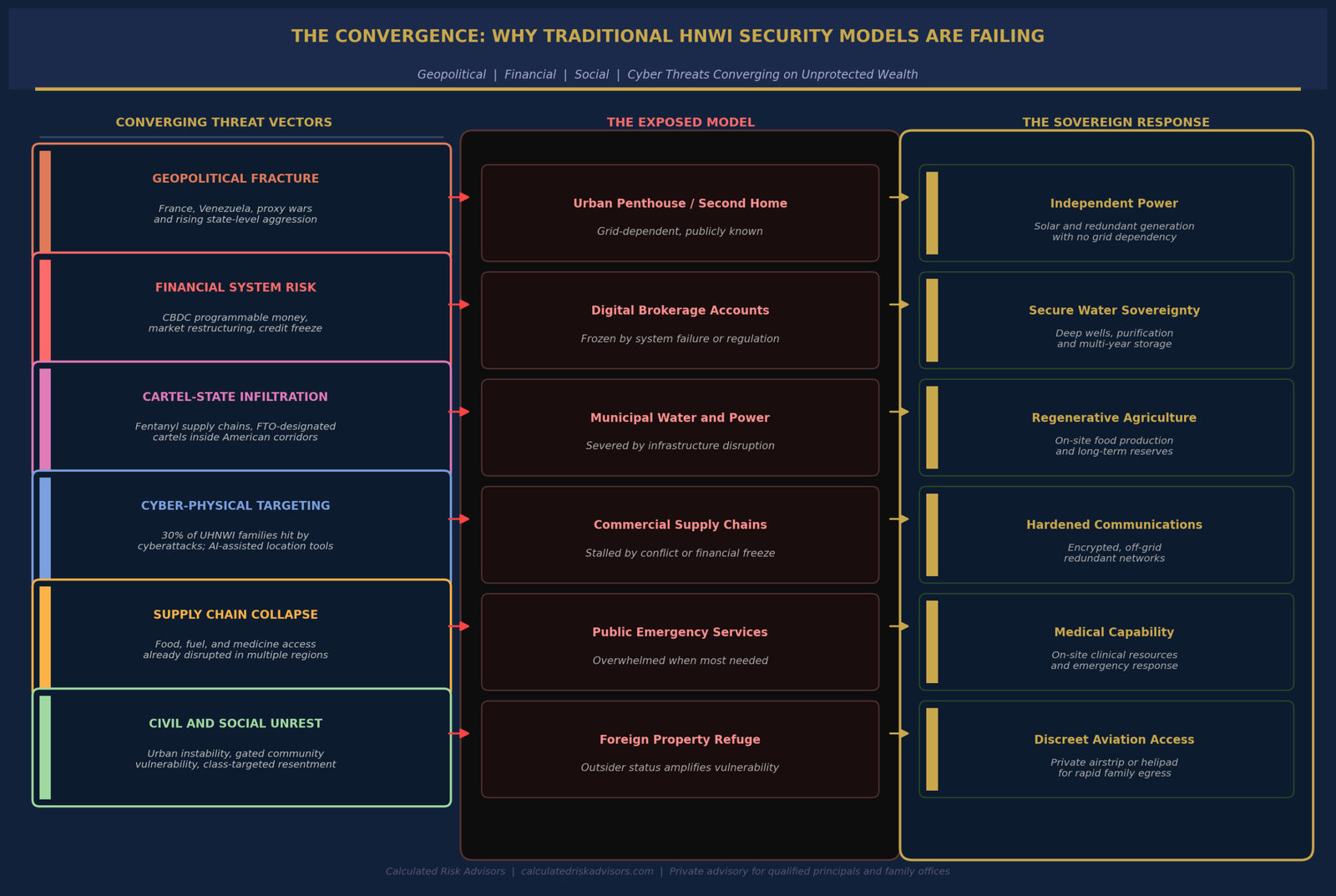
Figure 1. The Convergence: Why Traditional HNWI Security Models Are Failing | Calculated Risk Advisors
Not a Hedge. A Prerequisite.
Most high-net-worth families have built what they believe is a defensive architecture. Diversified portfolios across asset classes and geographies. Trusts and holding structures. A second property in a quieter country. Cash reserves. Gold. The assumption is that something in that collection will hold regardless of what happens. That assumption deserves a direct challenge, because every one of those positions depends on a system that is under simultaneous pressure right now.
Diversified portfolios depend on functioning markets and clearing systems. When access to capital is restricted, whether by regulatory intervention, grid-level disruption, or CBDC controls being rolled out across 98% of global GDP, the liquidity you count on does not reach you when you need it most. A second property abroad depends on your ability to move freely, on host countries that welcome you under pressure, and on infrastructure that continues to function, none of which can be assumed when regional instability is the condition, not the exception. Cash reserves depend on purchasing power that is being eroded by inflation, and on a financial system that has already demonstrated it can restrict access in a crisis. Gold requires security, transport, and a counterparty willing to accept it, and none of those are reliable when civil order is under stress. Each of these positions is designed for a world that is no longer the world you are living in.
A Private Resilience Estate and Autonomous Family Compound is the only position that does not depend on any of the systems that are failing. It generates its own power, holds its own water, produces its own food, and protects its own perimeter. It is not correlated to any market, any currency, any government decision, or any supply chain. It does not perform better when times are good and disappear when times are bad. It is constant, it is physical, and it is yours in every sense of the word. Every other asset you hold is meaningful only to the degree that you are alive, free, healthy, and positioned to act on it. The sovereign estate is the prerequisite that makes everything else worth having.
The families who did not act in time have a documented history. Venezuelan industrialists who waited through Chavez’s first term. Hong Kong business families who delayed through the handover years. European banking families in the 1930s who had the resources to leave and the assumption that things would not reach the point of no return. In every case, the window that seemed permanent was not. The warning signs that seemed manageable were not. And the decision to wait, which felt prudent at the time, was the most costly decision ever made. The only thing those families had in common with the wealthy families reading this brief today is the belief that they had more time than they did.
Generational legacies are not preserved by staying still. The families whose wealth and influence have compounded across centuries were not the ones who held their position while the world shifted around them. They were the ones who read the environment differently from their peers, who recognized structural changes before those changes became headlines, and who repositioned decisively while the majority was still telling itself that things would stabilize. The European banking families who survived the upheaval of the twentieth century intact did not do so by waiting for certainty. They moved on pattern recognition, on private intelligence, and on a willingness to act before the consensus formed. Today’s structural shifts, converging geopolitical fracture, programmable financial controls, energy grid stress, and the collapse of the assumption of urban safety, are as significant as any in modern history. The families who recognize this now are not pessimists. They are the ones who will write the next chapter of their legacy rather than become a footnote in someone else’s.
The gap between families who act now and families who wait is not a gap in information. Anyone reading this brief has the information. The gap is in the willingness to accept that the world the next generation will inherit is not the world the current generation built its wealth in, and that the most powerful act of stewardship available to a family of means today is to build the platform that makes their legacy survivable, transferable, and stronger under pressure than it was before the pressure arrived.
“There is no portfolio position, no trust structure, and no foreign property that protects your family when the systems those assets depend on are no longer functioning. A private resilience estate is not one option among many. It is the foundation everything else is built on.”
Private Resilience Estates and Autonomous Family Compounds: The Architecture of Continuity
More high-net-worth families are choosing a different path, creating estates that are independent of fragile systems, properties that generate their own power, secure their own water, store their own food, and protect their perimeters. These estates are not bunkers. They are sanctuaries, places of continuity where families can thrive regardless of what storms rage outside. They are also, increasingly, appreciating assets, because the same scarcity of stable land, water rights, and agricultural capacity that makes them necessary also makes them valuable.
The architecture of a properly designed compound integrates independent power generation, secure water sovereignty, regenerative agriculture, hardened communications, on-site medical capability, and discreet aviation access from the ground up, not as retrofitted additions but as the foundational infrastructure from day one. The result is not a property that survives disruption but one that operates through it, invisibly and continuously, while the families inside it continue to live, work, and make decisions without interference.
The critical decision is not whether to act. It is where, and whether the window is still open when you do.
Right now, permitting regimes remain workable, prime agricultural and forested parcels in stable jurisdictions continue to trade at valuations well below long-term replacement cost, and tier-one expertise, materials, and construction capacity remain fully available. These conditions are not permanent. The families who move in the next twelve to eighteen months will have access to options that will not exist for those who wait until the consensus has caught up with the reality.
“The choice is between reacting once collapse surrounds you, or preparing now while discretion, capital, and opportunity remain on your side. Those who act today are not driven by fear but by foresight.”
Calculated Risk Advisors specializes in designing private family compounds within stable, low-surveillance jurisdictions, including Switzerland, New Zealand, Panama, and other thoroughly vetted locations. We also provide guidance for North America following a comprehensive threat-modeling discussion, and confidential consultations are available exclusively for qualified principals and family offices.
About the Author
Brent Michael Hardin is the founder of Calculated Risk Advisors, a private advisory firm serving ultra-high-net-worth individuals and multi-generational family offices. CRA specializes in sovereign estate development, jurisdictional intelligence, and strategic relocation advisory for families navigating an era of accelerating geopolitical, financial, and technological change. Engagements are by private introduction only.
Limited Availability
Calculated Risk Advisors accepts a limited number of new families each quarter. Each engagement is tailored, confidential, and managed directly by our principals. There is no public intake. All relationships begin by private introduction.
A Note on This Publication
The observations, analysis, and commentary published on this site are produced for general informational and educational purposes only. They represent the research and independent perspective of the author and do not constitute financial, investment, legal, tax, real estate, or any other form of professional advice.
Nothing published here represents a solicitation, recommendation, or offer to acquire or dispose of any security, asset, property, or service. Access to this content does not establish an advisory, fiduciary, or client relationship of any kind between the reader and Calculated Risk Advisors LLC or any of its affiliated entities.
The decisions explored on this site — jurisdictional positioning, estate design, infrastructure strategy, and multi-generational wealth planning — are among the most consequential a family can make. They require qualified legal counsel, licensed tax professionals, credentialed financial advisors, and specialist practitioners who have direct knowledge of your specific circumstances, objectives, and risk profile. No publication, regardless of its depth or specificity, is a substitute for that counsel.
Calculated Risk Advisors LLC and its affiliates expressly disclaim responsibility for any decision made, action taken, or action not taken in reliance on content published here.
If you are seriously evaluating any of the strategies, jurisdictions, or approaches discussed in this publication, engage qualified independent advisors before proceeding. If you would like to explore whether a private advisory relationship with Calculated Risk Advisors is appropriate for your situation, you are welcome to request an introduction.
“The intelligence that protects generational wealth doesn’t make headlines; it circulates quietly among those who know where to look. Subscribe to the Calculated Risk Advisors Daily Brief. No noise. No mass-market advice. Just the signal.”
References
Ackerman Group. (2024). Mexico kidnapped American businessman found alive in Nuevo Leon. Ackerman Group Security Intelligence. https://ackermangroup.com/mexico-kidnapped-american-businessman-found-alive-in-nuevo-leon/
Al Jazeera. (2025, October 23). Irish police arrest 23 people in second night of anti-immigration unrest. Al Jazeera. https://www.aljazeera.com/news/2025/10/23/irish-police-arrest-23-people-in-second-night-of-anti-immigration-unrest
Atlantic Council. (2025). Central bank digital currency tracker. Atlantic Council GeoEconomics Center. https://www.atlanticcouncil.org/cbdctracker/
Atlantic Council. (2026, January). Experts react: The US just captured Maduro. What next for Venezuela and the region? Atlantic Council Dispatches. https://www.atlanticcouncil.org/dispatches/us-just-captured-maduro-whats-next-for-venezuela-and-the-region/
Drug Enforcement Administration. (2025). 2025 national drug threat assessment. U.S. Department of Justice. https://www.dea.gov/sites/default/files/2025-05/2025%20National%20Drug%20Threat%20Assessment_Web%205-12-2025.pdf
Federal Bureau of Investigation. (n.d.). U.S. citizens threatened by Mexican virtual kidnapping scheme. FBI News. https://www.fbi.gov/news/stories/us-citizens-threatened-by-mexican-virtual-kidnapping-scheme
International Energy Agency. (2025). AI is set to drive surging electricity demand from data centres. IEA News. https://www.iea.org/news/ai-is-set-to-drive-surging-electricity-demand-from-data-centres-while-offering-the-potential-to-transform-how-the-energy-sector-works
Mexico Business News. (2026). Mexico to phase out cash for tolls, fuel by end-2026. Mexico Business News. https://mexicobusiness.news/infrastructure/news/mexico-phase-out-cash-tolls-fuel-end-2026
Mexico News Daily. (2026). Looking to an all-digital future, Sheinbaum plans to eliminate cash at the pump and the toll booth. Mexico News Daily. https://mexiconewsdaily.com/news/digital-payments-gas-toll-booths-sheibaum-cash/
Gen Re. (2026, February). Navigating claims for high-net-worth individuals: Balancing opportunity and risk. Gen Re Insurance. https://www.genre.com/us/knowledge/publications/2026/february/navigating-claims-for-high-net-worth-individuals-en
UBS. (2025, December 4). Billionaire ambitions report 2025. UBS Global. https://www.ubs.com/global/en/media/display-page-ndp/en-20251204-billionaire-ambitions-report-2025.html
White House. (2025, January). Designating cartels and other organizations as foreign terrorist organizations and specially designated global terrorists. Executive Order. https://www.whitehouse.gov/presidential-actions/2025/01/designating-cartels-and-other-organizations-as-foreign-terrorist-organizations-and-specially-designated-global-terrorists/
White House. (2026, January). Fact sheet: President Donald J. Trump addresses threats to the United States by the government of Cuba. White House Fact Sheets. https://www.whitehouse.gov/fact-sheets/2026/01/fact-sheet-president-donald-j-trump-addresses-threats-to-the-united-states-by-the-government-of-cuba/
© 2026 Calculated Risk Advisors. All rights reserved. This content is provided for informational purposes only and does not constitute legal, financial, or investment advice.


0 Comments