

You are watching the wrong crisis.
While financial media tracks oil prices and freight rates through the Strait of Hormuz, something far more consequential is compounding in silence: the systematic collapse of the global fertilizer supply chain. The Iran conflict has not merely disrupted energy markets. It has severed the nitrogen pipeline that feeds roughly half the world’s population.
The disruption is not measured in weeks. It is not priced into equities. It is not modeled in most institutional risk frameworks. And it will not resolve itself in one growing season.
What follows is not a prediction. It is an accounting of what has already happened, what the data confirms comes next, and critically, three specific dimensions of this crisis that virtually no analyst is discussing. Each one has direct implications for the preservation of multi-generational wealth.
Current Crisis Overview
The Iran conflict has effectively closed the Strait of Hormuz, knocked out approximately 17% of Qatar’s LNG capacity at Ras Laffan—the world’s largest LNG hub—and triggered force majeure on long-term contracts. QatarEnergy’s CEO, Saad al-Kaabi, confirmed that repairs will take three to five years. Ras Laffan’s capacity is built around multiple LNG processing “trains”—each train is a full industrial line that purifies and super-cools natural gas into LNG for export—so when several trains go offline, a large block of global gas and fertilizer feedstock supply disappears for years, not months.
Urea fertilizer prices have already surged 30–40% (now above $700 per tonne), shipping costs are spiking, and one-third of global seaborne fertilizer trade is stalled.
The UN World Food Programme’s March 2026 analysis is unambiguous: if hostilities continue through June, an additional 45 million people will fall into acute food insecurity (IPC Phase 3+), pushing the global total from the current record of 319 million to over 363 million. The margin for a full cascade is razor-thin.
Historically, persistent food inflation diminishes real purchasing power and hampers the preservation of legacy wealth. Urban and centralized asset concentrations are particularly susceptible to devaluation during supply shocks. Multi-generational exposure further increases vulnerability to prolonged volatility.
Countries Hit First
Immediate Impact: Weeks to Months
The Gulf nations and the broader Middle East/North Africa region bear the first and sharpest blow: Qatar, Saudi Arabia, the UAE, Iran, Bahrain, and Kuwait, followed immediately by Egypt, Lebanon, and Jordan. These countries import 80–90% of their food through the Strait. Local fertilizer production has halted or slowed. The WFP projects 5.2 million additional people in this region alone pushed into acute hunger—a 14% regional increase.
Secondary Impact: Months to One Growing Season
Asia and Latin America follow quickly:
- India – More than 40% of urea and phosphate imports come from the Gulf; domestic fertilizer plants are already cutting output due to LNG and gas shortages.
- Pakistan, Bangladesh, Thailand, Indonesia – Factories shutting down; monsoon planting is at risk, compounded by potential El Niño-driven weather extremes.
- Brazil – Nearly half of its fertilizer imports transit Hormuz; massive soy and corn crops are directly threatened.
- China, South Korea, Japan – Major LNG buyers facing acute shortages.
- Europe (Italy, Belgium) – Already received force majeure notices on LNG contracts.
- Sub-Saharan Africa – Will absorb ripple effects through higher global prices and a significant reduction in humanitarian aid capacity.
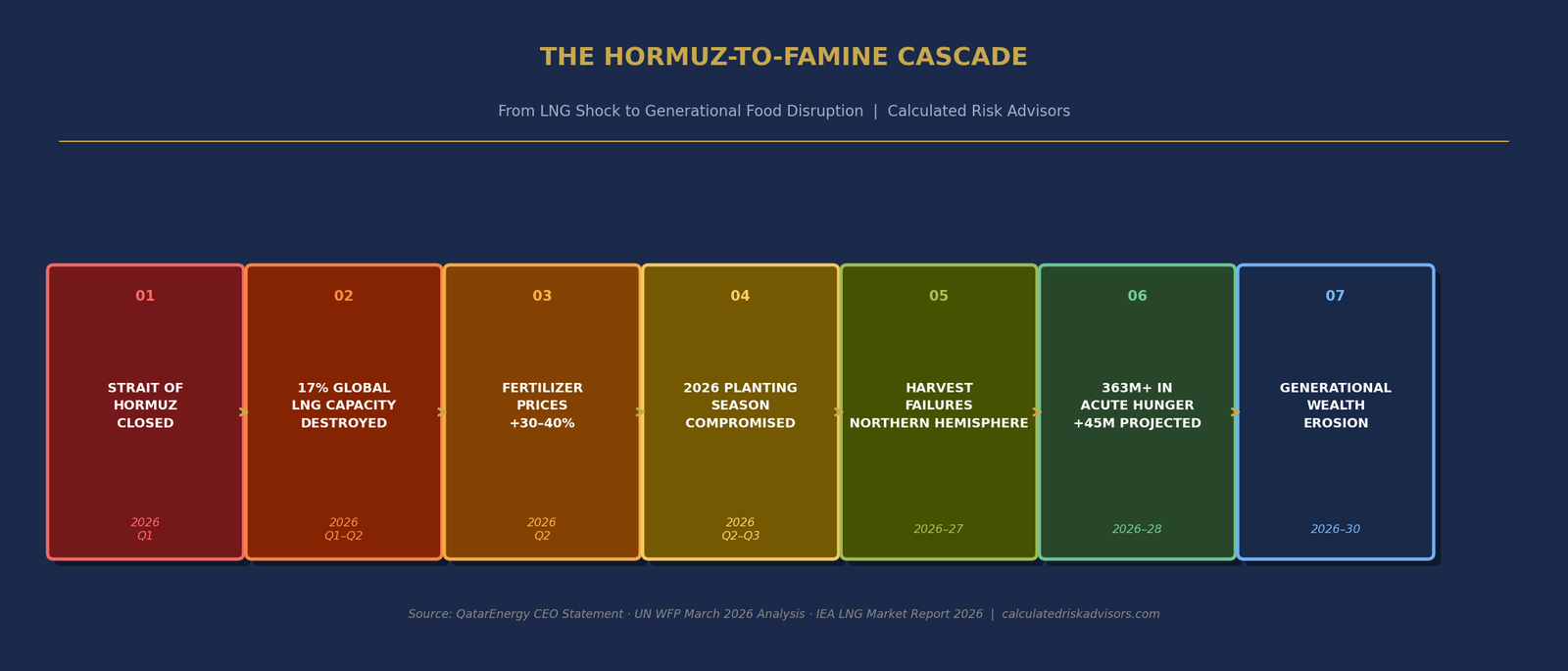
Figure 1. The Hormuz-to-Famine Cascade: From LNG Shock to Generational Food Disruption / Calculated Risk Advisors
Three Revelations Nobody Is Talking About
The mainstream analysis stops at fertilizer prices and this year’s harvest. Here is what it misses – three dimensions of this crisis that should fundamentally reframe how qualified principals and family offices are thinking about sovereign resilience.
REVELATION 01: The Nitrogen Debt Will Outlast the Crisis by Half a Decade
Most analysts focus on the 2026 crop failures. Almost no one is discussing soil nitrogen debt—and it is the most consequential long-term threat.
When farmers miss fertilizer applications, they are not simply losing one harvest. They are depleting the soil’s nitrogen capital. Agricultural science is explicit: fields with severe nitrogen depletion take three to seven growing seasons to recover to baseline productivity, even after full supply is restored. Mycorrhizal networks, nitrogen-fixing bacterial colonies, and organic matter levels cannot recover in a single season. The soil biology collapses, and rebuilding it is not a matter of simply re-applying inputs.
The precedent is documented. Sri Lanka’s 2021 organic-only fertilizer policy – which lasted only seven months before partial reversal – caused a 43% collapse in rice yields and contributed directly to the worst economic crisis in that nation’s post-independence history. The Hormuz disruption is involuntary, global in scale, and already projected to last three to five years. The math is stark: this is not a 2026 food problem. It is a 2026–2030 food problem – and the 2029 harvest will still bear the fingerprints of inputs denied in 2026.
“Soil nitrogen is not a commodity you replenish in one season. It is a biological asset that takes years to rebuild. The world is about to learn this at continental scale.”
Adapted from: Ladha et al. (2005). Efficiency of fertilizer nitrogen in cereal production. Advances in Agronomy.
REVELATION 02: Gulf Sovereign Wealth Funds Already Ran This Analysis – Fifteen Years Ago
Here is the signal the financial press is not reporting: the governments now facing the steepest domestic food shortages had already concluded their region’s food security was unsustainable—and spent the last fifteen years positioning accordingly.
Following the 2008 global food price crisis, Gulf sovereign wealth funds launched systematic global farmland acquisition programs that continue to this day. Saudi Arabia’s SALIC (Saudi Agricultural and Livestock Investment Company) has secured farming operations in Argentina, Ukraine, Sudan, Ethiopia, and the American Midwest. Qatar’s Hassad Food has acquired agricultural assets in Kenya, Tanzania, Australia, and Brazil. The UAE’s investment vehicles have pursued similar strategies across Central Asia and Southern Africa.
These are not speculative investments. They are state-level sovereign food security operations, managed by the same governments whose populations are now facing acute food insecurity. The sovereign wealth funds acted on intelligence that was available to any serious analyst. They simply had the institutional clarity to act on it.
The families who recognize this signal now are not early. They are late. But they are not yet too late. The same logic that drove Gulf states to secure agricultural land globally applies, with equal force, to every multi-generational family office operating without a sovereign food and energy platform.
“Food security has become a strategic asset class, quietly recognized by sovereign actors while institutional wealth management has yet to incorporate it into standard portfolio frameworks.”
Woertz, E. (2013). Oil for Food: The Global Food Crisis and the Middle East. Oxford University Press.
REVELATION 03: Standard Wealth Insurance Has Zero Coverage for This Risk
In 2015, Lloyd’s of London published a scenario analysis titled “Food System Shock,” examining the insurance implications of acute global food supply disruption. Their conclusion was categorical: standard commercial insurance—including business interruption, property and casualty, and portfolio protection policies—does not cover losses attributable to systemic food system failures.
Lloyd’s modeled a simultaneous failure of just four major breadbaskets. The projected outcome: global food price increases of 500% or more. Civil unrest in urban centers across 25+ countries. Catastrophic impairment of import-dependent economies. And not a single named peril in any standard wealth protection policy that would respond.
Parametric triggers don’t capture diffuse agricultural shocks. Traditional wealth insurance was architected for a world in which food was a stable, abundant input—not a scarce, contested strategic resource. Most family offices have never audited their insurance architecture against food system risk. The exposure is unquantified, therefore unmanaged, and it is now active.
“A food system shock of sufficient magnitude falls outside the scope of standard commercial insurance instruments. The insurance industry has no adequate product for this risk.”
Lloyd’s of London. (2015). Food System Shock: The Insurance Impacts of Acute Disruption to Global Food Supply.
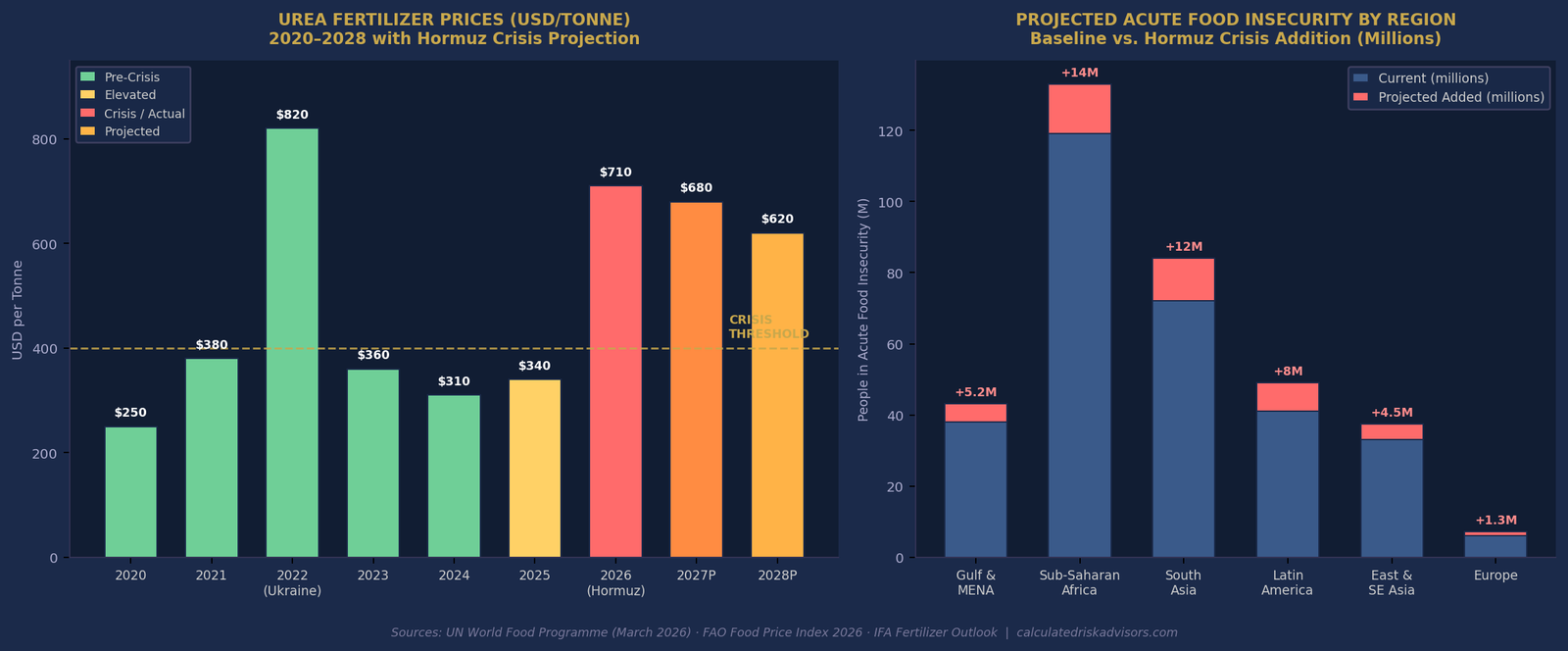
Figure 2. Urea Fertilizer Prices 2020–2028 (with Hormuz Projection) and Regional Acute Food Insecurity Impact | Calculated Risk Advisors
Global Systemic Shock
Fertilizer and energy are the twin foundations of modern farming. Without them, crop yields drop sharply during the Northern Hemisphere’s critical 2026 planting season. Higher food prices, empty shelves in import-dependent cities, and civil unrest are not speculative outcomes. They are the logical consequence of inputs already denied.
No country is fully insulated. Even the United States and Europe will feel the effects: urea prices at New Orleans have already jumped 32%, with broader agricultural inflation following. Compounding factors—climate variability, potential El Niño disruption of monsoons in India and Pakistan, and amplified drought conditions transform short-term disruptions into prolonged threats to global stability and family wealth preservation.
Food inflation directly erodes real returns, devalues urban-centric holdings, and amplifies multi-generational exposure to systemic fragility. This is not a macroeconomic abstraction. It is a direct threat to the purchasing power and capital preservation objectives of every family office with concentrated urban asset exposure.
Repair Timelines Make This Lasting
- Qatar Ras Laffan LNG trains and urea plants – Three to five years to fully restore.
- Gas-to-liquids (GTL) facilities – Up to one year for initial restart.
- Other Gulf refineries and fertilizer factories – Months to years; restarts are staged for safety, with strike damage compounding every timeline.
Traditional urban homes and paper portfolios cannot protect against this. When imports halt, prices explode, and centralized systems fracture, famlies need **direct control over essentials**-not exposure to markets that price risk after the fact.
Autonomous Rural Platforms: Multi-Generational Sovereignty
Calculated Risk Advisors specializes in designing private family compounds within stable, low-surveillance jurisdictions—including Switzerland, New Zealand, Panama, and other thoroughly vetted locations. We also provide guidance for North America following a comprehensive threat-modeling discussion regarding the inherent risks involved. These platforms transform proximity to disruption into enduring independence and legacy security.
These are not survival bunkers. They are sophisticated, appreciating legacy estates with sovereign power systems (solar with full redundancy), secure water infrastructure (deep wells, purification, and storage), and privacy-first design engineered to let your family operate uninterrupted through 2028 and well beyond.
Core Capabilities
- Storable Food Reserves – Sealed, long-shelf-life staples—rice, beans, lentils, powdered milk, freeze-dried meals—stored cool and dry last 10 to 30 years, providing a multi-year bridge while global harvests recover and soil nitrogen debt is repaid.
- Networks with Local Farmers and Agriculture – Deliberate relationships for shared seeds, tools, and knowledge exchange, creating reliable local supply chains and barter systems that function precisely when global logistics fail.
- Regenerative Gardening, Farming, and Permaculture – Nature-mimicking methods that build resilience and abundance over time. Key techniques include layered planting, mulching, composting, and integrating livestock. Over time, land becomes a self-replenishing food engine—resilient even if global supplies are impaired for years.
The Window Is Closing
The window is closing. One further escalation and the disruption becomes generational. Soil nitrogen debt is already accruing. Sovereign wealth funds have been positioned for a decade. Insurance frameworks have no response. And the families who wait for consensus confirmation—the moment this risk is universally understood—will find that the prime agricultural parcels, the stable jurisdictions, and the tier-one expertise are no longer available at any price.
Right now, permitting regimes remain workable. Prime agricultural and forested parcels in stable jurisdictions continue to trade at valuations well below long-term replacement cost. Tier-1 expertise, materials, and construction capacity remain fully available. These conditions are not permanent.
The coming decade will separate those who merely possess wealth from those who can protect it, compound it, and transmit it intact. Acting deliberately today—while prime jurisdictions, resources, and expertise remain fully available—represents the ultimate asymmetry.
You do not need to predict the future with certainty. You only need to occupy a position from which the future cannot take anything you are unwilling to surrender.
“Secure a confidential consultation today – exclusively for qualified principals and family offices to position your family’s sovereign resilience before the next headline. Timing is critical. Act with foresight to defend what matters most.”
About the Author
Brent Michael Hardin is the founder of Calculated Risk Advisors, a private advisory firm serving ultra-high-net-worth individuals and multi-generational family offices. CRA specializes in sovereign estate development, jurisdictional intelligence, and strategic relocation advisory for families navigating an era of accelerating geopolitical, financial, and technological change. Engagements are by private introduction only.
Limited Availability
Calculated Risk Advisors accepts a limited number of new families each quarter. Each engagement is tailored, confidential, and managed directly by our principals. There is no public intake. All relationships begin by private introduction.
A Note on This Publication
The observations, analysis, and commentary published on this site are produced for general informational and educational purposes only. They represent the research and independent perspective of the author and do not constitute financial, investment, legal, tax, real estate, or any other form of professional advice.
Nothing published here represents a solicitation, recommendation, or offer to acquire or dispose of any security, asset, property, or service. Access to this content does not establish an advisory, fiduciary, or client relationship of any kind between the reader and Calculated Risk Advisors LLC or any of its affiliated entities.
The decisions explored on this site — jurisdictional positioning, estate design, infrastructure strategy, and multi-generational wealth planning — are among the most consequential a family can make. They require qualified legal counsel, licensed tax professionals, credentialed financial advisors, and specialist practitioners who have direct knowledge of your specific circumstances, objectives, and risk profile. No publication, regardless of its depth or specificity, is a substitute for that counsel.
Calculated Risk Advisors LLC and its affiliates expressly disclaim responsibility for any decision made, action taken, or action not taken in reliance on content published here.
If you are seriously evaluating any of the strategies, jurisdictions, or approaches discussed in this publication, engage qualified independent advisors before proceeding. If you would like to explore whether a private advisory relationship with Calculated Risk Advisors is appropriate for your situation, you are welcome to request an introduction.
“The intelligence that protects generational wealth doesn’t make headlines; it circulates quietly among those who know where to look. Subscribe to the Calculated Risk Advisors Daily Brief. No noise. No mass-market advice. Just the signal.”
References
Berg, M., & Nelken-Zitser, J. (2026, June 4). For billionaires like Peter Thiel, plan B is another country:
Here’s where they’re lining up passports or second homes. Business Insider.
https://www.businessinsider.com/where-billionaires-peter-thiel-second-passports-
residences-2026-6
Clapp, J. (2023). Concentration and crises: Exploring the deep roots of vulnerability in the global
industrial food system. The Journal of Peasant Studies, 50(1), 1–25.
https://doi.org/10.1080/03066150.2022.2129013
Food and Agriculture Organization of the United Nations. (2022). World fertilizer trends and outlook
to 2025. FAO. https://www.fao.org/3/cc0025en/cc0025en.pdf
International Fertilizer Association. (2026). Fertilizer outlook 2026–2030. IFA.
Ladha, J. K., Pathak, H., Krupnik, T. J., Six, J., & van Kessel, C. (2005). Efficiency of fertilizer nitrogen
in cereal production: Retrospects and prospects. Advances in Agronomy, 87, 85–156.
https://doi.org/10.1016/S0065-2113(05)87003-8
Lloyd’s of London. (2015). Food system shock: The insurance impacts of acute disruption to global food
supply. Lloyd’s Emerging Risk Report. https://www.lloyds.com/news-and-insights/risk-
reports/library/society-and-security/food-system-shock
UBS. (2025, December 4). Billionaire ambitions report 2025. UBS Global.
https://www.ubs.com/global/en/media/display-page-ndp/en-20251204-billionaire-ambitions-
report-2025.html
United Nations World Food Programme. (2026, March 17). WFP global food crisis update—March
2026: Hormuz conflict impact assessment. WFP. https://www.wfp.org
Woertz, E. (2013). Oil for food: The global food crisis and the Middle East. Oxford University Press.
© 2026 Calculated Risk Advisors. All rights reserved. This content is provided for informational purposes only and
does not constitute legal, financial, or investment advice.



0 Comments