

Most HNWI families get the hard part right. They find the land, engage the architects, engineer the infrastructure, and fund the build — a compound designed to last for centuries. What they rarely engineer with equal rigor is the system that keeps the family inside it unified, committed, and functional across the generations that follow.
The result is a pattern that repeats across families of significant means: the physical estate outlasts the family’s capacity to steward it. Not because of external threats. Not because of poor investment. Because of unresolved governance, diverging expectations, and the quiet fracture that begins the moment the founding generation steps back.
This brief addresses what most estate advisors and family office consultants leave on the table: the human architecture that determines whether a sovereign compound becomes a generational asset or an expensive liability dressed in permanence.
Why Multi-Generational Planning Is Now Essential
You are not just building a secure retreat for yourself. You are creating a lasting home for your children, grandchildren, and potentially great-grandchildren in a world that is becoming less predictable. Early, deliberate planning provides something no financial instrument can replicate: peace of mind rooted in physical and relational infrastructure.
Extended family living on a single rural platform offers both tremendous opportunity and real challenges. Without proactive planning, differing needs, expectations, and lifestyles create friction that undermines the very autonomy and security you are working to achieve. The families who succeed across generations are those who treat multi-generational planning as a core engineering discipline from the earliest stages of site selection and compound design.
Industry research widely cited across the wealth management profession suggests that the majority of estate transitions fail before the third generation — not from poor investment returns, but from breakdowns in family communication, trust, and governance (Williams & Preisser, 2010). Cerulli Associates projects $84.4 trillion in wealth transfers through 2045, with 42% originating from HNWI and UHNWI households — families for whom structured planning is not optional but existential (Cerulli Associates, 2022). The compound, no matter how well-built, cannot survive that breakdown without deliberate human architecture to support it.
Allocating Scalable Living and Production Zones
A successful multi-generational compound requires thoughtful space allocation from day one. Begin by designing distinct but connected living zones that can expand or contract as
family needs change. Younger generations may want independent quarters with more autonomy, while elders may need easier access, lower-maintenance environments, and proximity to shared support.
Production zones should be sized to grow food, generate energy, and manage resources for the current household plus a realistic buffer for additional family members or staff during extended stays or crisis periods. The key is flexibility without fragmentation. Use natural topography, landscaping, and low-impact pathways to create gentle separation between zones while keeping the entire compound cohesive.
This approach allows privacy when needed and easy gathering when desired, reducing the most common sources of tension in multi-family living. Getting this spatial logic right in the design phase costs a fraction of what it costs to retrofit it after conflict has already emerged.
Facilitating Family Vision Sessions
One of the most valuable investments a family can make is structured family vision sessions initiated early in the planning process. Bringing key family members together before the first shovel enters the ground fosters shared purpose, making the compound feel like a collective legacy rather than a personal project.
These conversations should cover daily living preferences and privacy needs, long-term legacy goals, contingency planning for different future scenarios, and the governance principles that will guide major compound decisions across decades. Effective facilitation includes:
- Holding sessions in a neutral, relaxed setting away from daily obligations and professional hierarchy.
- Using a skilled, independent facilitator to keep discussions balanced and productive.
- Employing guided exercises: vision mapping, scenario planning, and values-ranking activities that surface assumptions before they become conflicts.
- Drafting a written family charter that captures shared principles, decision-making processes, and stewardship obligations for each participating branch.
“A family compound is not a collection of houses on one piece of land. It is a single living system designed to grow stronger with each generation.”
When facilitated with clear ground rules and professional support, these sessions prevent assumptions from calcifying into conflicts. They build buy-in and shared ownership, transforming the compound from “your project” into “our family legacy.” Many families discover that these discussions not only clarify practical needs but also deepen bonds and reinforce shared values that will guide the compound for decades after the founding generation is gone.
The Next-Generation Buy-In Problem: The Pain Point Nobody Plans For
There is a risk that does not appear on any architectural drawing and is absent from most estate planning conversations. It is arguably the most common cause of compound failure among families of significant means.
The next generation does not want to live there.
Children who grew up in urban environments, attended elite universities on multiple continents, built careers and social networks in global cities, and cultivated fundamentally different
lifestyles from their parents frequently view the family compound as their parents’ vision, not their own. They visit at holidays. They appreciate its existence in the abstract. But they do not see themselves as stewards of it, and they do not intend to relocate their lives to it.
This creates a specific and expensive set of problems. The compound sits underutilized, bearing full operational costs, while heirs treat it as a shared burden rather than a shared asset. Disagreements over maintenance expenses, improvement decisions, and long-term use rights generate legal friction. Eventually, one branch proposes a sale. The estate designed to last four generations fragments in the second.
The data confirms this is not anecdotal. A 2025 study found that 58% of Millennials fear family conflict more than financial risks such as taxes when it comes to wealth transfer — and 42% of Millennials expecting an inheritance have never discussed it with the transferring generation (BusinessWire, 2025). More than one-third of next-generation stewards reported feeling uninformed and overwhelmed by the prospect of managing inherited assets. These are not financial failures. They are communication and governance failures — precisely the category of risk that compound design alone cannot solve.
Family governance councils with defined decision-making frameworks have been shown to significantly improve multi-generational wealth continuity, particularly when established before the founding generation transitions control (Collier, 2012). But governance alone is insufficient if the next generation has never been meaningfully included in the compound’s vision from the beginning.
The solution requires deliberate cultivation of stewardship identity across all generations, starting early. This means involving adult children in site selection visits and design reviews, creating real roles for the next generation in compound operations and governance, building compound experiences that are relevant to younger family members’ lives, and designing spaces and programs that give the next generation reasons to want to be there.
A compound built for the founding generation’s vision alone is a single-generation investment. A compound built with all generations in mind is a dynasty.
Legacy Wealth Transfer Strategies
Beyond physical design, true multi-generational success requires clear strategies for wealth transfer across ownership structures. These go well beyond basic estate documents.
Consider using family limited partnerships or series LLCs to hold portions of the compound, allowing gradual transfer of ownership and control while retaining management flexibility. Dynasty trusts or generation-skipping trusts protect assets from future taxes and creditors while providing structured income and use rights for descendants.
The OBBBA: A Landmark Shift in Dynasty Planning
On July 4, 2025, the One Big Beautiful Bill Act (OBBBA) was signed into law, permanently raising the federal estate and gift tax exemption to $15 million per individual — $30 million for married couples — effective January 1, 2026. The generation-skipping transfer (GST) tax exemption aligns at the same threshold and is indexed for inflation beginning in 2027. Unlike the 2017 Tax Cuts and Jobs Act provisions, the OBBBA contains no sunset clause. This is a permanent restructuring of the estate tax landscape (U.S. Congress, 2025).
For families designing sovereign compounds, the implications are immediate and substantial. A dynasty trust funded with up to $15 million can compound and transfer across multiple generations without further estate or GST taxation. Compound assets, production systems, and adjacent land holdings can be structured into these vehicles before appreciation compounds, locking in today’s valuations against tomorrow’s estate exposure.
One critical planning distinction: the GST exemption is not portable between spouses. Unlike the estate tax exemption, any unused GST exemption does not automatically transfer to the surviving spouse at death. Each spouse must independently allocate their own $15 million exemption — during life or at death — for dynasty trust funding to be fully optimized. Families designing compound trust structures should address this in parallel with physical site planning, not after (Venable LLP, 2025).
Tax-Efficient Trust Vehicles
One highly effective approach employs tax-efficient trust structures including irrevocable life insurance trusts (ILITs), grantor-retained annuity trusts (GRATs), and intentionally defective grantor trusts (IDGTs). These vehicles allow you to transfer appreciating assets — including portions of the rural compound or associated business interests — out of your taxable estate while retaining certain controls or income streams during your lifetime.
When structured correctly, they dramatically reduce estate tax exposure, provide creditor protection, and create predictable pathways for wealth to flow to future generations without triggering large tax events. Many families pair these trust structures with the physical compound design so that specific zones or production areas are held in vehicles tailored to different family branches, ensuring both tax efficiency and operational harmony.
Some families establish a family governance council with defined roles and voting mechanisms for major compound decisions. Others create incentive-based structures that tie access or financial benefits to demonstrated responsible stewardship of the land. When integrated early with compound design, these strategies ensure that wealth, values, and responsibility transfer smoothly across generations rather than creating disputes or fragmentation.
Designing Shared Autonomous Utilities for Multi-Generational Harmony
Shared utilities can either create unity or become the most persistent source of conflict in a multi-family compound. The most successful designs use redundant, modular systems that allow fair allocation without requiring constant negotiation between family branches.
Effective approaches include zoned water and power distribution, separate but connected septic or composting systems, and common storage areas with clearly documented usage protocols. Thoughtful design also anticipates future demand: utility runs should include expansion capacity for additional living spaces, increased energy needs, and the inevitable changes in family size and composition over time.
When every family member understands how the systems work and feels that the design is equitable, shared infrastructure becomes a source of collective strength. When the systems are opaque or perceived as unfair, they become the surface expression of deeper relational friction. Design for equity from the start. Retrofitting fairness is significantly more expensive than engineering it in.
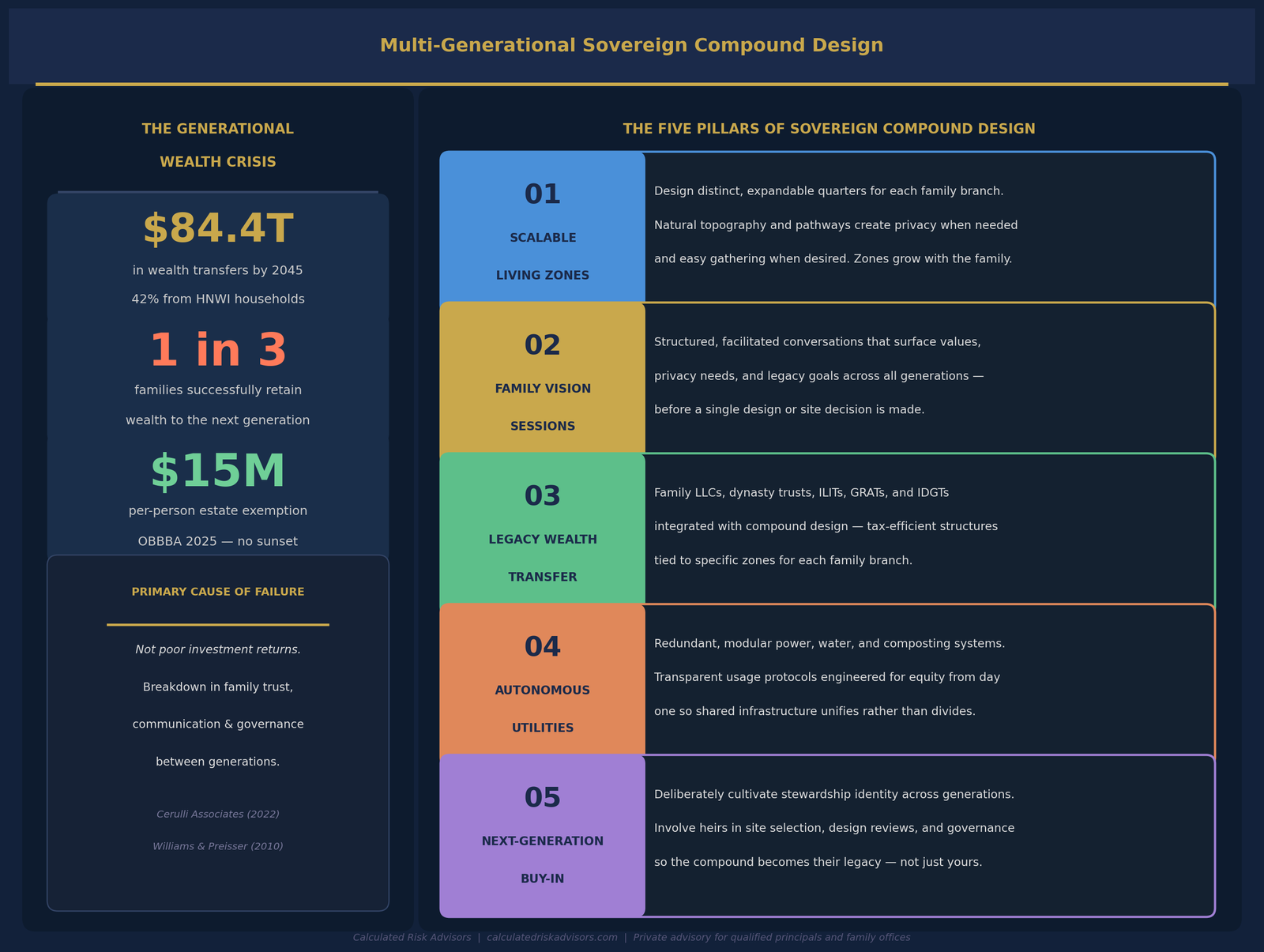
Figure 1. Generational Wealth Survival Rates and CRA’s Five Pillars of Multi-Generational Sovereign Compound Design | Calculated Risk Advisors
Actionable Steps
These are the practical priorities for families at any stage of compound planning:
- Initiate structured family vision sessions with key family members across all generations to clarify values, needs, lifestyle expectations, and long-term legacy goals before design is finalized.
- Allocate scalable living and production zones during the master planning phase, using topography and landscaping to create natural separation with connection — not isolation.
- Cultivate next-generation stewardship deliberately: involve adult children in site visits, design reviews, and governance from the beginning, not as an afterthought after the compound is built.
- Design shared autonomous utilities with built-in redundancy, modularity, and transparent usage protocols that every family branch understands and accepts as equitable.
- Establish trust structures and family governance frameworks in parallel with physical design, ensuring wealth transfer vehicles and decision-making authority are defined before they are needed.
- Review and refine the multi-generational plan annually as family circumstances, external conditions, and generational priorities evolve. A plan that reflects only the founding generation’s current preferences is already incomplete.
“The strongest family compounds are those where independence and interdependence are deliberatly balanced- where every generation has a reason to be there and a stake in its survival.”
This Is Calculated Positioning at Its Most Personal
Multi-generational planning is not just about buildings and utilities. It is about creating a physical and relational environment where your family can grow stronger together through uncertain decades. By allocating scalable zones, facilitating open vision sessions, engineering equitable shared systems, cultivating next-generation buy-in, and implementing thoughtful legacy wealth transfer strategies, you build a compound that preserves wealth, strengthens bonds, and provides a true legacy of resilience.
A well-planned family platform does not merely survive the decades ahead. It thrives. And it helps your family thrive within them.
Calculated Risk Advisors specializes in exactly these evaluations for high-net-worth clients. We deliver a confidential Family Multi-Generational Planning Assessment that integrates spatial design, family vision work, utility planning, and governance architecture into one clear, actionable roadmap — typically completed within 30 days.
About the Author
Brent Michael Hardin is the founder of Calculated Risk Advisors, a private advisory firm serving ultra-high-net-worth individuals and multi-generational family offices. CRA specializes in sovereign estate development, jurisdictional intelligence, and strategic relocation advisory for families navigating an era of accelerating geopolitical, financial, and technological change. Engagements are by private introduction only.
Limited Availability
Calculated Risk Advisors accepts a limited number of new families each quarter. Each engagement is tailored, confidential, and managed directly by our principals. There is no public intake. All relationships begin by private introduction.
A Note on This Publication
The observations, analysis, and commentary published on this site are produced for general informational and educational purposes only. They represent the research and independent perspective of the author and do not constitute financial, investment, legal, tax, real estate, or any other form of professional advice.
Nothing published here represents a solicitation, recommendation, or offer to acquire or dispose of any security, asset, property, or service. Access to this content does not establish an advisory, fiduciary, or client relationship of any kind between the reader and Calculated Risk Advisors LLC or any of its affiliated entities.
The decisions explored on this site — jurisdictional positioning, estate design, infrastructure strategy, and multi-generational wealth planning — are among the most consequential a family can make. They require qualified legal counsel, licensed tax professionals, credentialed financial advisors, and specialist practitioners who have direct knowledge of your specific circumstances, objectives, and risk profile. No publication, regardless of its depth or specificity, is a substitute for that counsel.
Calculated Risk Advisors LLC and its affiliates expressly disclaim responsibility for any decision made, action taken, or action not taken in reliance on content published here.
If you are seriously evaluating any of the strategies, jurisdictions, or approaches discussed in this publication, engage qualified independent advisors before proceeding. If you would like to explore whether a private advisory relationship with Calculated Risk Advisors is appropriate for your situation, you are welcome to request an introduction.
“The intelligence that protects generational wealth doesn’t make headlines; it circulates quietly among those who know where to look. Subscribe to the Calculated Risk Advisors Daily Brief. No noise. No mass-market advice. Just the signal.”
References
BusinessWire. (2025, July 28). New study finds America’s largest wealth transfer faces unexpected obstacle: The family dinner table. BusinessWire. https://www.businesswire.com/news/home/20250728589663/en/New-Study-Finds-Americas-Largest-Wealth-Transfer-Faces-Unexpected-Obstacle-The-Family-Dinner-Table
Cerulli Associates. (2022). U.S. high-net-worth and ultra-high-net-worth markets 2022: Anticipating $84 trillion in wealth transfers through 2045. Cerulli Associates. https://www.cerulli.com/press-releases/cerulli-anticipates-84-trillion-in-wealth-transfers-through-2045
Collier, C. (2012). Wealth in families (3rd ed.). Harvard University.
Grubman, J. (2022). There is no 70% rule: Improving outcome research in family wealth longevity. International Family Office Journal, 6(2), 1–12. https://jamesgrubman.com/wp-content/uploads/2022/06/2022-06-There-is-no-70-rule-JGrubman-IFOJ.pdf
Hughes, J. E., Jr., Massenzio, S. E., & Whitaker, K. (2012). The cycle of the gift: Family wealth and wisdom. Bloomberg Press.
U.S. Congress. (2025). One Big Beautiful Bill Act (Pub. L. No. 119-21). https://www.congress.gov
Venable LLP. (2025, September). Estate planning in the OBBBA era: What the $15 million exemption means for you. Venable LLP Insights. https://www.venable.com/insights/publications/2025/09/estate-planning-in-the-obbba-era-what-the-15
Williams, R., & Preisser, V. (2010). Preparing heirs: Five steps to a successful transition of family wealth and values. Robert D. Reed Publishers.
© 2026 Calculated Risk Advisors. All rights reserved. This content is provided for informational purposes only and does not constitute legal, financial, or investment advice.



0 Comments