
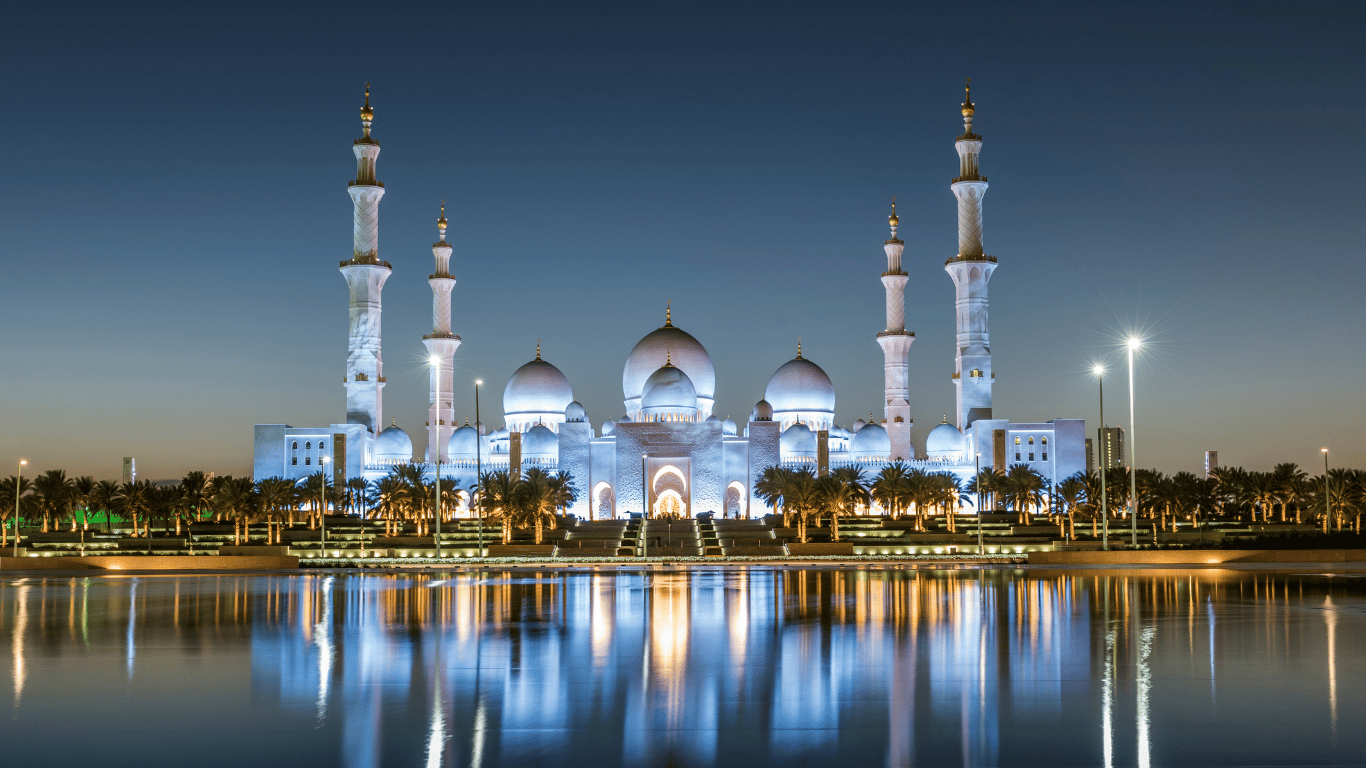

In early 2026, one of the world’s most celebrated wealth destinations became a case study in how quickly the assumption of safety collapses. Iranian retaliatory strikes on Gulf infrastructure forced Dubai International Airport to suspend operations for days. Private aviation clients, long-term residents, and high-net-worth families who had built their lives around the UAE found themselves with no exit, rerouting overland through neighboring countries simply to reach a functioning airport. The city that sold certainty had none left to offer.
If the world’s most engineered safe haven can be neutralized in a single night, no jurisdiction earns permanent trust on reputation alone.
Historically, those with the ability, means, and wealth could separate themselves from military conflict, crime, geopolitical discord, and social upheaval through geography, social status, and environments composed of those of the same social or economic standing.
Over many decades, with the advent of globalization, the electronic frontier, and a fractional reserve financial infrastructure based on the petrodollar, vast amounts of accumulated wealth were created. With it came the ability for even those of modest means to access international travel, living standards far beyond what the underlying economy would otherwise support, the expansion of personal credit, and a connected just-in-time infrastructure capable of delivering goods in hours or days rather than the months it once required in the early 20th century.
With this expanding reach of the global citizen, those who had historically isolated themselves from war, crime, immigration, and geopolitics could remain separated from these dangers for decades, insulated by geographic distance and communities of like-minded economic equals.
Politicians and others have used the global chessboard for centuries, deploying migration, war, economics, and social engineering to advance their agendas at the highest levels. Circling back to now: we are in real time being impacted by financial, geopolitical, and social engineering activities that are affecting even the uber-wealthy in ways we have not seen in decades.
The Grand Chessboard Is Still in Play
According to Zbigniew Brzezinski in The Grand Chessboard: American Primacy and Its Geostrategic Imperatives:
“How America ‘manages’ Eurasia is critical. A power that dominates Eurasia would control two of the world’s three most advanced and economically productive regions. About 75 per cent of the world’s people live in Eurasia, and most of the world’s physical wealth is there as well, both in its enterprises and underneath its soil. Eurasia accounts for about three-fourths of the world’s known energy resources.”
This highlights how U.S. and allied government policies, particularly in conflicts such as U.S./Israeli actions against Iran, directly influence control over critical energy resources and global economic lifelines. The ripple effects reach across global markets and significantly impact billionaires whose fortunes are tied to stability in these geostrategic arenas.
In the past, geography, borders, and strategic relocation promised security and convenience for UHNWI and HNWI. That narrative has collapsed across many regions of the globe.
When the Safe Haven Is No Longer Safe
The recent U.S.-Israeli conflict with Iran, which escalated in early 2026 with airstrikes and retaliatory missile and drone attacks on targets including Dubai and Abu Dhabi, dramatically disrupted the lives and assets of High Net Worth and Ultra High Net Worth Individuals.
Many who had vacationed in the Gulf, purchased luxury properties, or established residences there found their lifestyles upended overnight by sudden insecurity, flight disruptions, and economic ripple effects. Wealthy vacationers and expats in hubs like Dubai and Abu Dhabi faced immediate chaos as Iranian strikes damaged infrastructure, including luxury hotels and airports. Dubai International Airport shut down for days, stranding tourists and residents alike. Senior executives, influencers, business travelers, and holidaymakers scrambled for safety, often driving hours across borders to Oman or Saudi Arabia for onward flights.
This shattered the perception of the UAE as an impregnable safe haven, forcing abrupt changes to once-luxurious routines of sun-soaked getaways and high-end networking.
Dubai over many decades built a reputation for affluence, safety, and security. It used its wealth to care for residents and visitors by promoting and delivering a premier destination. It is a city that invested heavily in being a world-class global hub, and by nearly every measure succeeded.
Unfortunately, recent geopolitical objectives pursued by powerful lobbies, organizations, and unseen powers serve as a striking reminder: even the most dedicated safe haven cannot control the tides of an evolving multipolar world.
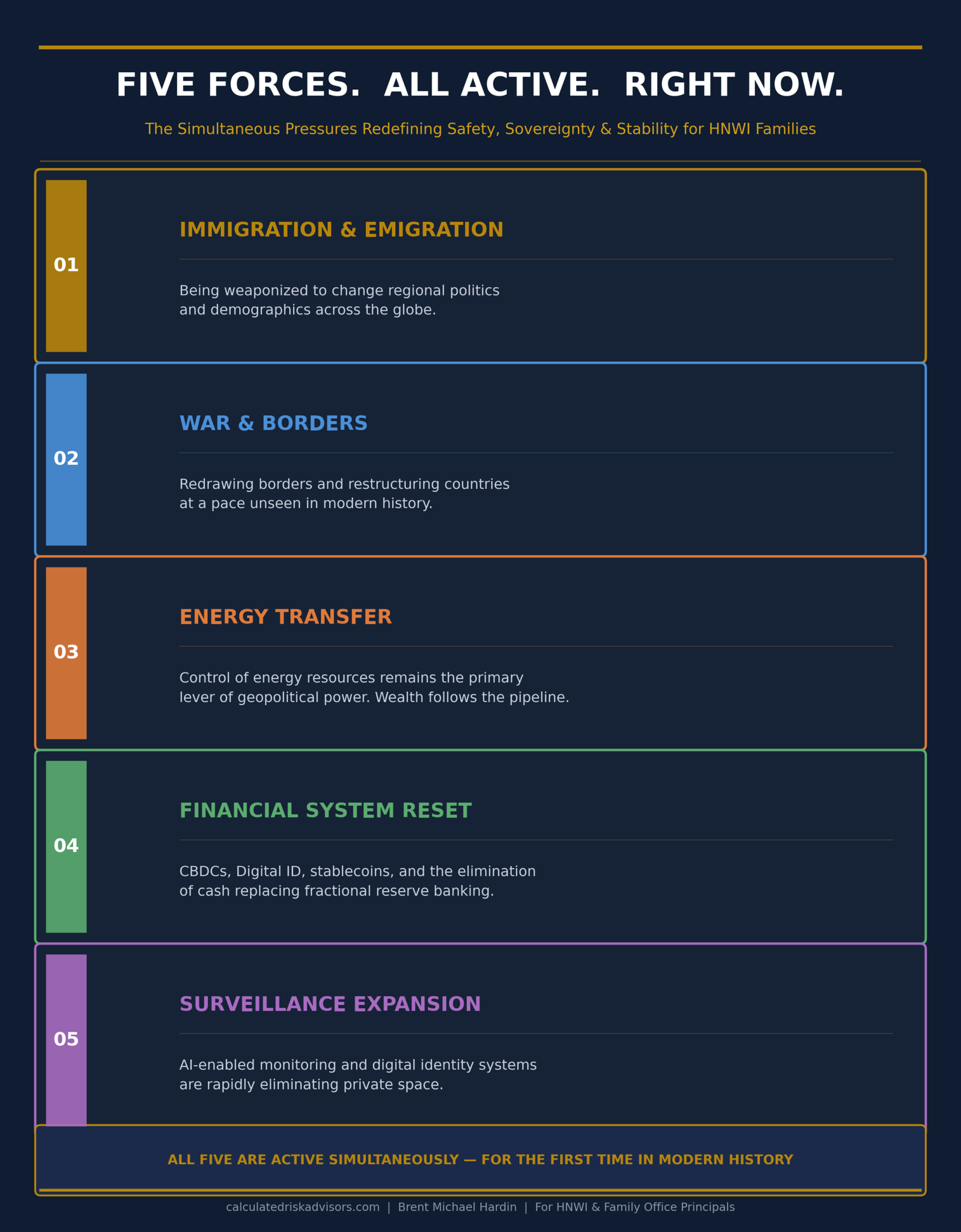
Five Converging Forces | calculatedriskadvisors.com
Five Forces. All Active. Right Now.
These are not isolated trends. They are converging simultaneously, and for the first time in modern history, all five are in motion at once:
- Immigration and emigration are being weaponized to change regional politics and demographics
- War is redrawing borders and restructuring countries
- Energy transfer is being used to move wealth and create new global energy policy
- Financial stress and economic correction are preparing the ground for banking and financial powers to introduce a new digital financial system
- The rollout of CBDCs, Digital ID, stablecoins, and the reduction of cash will push global financial institutions toward a new solution as the debt-based fractional reserve banking system reaches its unsurprisingly, and many would argue planned, historic end
With all of these imminent challenges, some jurisdictions and locales are soon going to be no longer comfortably livable for those who wish to maintain their safety, security, and standard of living. This transition requires strategic intelligence, forethought, and action before the crises become apparent to the masses.
For those who were exposed to the events in Abu Dhabi and Dubai, these events are unfolding in real time. Others should take warning: these events are evolving and will multiply exponentially over the next five years.
It is imperative to act now, to get ahead of the cascading events, for a lasting legacy and a long-term security plan. The chess pieces are moving, and nearly everyone is a player in this game, whether they want to be or not.
What Billionaires Are Actually Doing
The public-facing narrative about ultra-high-net-worth individuals is one of confidence, expansion, and continuity. The private reality, in my direct experience advising principals in this space, is considerably more active.
The most sophisticated family offices are:
- Diversifying jurisdictionally: not just across asset classes, but across legal and political systems
- Establishing infrastructure-independent residential platforms: rural estate systems that function regardless of grid reliability, supply chain disruption, or political instability
- Acquiring second and third citizenship: not as tax avoidance, but as genuine optionality
- Building generational knowledge systems: ensuring that the next generation understands how to operate in complexity, not just inherit in stability
- Recalibrating what “safe” means: including physical security, information security, and legal jurisdictional security as core portfolio considerations alongside traditional financial metrics
The families taking these steps are not reacting in fear. They are executing with foresight, and the difference between those two postures, over the next five years, will be generational.
The Window Is Open — But Not Forever
Every one of these forces is further advanced than it was two years ago. Every one of them will be further advanced two years from now. The policy architectures being built: financial surveillance, digital identity, and jurisdictional regulatory convergence, are specifically designed to reduce optionality over time.
The families who will look back at this period and credit themselves with foresight are the ones making proactive decisions now, before the conditions that make those decisions necessary become visible to everyone.
This is not about paranoia. It is about what the most sophisticated risk managers have always understood: the time to act is before the risk is priced.
If you are recognizing the gap between what you have built financially and what you have built structurally, that recognition is the beginning of a very productive conversation. That is precisely the work we do at Calculated Risk Advisors.
About the Author
Brent Michael Hardin is the founder of Calculated Risk Advisors, a private advisory firm serving ultra-high-net-worth individuals and multi-generational family offices. CRA specializes in autonomous rural estate development, jurisdictional intelligence, and strategic relocation advisory for families navigating an era of accelerating geopolitical, financial, and technological change. Engagements are by invitation and private introduction only.
“The information presented in this article is provided for educational and informational purposes only and does not constitute legal, financial, investment, or tax advice. All views expressed are those of the author based on professional research, independent analysis, and direct field experience. References to geopolitical events, jurisdictional intelligence, and asset protection strategies are general in nature and should not be construed as recommendations specific to your circumstances. Readers are encouraged to conduct independent due diligence and consult qualified legal and financial professionals before acting on any information contained herein. Calculated Risk Advisors serves a private, invitation-only client base and does not solicit the general public.”
0 Comments