


I enjoy advising families and individuals to operate with a safety-and-security mindset, not only to protect their money but also to safeguard their freedom. Over that evolution, one truth has become painfully clear: absolute freedom isn’t about chasing the next opportunity; it’s about making sure the chaos of the world can’t take it away from you.
The world is experiencing a paradigm shift, driven by an agenda centered on CBDCs, digital ID, tokenization, and other digital technologies, such as the Internet of Things and the Internet of Bodies. These changes are reshaping our understanding of privacy, security, and personal autonomy. Many in the world do not understand or are unaware of the changes being implemented, and many give voluntary consent to their own detriment, such as by voluntarily providing their biometric data or DNA without considering the ramifications.
In 2020, the lesson hit everyone hard. Borders slammed shut overnight, supply chains snapped like brittle twigs, and even the wealthiest among us found themselves grounded, staring at four walls that suddenly felt more like a cage than a home. Private jets didn’t matter. Offshore accounts didn’t matter. The systems we thought we could always rely on were gone in a flash. That wasn’t just a blip on the radar; it was a warning shot. As Gerald Celente of Trends Research exclaims in his famous tagline: “Past practice shows future trends.”
Now, as we find ourselves in December 2025, the signs are blaring again. Political dysfunction, economic fragility, cyber threats, climate volatility, and pandemics aren’t far-off possibilities. They’re converging into a perfect storm that could strand even the most mobile and connected among us. Picture this: you’re in your penthouse, scrolling through headlines about another government standoff, when suddenly your flight’s canceled, your assets freeze, and the roads out are barricaded. It’s not paranoia; this is pattern recognition.
The first example of this pattern is right here in the U.S. government. We just emerged from a 43-day government shutdown, the longest in history, which ended with a stopgap bill funding most agencies only until January 30, 2026. Nearly 11,000 air traffic controllers worked without pay, with some taking side jobs to support their families. The FAA is still short-staffed and overworked, sick calls are increasing, and delays are piling up like luggage at a holiday airport. Come January, if Congress doesn’t resolve the budget, the next shutdown could be worse. Flights will be disrupted, services frozen, and ripple effects will be felt across everything from veterans’ care to food programs. Then there’s the threat of pandemics. We all remember 2020—the empty shelves, the isolation, the gut punch of vulnerability. But what’s easily forgotten is just how exposed we were. Self-proclaimed experts like Bill Gates are already warning again, estimating a 10–15% chance of a natural pandemic within the next four years, driven by climate shifts, population density, and fragile global health infrastructure. I have strong reservations that many of these biological events are artificially developed and manufactured to pursue specific agendas, but that’s a topic for another article. Just understand the pattern: introduce the problem, control the reaction, and provide a solution. This cycle continues until enough people stand up and say Enough is enough. Adding to this are the cyber pandemic scenarios predicted by the World Economic Forum—digital attacks crippling hospitals, supply chains, and governments—and it’s easy to see how a single failure could lock down entire cities faster than a biological outbreak. Again, I ask, are these natural events or manufactured to serve agendas such as Agenda 2030?
Another concern is climate volatility, which adds another layer of risk. Wildfires, floods, extreme heat, and cold aren’t distant forecasts. They’re happening now. The sun’s reduced solar activity will have a significant impact on our weather, perhaps till 2030-2040, and the expected cold temperatures impacting the northern hemisphere will reduce food and agricultural yields. Policy makers are discussing emergency measures such as vehicle bans, energy curfews, and meat rationing designed to “flatten the emissions curve.” In practice, this could mean sudden restrictions on movement, creating localized lockdowns that mirror the chaos of a pandemic. Add biological wildcards, like outbreaks emerging from shifting habitats, and you get emergencies that can seal borders overnight.
Geopolitics doesn’t make things easier. Ukraine grinds on with staggering casualties, Sudan is in civil war, Taiwan and the Baltics hover on a knife’s edge, and tensions in the Middle East, Myanmar, and Haiti threaten further escalation. Civil unrest is simmering globally from Bangladesh and Pakistan to Western nations, where elections and inequality fuel protests. Even in the U.S., serious analysts warn of “anocracy” – a halfway state between democracy and authoritarianism that is a breeding ground ripe for conflict.
Financial systems are equally fragile. J.P. Morgan and other economists warn of a 40% chance of recession by 2026. Some even whisper of a depression reminiscent of 2008, but worse, amplified by trillion-dollar deficits that make traditional bailouts impossible and bail-ins likely. Markets could crash, ATMs could run dry, and suddenly, liquidity is an illusion.
At the same time, digital ID systems and travel restrictions are tightening the noose. REAL ID is mandatory for U.S. flights, Europe is rolling out biometric entry systems, and Apple Wallet integration with TSA checkpoints is becoming standard. If you opt out, you don’t move. In this environment, mobility itself becomes conditional, even for those with the deepest pockets.
For high-net-worth individuals, this convergence isn’t theoretical; it’s existential. Your portfolio might weather shocks, but if you’re physically stranded, your options vanish. And that’s why the families I advise are acting proactively, building a different kind of security: sovereign, autonomous rural platforms.
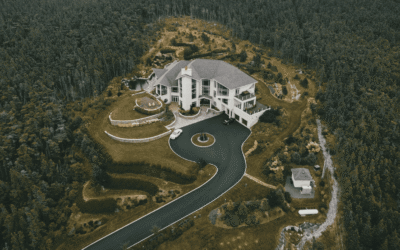
These platforms are self-sufficient, independent living arrangements, often located in remote, natural settings. They provide a level of security and resilience that is hard to match in urban environments. The ability to live among nature, void of the concrete, sanitized cities that evaporate your soul and purpose. A connection with nature breathes life into even the weary and isolated. It prompts reflection on what matters and shifts the mindset that the material world can offer only so much.
Building this kind of resilience requires a methodical approach. Starting with a personal risk audit. Where are your assets concentrated? How dependent is your family on specific schools, health systems, or digital infrastructure? Understand these aren’t doomsday bunkers; they’re residences designed to operate independently of grids, supply chains, and political volatility.
Consider solar-powered estates in the Andes, coastal redoubts in Patagonia, or remote properties in the South Island of New Zealand or Tasmania. These are places where life continues smoothly, even if the world outside comes to a halt. It should be noted that New Zealand, touted as a haven for the wealthy, imposed the most egregious government controls on its citizens, and one needs to weigh the risks vs. the rewards before committing to any relocation.
Next, we focus on the pillars of resilience.
Geopolitical neutrality is key; countries like Uruguay, Costa Rica, and Paraguay offer stability, a low-profile lifestyle, and minimal interference. But will you, as a foreigner, be welcome when things deteriorate?
Sufficiency in water, energy, and food production should be independent, with robust systems such as rainwater harvesting, solar arrays, and permaculture gardens. Access and exit strategies are crucial: even a fortress needs gateways. Properties in Portugal’s Algarve can provide EU access, while a bolt-hole in the Azores offers isolation with flexibility. Community and legacy matter too; expat clusters, international schools, and reliable healthcare make long-term living feasible without exposure.
Acquiring such a property requires a strategy.
Engage firms experienced in HNWI relocations and plan budgets of $5–20 million for turnkey platforms. You should consider citizenship or residency options in places such as St. Kitts, Malta, or Panama, and ensure that legal protections, such as trusts, are in place. Site selection is critical for 100+ acres with defensible terrain, water access, renewable energy, and potential for helicopter access. Build smart: modular structures, Faraday cages, hydroponics, and redundant systems provide peace of mind that money alone cannot buy.
The point isn’t panic; it’s agency. By anchoring yourself in a well-chosen, self-sufficient location, you reclaim control. You don’t just survive; you outmaneuver the forces that would otherwise trap you.
The patterns are clear. Shutdowns, pandemics, cyber threats, climate crises, geopolitical tension, financial stress, and digital checkpoints are all converging. The world isn’t waiting for you to prepare. But you can act and act now. Begin with an audit, identify your ideal jurisdictions, and secure a residence that guarantees operational freedom even when the rest of the world falters. When the next storm hits, and it will, you’ll be the one watching from solid ground, a glass in hand, your family safe, your legacy intact, and stranded no more. Secure a confidential consultation.
Secure a confidential consultation.
Important Disclosure
This publication is for general informational purposes only and reflects the author’s perspective. It is not financial, investment, tax, legal, or professional advice of any kind, nor an offer or solicitation. Calculated Risk Advisors disclaims all liability for actions taken or not taken based on this content. Readers should consult their own qualified advisors before making decisions.
© 2025 Calculated Risk Advisors. All rights reserved.
0 Comments